




A REVIEW ON SLN-INCORPORATED TRANSDERMAL PATCHES FOR PCOS TREATMENT
HTML Full TextA REVIEW ON SLN-INCORPORATED TRANSDERMAL PATCHES FOR PCOS TREATMENT
K. A. Kailash * and Beny Baby
Karnataka College of Pharmacy, Bangalore, Karnataka, India.
ABSTRACT: Polycystic Ovary Syndrome (PCOS) is a prevalent endocrine disorder and a leading cause of anovulatory infertility in women of reproductive age. Conventional oral therapies, such as clomiphene citrate, are often limited by poor bioavailability, first-pass metabolism, systemic side effects, and reduced patient compliance. Recent advancements in nanotechnology have introduced solid lipid nanoparticles (SLNs) as promising drug carriers due to their biocompatibility, stability, and controlled drug release properties. This review focuses on the application of SLN-incorporated transdermal drug delivery systems (TDDS) for PCOS management. Transdermal patches offer advantages such as bypassing hepatic first-pass metabolism, sustained drug release, and improved patient compliance. The review also highlights skin structure, formulation strategies, and evaluation parameters relevant to TDDS. Overall, combining SLNs with transdermal patches presents a novel and effective approach to enhance therapeutic outcomes and minimize adverse effects in the treatment of PCOS.
Keywords: Polycystic Ovary Syndrome (PCOS), Solid Lipid Nanoparticles (SLN), Transdermal Drug Delivery System (TDDS), Clomiphene Citrate (CC).combined oral contraceptive pills (COC)
INTRODUCTION: PCOS is considered to affect 6–15% of females, making it one of the most common endocrine disorders. A very erratic cycle with no ovulation is often a hallmark symptom. Several important endocrine tissues known to be contributing organs with active functions in PCOS include the adrenal gland, hypothalamus, pituitary gland, ovaries, and peripheral adipose tissue. These glands are interrelated and their dysfunction can lead to overall hormonal dysfunction 1. PCOS is a medical condition that arises because of hormonal imbalance in females. It consists of high levels of testosterone, DHEA-S, androstenedione, prolactin, and LH, and normal, high, or low levels of estrogen.
High insulin levels, insulin resistance, and glucose intolerance have also been observed in women with PCOS 2. SLN were developed during the mid-1990s and provide an alternative to liposomes, emulsions, micelles, and polymeric nanoparticles due to their numerous advantages. SLN consist of lipids that are both biocompatible and biodegradable, along with other Generally Recognized as Safe materials. As a result, SLN can be considered safe methods for drug delivery utilizing nanotechnology. The solid structures employed can serve as protective shields for SLN, thereby enhancing the stability of the drugs contained within.
Both hydrophilic and hydrophobic medications can be encapsulated within SLN at higher entrapment efficiencies compared to liposomes. The rates at which drugs are released from SLN can be regulated by altering the lipid components of the SLN. Adjustments to the surface of SLN can facilitate their targeting of specific tissues and help maintain stability. SLN can be created using non-solvent techniques such as high-pressure homogenization and high-speed stirring 3, 4.
Various methods of nanoparticle drug delivery exist, such as improving drug penetration and resolving the first-pass issue or P-glycoprotein (P-gp)-mediated efflux, where drug bioavailability can be dramatically improved. However, the field of lipid-based DNA/RNA carriers is developing vigorously owing to the non-toxic nature of lipid nanoparticles for both in-vitro and in-vivo uses. Most lipids used to prepare lipid nanoparticles can be easily degraded and do not have any toxic or adverse effects. Most polymeric nanoparticles, on the other hand, have been found to possess toxic or adverse effects on in-vivo degradation processes. Solid lipid nanoparticles (SLNs) are the first generation of solid lipid carriers on a nanoscopic scale, although nanostructured lipid carriers (NLCs) are sometimes included as the 2nd generation of SLNs. The combination of different benefits offered by other carriers, such as liposomes and polymeric nanoparticles, is also possible. These nanoparticles prioritize biocompatible excipients, which are easily tolerated or accepted by the physiological bodies 5. TDDS, commonly known as patches, is used for the application of a therapeutically effective dose of medication to a patient’s skin. It should be noted that during the delivery of medications across the human skin to achieve a systemic response, it is important to consider the entire morphological, biophysical, and physicochemical properties of the human skin. The main advantage of the transdermal route over the injectable and oral routes of administration is the improvement in patient compliance 6.
Polycystic Ovary Syndrome (PCOS): PCOS is a common endocrine condition that affects women of reproductive age and is one of the most common causes of anovulatory infertility. Ovarian dysfunction is the principal cause; however, obesity and environmental factors can affect symptom severity. Hyperandrogenism, ovulatory dysfunction, infertility, central obesity, insulin resistance, and type 2 diabetes are some of the characteristics of this disorder. PCOS affects approximately 15–20% of cases of female infertility and may have genetic origins, with X-linked inheritance possibly playing a role. The metabolism of androgens and estrogens is dysregulated in PCOS, with elevated levels of circulating androgens, such as testosterone, androstenedione, and DHEAS, although the actual levels may vary between individuals. This condition tends to be associated with insulin resistance and hyperinsulinemia, further stimulating ovarian androgen production and lowering adiponectin levels, independent of body weight. An ovulation and hyperandrogenism are consequences of heightened LH activity in relation to FSH, leading to overproduction of androgens by theca cells and impaired aromatization to estrogens in granulosa cells. Hormonal imbalance disrupts follicle maturation, leading to the arrest of the development of multiple follicles and infrequent ovulation 7.
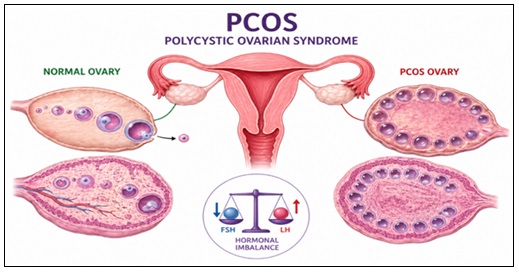
FIG. 1: SYSTEMATIC VIEW OF POLYCYSTIC OVARIAN SYNDROME
Diagnosis of PCOS: Women affected by PCOS have an elevated risk of developing type 2 diabetes mellitus and cardiovascular diseases. Parameters leading to low fecundity in this population will be anovulation, high chances of miscarriage in early pregnancies, and complications during the latter phases of gestation. The criteria used to confirm this diagnosis include meeting at least two of the three specified criteria having been met.
- Hyperandrogenism: This condition is recognizable through clinical and/or biochemical evaluations.
- Abnormalities in ovulation.
- Presence of 12 or more cysts in one ovary or ovarian volume of 10mL or more. According to the guidelines developed by the National Institute of Health (NIH, 2009), the diagnosis of PCOS should involve the exclusion of clinical or biochemical hyperandrogenism accompanied by ovulatory dysfunction 8.
PCOS has Four Different Types:
- It can be identified by the presence of hyperandrogenism (H), ovulatory problems (O), or a polycystic ovary (P) as seen
- It is characterized by signs of hyperandrogenism and ovulatory dysfunction but normal ultrasound findings of the ovaries (HO).
- Hyperandrogenism is characterized by the presence of polycystic ovaries on ultrasound without ovulation disorders (Hyperandrogenism).
- With Ovulatory dysfunction and polycystic ovaries on ultrasound scans without evidence of hyperandrogenism (OP). Pelvic exam. Your physician will examine your reproductive system using sight and touch. During a pelvic examination, the physician inserts two gloved fingers into the vagina. While pressing down on the abdomen with the other hand, the physician can examine the uterus, ovaries, and other female organs 9.
Management of PCOS: Approximately half of the women diagnosed with PCOS are obese, which has adverse effects on fertility, metabolic complications, skin problems, and mental health. Overweight women can also suffer from insulin resistance and cardiometabolic issues, which can worsen if the condition becomes more pronounced. Studies have indicated that various lifestyle modifications, including the practice of regular physical activity and participation in a combination of approaches, including changes in lifestyle and food, can result in the reduction of abdominal fat and lipids in women with PCOS. Therefore, any woman diagnosed with PCOS should make the right lifestyle changes to promote health and facilitate weight control.
Currently, no specific diet or exercise regimen has been proven to be more effective than the others. Healthcare providers also need to be aware of misinformation and weight-related stigma experienced by women living with PCOS when providing advice. In conclusion, lifestyle management remains the only widely accepted treatment for improving health outcomes and preventing further weight gain in women with PCOS 10.
Obesity and Weight Loss: Dietary modifications play an important role in the management of PCOS. The Mediterranean diet is rich in unsaturated fatty acids, complex carbohydrates, fiber, antioxidants, and high-quality proteins. It has been reported to have anti-inflammatory effects, improve insulin sensitivity, reduce lipid profiles, and promote vascular health, thereby helping in the management of PCOS. The ketogenic diet has also been linked to rapid improvements in symptoms of PCOS, particularly in obese, insulin-resistant patients, by promoting fat as the main energy source and improving metabolic outcomes 11.
Diet: The Mediterranean diet, recommended by international guidelines, is rich in fiber, unsaturated fats, antioxidants, low glycemic index carbohydrates, vitamins, and sufficient protein. The Mediterranean diet has been proven to have a positive effect on disorders associated with insulin resistance, such as obesity, type 2 diabetes, cardiovascular diseases, and chronic inflammation. Thus, the Mediterranean diet will serve as a non-pharmacological approach in the management of PCOS by improving insulin sensitivity, lipid profiles, maintaining endothelial function, and reducing inflammation and oxidative stress 12. Adherence to the Mediterranean diet is strongly related to reduced symptoms of PCOS, while an inappropriate dietary pattern is linked with hyperandrogenism, insulin resistance, and chronic inflammation. A diet characteristic of the Western pattern that is rich in sugars, n-6 fatty acids, and meat but low in fruits and vegetables reduces the integrity of enteric microbes as well as that of the intestinal barrier, which causes persistent inflammation 13.
Ketogenic Diet: The keto diet consists of highly rich food in fats but very low in carbohydrates. It is called so because it results in fat making up over 70% of intake, whereas minimal carbohydrates are taken in. This diet induces a metabolic state called ketosis in the body. Keto diet is highly renowned for its property to handle and prevent seizures in epilepsy, which is otherwise resistant to anti-epileptic drugs. Studies say that the keto diet can also be helpful for polycystic ovary syndrome patients for some time by using calorie restriction to start up ketosis in the body.
This way, this pharmaceutical-free treatment may improve body measurements and the overall functioning of your body and may prove to act complementary with the pharmaceuticals used against polycystic ovary syndrome. In addition, the keto diet may be helpful for neurological disorders like Alzheimer's Parkinson's disease, and autism. It has been speculated that the keto diet might improve the body's condition concerning polycystic ovary syndrome through induced ketosis and may act as an adjunct support for many brain-related diseases 14.
Drugs: For women with PCOS, if they are not planning to have children, the mainstay of management includes lifestyle modifications and the administration of combined oral contraceptive pills (COC). COC helps manage the menstrual irregularities and the associated clinical symptoms of hyperandrogenism. The progestin component of COC acts either by inhibiting the secretion of the LH hormone, which decreases the production of androgens from the ovaries, while the estrogens increase the blood levels of the SHBG, thereby reducing the secretion of free androgenic hormones. Some progestins also display antiandrogenic effects either due to the inhibition of androgen receptor binding and 5α-reductase inhibitor. COC also has a mild inhibitory action on the secretion of adrenal androgens. Internationally, the COCs have been recommended in the evidence-based Guidelines issued by ASRM and ESHRE for the first-line treatment of PCOS in women to counter the symptoms of menstruation and hyper-androgenism. The lowest effective dose of estrogen (20-30 micro-grams of ethinyl estradiol or equivalent) should be used to prevent metabolic side effects 15.
Metformin is a medicinal compound that has been in use for a period of six decades. Furthermore, metformin has been classified as a type of biguanide drug that has been proved to be very effective in insensitive blood sugar levels by reducing glucose production in the liver and through a reduction in intestinal absorption. Consequently, this has been effective in lowering levels of fasting and postprandial blood sugar levels.
Regarding patients with PCOS, metformin has been effective in lowering insulin levels, thereby resulting in a reduction in levels of luteinizing hormones and androgens. This has helped in balancing levels of female hormones and has thereby been effective in regulating menstruation cycles in women. Physicians should brief premenopausal women regarding increased possibilities of conception during metformin use 16.
Clomiphene Citrate (CC): The drug of choice for ovulation induction in adolescents with PCOS is Clomiphene citrate (CC). CC stimulates ovulation by blocking the estrogen receptors in the hypothalamus. Thus, it is an anti-estrogenic agent. This leads to an increased pulse width of GnRH in the anterior pituitary gland and an increased secretion of FSH. The drug is administered for five days, starting from the 2nd to the 5th day of the menstrual cycle, and is begun at 50 mg per day, increasing to 150 mg per day if needed. In women with PCOS who do not respond to CC alone, it is usually combined with Metformin. With CC, the success rate of pregnancy is about 30%, but 20% of these pregnancies are stillbirths/miscarriages. Side effects include hyperstimulation syndrome, gas, ovarian enlargement, hot flashes, multiple pregnancies, bloating, and fatigue 17. Spironolactone, a medication that opposes the androgen receptor, is often co-administered in combination with combined oral contraceptives. However, its use must be done with extreme caution owing to potential issues with menses abnormalities and the teratogenic effect of feminizing males if administered during gestation in pregnant women 18. Inositol, a non-prescription dietary supplement that falls under the B Vitamin complex, may be used in PCOS treatment.
It plays diverse signaling mechanisms that include the mechanisms of FSH and insulin, thereby having the capability to increase the sensitivity of the latter. Recently, the findings of a meta-analytic study revealed that Myo-inositol, in terms of reducing BMI values (MD of 0.45 kg/m2) and increasing the rate of cycle normalization (Relative Risk of 1.79), was significantly effective compared to the placebo, while experiencing minimal side effects. Since the said product is in the supplements category, being unregulated, the use of inositol must be done carefully 19.
TABLE 1: PHYSICOCHEMICAL PROPERTIES OF PCOS DRUGS
| Drug | Molecular Weight | LogP | Half-life | Transdermal Suitability | Reason |
| Metformin | 129.2 Da | 1.4 to
2.6 |
4–8 h | Poor / Limited | Highly hydrophilic, high therapeutic dose, low skin permeability |
| Clomiphene citrate | 598.1 Da | 4–5 | 5–7 days | Moderate | Good lipophilicity but molecular weight exceeds ideal transdermal limit |
| Spironolactone | 416.6 Da | 2.8 | 1.5–2 h | Suitable | Moderate lipophilicity and acceptable molecular weight |
| Myo-inositol | 180.16 Da | 2.6to 3.7 | 4–8 h (not well established) | Poor / Limited | Highly hydrophilic molecule with poor passive skin permeation |
Overview of Solid Lipid Nanoparticles: SLNs are spherical systems comprising solid lipids in which drugs are incorporated, and a surfactant layer that helps stabilize them in an aquatic environment 20. SLNs begin to form their structures based on the α and β’ structures in terms of high energy density levels. SLNs are spherical particles with a rigid lipid matrix that incorporates drug components and an outer surfactant shell, which stabilizes the SLNs in an aqueous dispersion. The SLN matrices are available in α and β′ forms, both of which are considered high-energy state polymorphs. The similarity of the fatty acid chains that provides room for transformation into the most superior β polymorph with high quality renders the drug bound to SLNs liable to be released during storage. Furthermore, SLN matrices, composed of identical chains of fatty acids, exhibit a very low drug-loading potential 21.
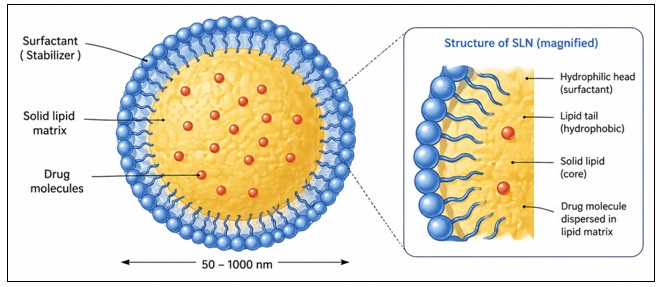
FIG. 2: SOLID LIPID NANOPARTICLES
In order to prepare SLNs, it has been generally observed that it would be necessary to use solid fat, liquid fat (oils), or materials that would help to blend them effectively. The solid fat and liquids used in preparing SLNs are often considered safe for use in American and European hospitals 22.
Methods for the Preparation of Solid Lipid Nanoparticles:
Homogenization under High Pressure: It was proven that HPH is an effective and efficient dispersion technique for the formulation of SLN. The application of HPH results in a controllable reduction in the SLN particle size. This technique is preferred because of its simplicity in terms of realization and cost; it increases the production rate, shortens the production time, and does not require any organic compound-derived solvents. However, this technology still faces some problems regarding the degradation of active pharmaceutical ingredients and supercooled liquid and gel phenomena 23, 24.
Hot Fomogenization: In hot homogenization, the temperature is maintained above the lipid melting point throughout the dissolution stage of the active pharmaceutical ingredient in the melted lipid, which is then poured into a warm surfactant solution. A pre-emulsion was formed by mixing the active pharmaceutical ingredient, lipid, and surfactants, which was then homogenized using an Ultra Turrax homogenizer for three minutes. The crude dispersion was further processed using a homogenizer, which uses high temperature and pressure for a short period of three cycles 25.
Cold Homogenization: In contrast, during cold high-pressure homogenization processes, lipids are heated above their melting point, making it possible to dissolve and disperse the active pharmaceutical ingredient in the melted lipids. This step is followed by a cooling stage that utilizes dry ice and liquid nitrogen. Once solidified, the lipid mass is ground using a mortar and ball mill to form lipid microparticles, which are 50–100 micrometers in size. The next step involves the formation of a microemulsion by adding lipid microparticles to a chilled surfactant solution. This solution is then subjected to a high-pressure homogenizer, which operates at or below room temperature to homogenize lipid microparticles into nanoparticles. Solid lipid nanoparticles (SLNs) derived from cold HPH homogenization processes typically exhibit a relatively higher polydispersity index (PI) and increased size compared to those homogenized using hot HPH processes.
Solvent Emulsification: In such a procedure, the lipids have to be extracted with solvents that are non-miscible with water. Chloroform is an example of a solvent. The solution was then emulsified and evaporated under reduced pressure. This is a useful procedure for lipophilic drug compounds that are sensitive to heating. However, it is essential to be cautious about the health-related liabilities that may be posed by solvent residues.
Microemulsion: For hot microemulsion preparation, molten lipid, surfactant, and co-surfactant mixtures were added together while stirring. Freeze-drying was used to remove the remaining water. This technique has the following advantages: no equipment is required, no energy is needed for its preparation, and the lipid nanoparticles produced using the technique can be easily scaled up. However, the disadvantage of the micro-emulsion technique is that the suspension of the particles is diluted using water. This requires additional work to remove surplus water. Furthermore, the presence of high surfactant and co-surfactant levels is a concern from a regulatory perspective 26.
Supercritical Fluid Method: Supercritical fluids find their principal applications in Solid Lipid Nanoparticle production through the application of supersonic fluid solution technologies. This offers multiple routes for producing powdered particles and nanoparticles. For example, carbon dioxide and/or nitrogen gas have been largely favored as supercritical fluids owing to their non-toxicity and easy critical temperature and pressure. In addition, variables such as viscosity, density, and diffusion rates can be easily controlled. The benefits of this technique include the absence of an organic solvent system. Moreover, it can produce dried powdered nanoparticles 27.
Double Emulsion-Based Method: Warm water in oil-in-water (W/O/W) double microemulsions can be formed in two steps. First, the W/O/w micro-emulsion was prepared by adding an aqueous solution of the drug to melted lipids, surfactant, and co-surfactant at a temperature at which the lipids melted to obtain a clear solution. Subsequently, the W/O/w micro-emulsion was added to another solution of water, surfactant, and co-surfactant to form W/O/W. To prepare solid lipid nanoparticles (SLNs) from warm micro double emulsions, the micro double emulsions were suspended at lower temperatures, followed by washing with the dispersion medium in an ultrafiltration system.
It is essential to understand that multiple emulsions can be unstable because of the merging of water droplets in the oil phase, coalescence of oil droplets, or disruption of high-water concentration at the water droplet surface 28.
Lyophilization: Lyophilization has been proven to be a relevant technique for advancing the chemical and physical stability of Solid Lipid Nanoparticles (SLNs) for an extended period of time. This technique is especially important in scenarios where hydrolysable drugs are present or if the formulation is in an oral form, which ensures stability for an extended period. In this technique, because the sample is in solid form, Ostwald ripening and hydrolysis become less significant issues. Simultaneously occurring freeze-drying allows for the merging of all lipid matrices to form larger SLNs owing to a larger distribution in size caused by SLN aggregation, which depends on the freeze-drying conditions and water removal. However, a larger amount of cryoprotectants, such as sucrose, lactose, mannitol, or polyethylene glycol, is required to prevent the aggregation of SLNs during freeze-drying 29.
In solid lipid nanoparticles (SLNs), a major fraction of the ingredients used in the formulation process consists of water-soluble ingredients, including polysorbate 80 or Tween 80, lecithin, poloxamer 407 or Pluronic F127, poloxamer 188 or Pluronic F68, and phosphate.
TABLE 2: INGREDIENTS USED FOR PREPARATION OF SLN
| Ingredient | Examples |
| Solid lipid | Glyceryl palmitostearate
Glyceryl behenate Stearic acid Palmitic acid Tristearin Tripalmitin Trimyristin Acetyl palmitate Cholesterol Triolein Tricaprylin |
| Liquid lipid | MCT
Propylene glycol dicaprylocaprate Caprylocaproyl Polyoxyl glycerides Propylene glycolmonocaprylate Isopropyl myristate Oleic acid Squalene α-tocopherol |
| Emulsifier | Poloxamer188
Poloxamer407 Soybean lecithin, phosphatidylcholine Polysorbate80 Polysorbate60 PEG-40castoroil Sodium deoxycholate Sodiumdodecylsulfate |
Transdermal Patch: The use of a medicated transdermal patch on the skin provides controlled delivery of a specific dose of medication through the skin and into the bloodstream, thus providing a therapeutic effect.
Types of Transdermal Patches:
Single Layer Matrix Type Drug in Adhesive Patch: In this system, the drug is embedded within a pressure-sensitive adhesive, which serves as both the adhesive component and drug-release matrix. The adhesive layer is enclosed by a backing layer and removable protective liner.
Multi-phase Drug in Adhesive System: The key similarity between the two versions is that the structure of the first version is very similar to that of the single-layer patch, but it consists of two layers, one for the controlled release of medication and the other for the immediate release of medication, apart from the adhesive layer. The adhesive layer helps release the medication. The patch has a temporary liner and permanent backing.
Reservoir Controlled Drug in Adhesive System: It has a liquid compartment with a suspension or solution of a drug. The adhesive separates this compartment from the semi-permeable membrane and release liner.
It is characterized by the presence of a semisolid matrix containing a solution or suspension of a drug placed near the release liner.
It is a concentric arrangement that surrounds the membranes. It can hold the adaptation component of the product responsible for regulating adhesion to the skin. It is the component that sticks to the skin and is placed in an overlay that surrounds the semisolid matrix in a circular manner 30.
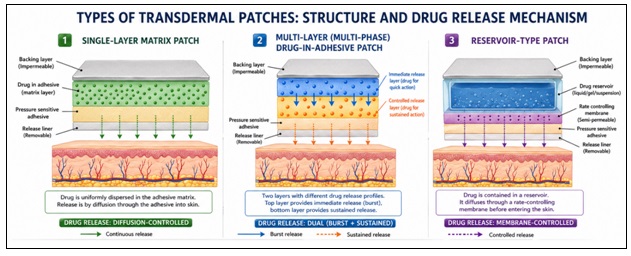
FIG. 3: TYPES OF TRANSDERMAL PATCHES
Anatomy and Physiology of Skin: The skin is the largest organ of the body. It covers an area of nearly 20 sq. feet. It helps us feel touch, heat, and cold, and at the same time, it functions to protect us from bacteria and other external matters while helping us maintain body temperature.
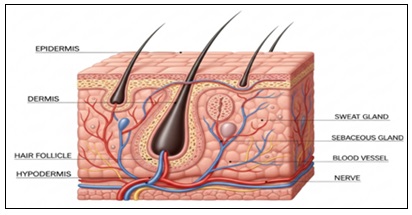
FIG. 4: STRUCTURE OF SKIN
It is Structured into Three Major Layers: The outermost layer, named epidermis is composed mainly of keratin-producing keratinocytes. This layer is responsible for skin colors and maintains a waterproof layer. The epidermis is constructed of several layers, namely, the stratum corneum, stratum lucidum, stratum granulosum, stratum spinosum, and stratum basale, in order from the innermost to the outermost layers. Beneath this layer lies the dermis, composed of connective tissue, blood vessels, sweat glands, hair follicles, and nerve endings. This layer provides skin support, elasticity, and sustenance. The dermis can be further divided into two layers: the reticular dermis and papillary dermis. The innermost skin layer is the hypodermis, also known as the subcutaneous tissue, composed of both fat and connective tissue, providing a comfortable and protective layer around the body by affording protection and anchoring itself to the underlying bones and muscles. Moreover, skin tissue contains different specialized cells called melanocytes, which help in skin coloring. Langerhans cells help in immune responses. and Merkel cells that affect emotional perception. The highly complex skin tissue protects and maintains the body with other required functions simultaneously 31.
Elements of Trans-Dermal Patch: The essential constituents of a transdermal patch include a polymer matrix or drug reservoir, an active pharmaceutical ingredient, permeation enhancers, a pressure-sensitive adhesive, backing laminates, and a release liner, along with auxiliary excipients such as plasticizers and solvents.
Polymer Matrix: The polymer matrix forms the basic unit of the transdermal drug delivery system, which is made in the form of a multilayer polymeric laminate that holds the drug reservoir or drug-polymer matrix between the layers.
Polymeric Layers: The formulation consists of a top impermeable layer serving as a barrier to prevent the drug from leaking out of the surface and a bottom layer of polymeric materials acting as an adhesive or releasing membrane. The selection and design of polymeric materials are of prime importance because of their wide applicability in designing effective transdermal drug delivery systems. The key is to prepare a polymeric matrix and carefully control the drug-loaded matrix in terms of its release properties, and attempt to achieve a balance of adhesion and cohesion, along with its physicochemical properties and compatibility or stability in the presence of other components in a transdermal drug delivery system and skin tissue 32.
Polymers used in Transdermal Drug Delivery Systems (TDDS) can be classified as follows:
- Natural polymers: cellulose derivatives, zein, gelatin, shellac, wax, gum, natural rubber, and chitosan.
- Synthetic elastomers: polybutadiene, hydrin rubber, polyisobutylene, silicone rubber, nitrile, acrylonitrile
Examples of synthetic polymers: polyvinyl alcohol, polyvinyl chloride, polypropylene, polyurea, polyacrylate, polyethylene. For a polymer to be used in a transdermal patch, the following conditions must be satisfied:
- The molecular weight, temperature, glass transition temperature, and functionality of polymers should facilitate or enable the diffusion and release of a specific drug.
- The polymer should allow the absorption of a relatively large amount of the drug.
- The polymer should not interact physically or chemically with the drug.
- The polymer should be easily manufactured and processed into the desired product and should also provide cost-effective products.
- The polymer should be stable and not degrade when exposed to contact with the drug substance and other excipients added to the formulation under high-humidity and physiological temperatures.
- Both the polymer(s) used and the degraded materials should be nontoxic.
Drug: The most essential criterion for transdermal drug delivery systems (TDDS) is that the drug should have appropriate physicochemical properties. Transdermal patches have been of immense use for drugs undergoing extensive first-pass metabolism, drugs with a narrow therapeutic index, or drugs with a short half-life, leading to non-compliance.
Factors Influencing the Drug of Choice in Transdermal Drug Delivery: There are many factors influencing drug choice in transdermal drug delivery.
Physicochemical Properties:
- The compound should have a certain solubility in oil and water (ideally, in excess of 1 mg/mL). The melting point should be below 200 °F. The concentration gradient in the membrane is proportional to the logarithm of solubility in the lipid part of the membrane, which is in turn proportional to the inverse of the melting point in absolute degrees for the drug. To identify the best candidates for TDD, the melting point should be minimized.
- A molecular weight of less than 1000 Da is regarded as acceptable.
- The saturated solution of the drug in water should have a pH range of 5–9. Drugs that are excessively acidic or basic cannot be used for TDD. This is because the drug ionizes rapidly at physiological pH, and the ionized compound has poor skin penetration properties.
- The number of hydrogen-bonding groups must not exceed two 33.
Biological Properties:
- The drug must have strong potency levels, which means that the drug must be effective at low doses, preferably below 25 mg/day.
- It should have a short biological half-life.
- The drug should be non-irritating to, as well as non-allergenic to, human skin.
- The drug should remain stable upon contact with the skin.
- The medicine must not induce an immunological reaction on the skin.
- There should be no development of tolerance to the drug when there is a near-zero-order release profile of the transdermal delivery system, and it should not irreversibly bind to the subcutaneous tissue.
- The drug should not be extensively metabolized in the skin.
Permeation Enhancers: Permeation enhancers facilitate drug transport through the skin by interacting with the lipids and proteins in the stratum corneum. They help to increase the diffusion of drugs in the skin by improving the extraction of lipids in the case of chemical enhancers, which helps to increase the wetting properties of drugs. They help transport drugs in the case of lipophilic drugs. The miscibility of chemicals aids in drug transport, particularly for hydrophilic drugs. The best permeation enhancer is pharmacologically inactive, non-toxic, reversible, predictable, and does not cause dehydration.
The permeability of the drug can also be improved using physical methods such as iontophoresis, electroporation, sonophoresis, and microneedles. Iontophoresis uses low electric currents to drive drug molecules across the skin, whereas electroporation uses successive electric pulses with higher potentials to create temporary pores in the skin for drug permeation. Sonophoresis involves the use of low-frequency ultrasound to enhance drug delivery, including macromolecular substances. Microneedles create minute pores in the skin, enabling the efficient delivery of large drug molecules 34.
Pressure-sensitive Adhesive (PSA): A PSA ensures a strong attachment between the skin surface and the patch. The adhesive should have a high gripping force, should not require pressure to come into contact with the finger, should have high adhesive strength, should have a high gripping force, should not require pressure to contact the skin or fingers, or should not require pressure to make contact with skin or fingers. The types of adhesives used may include silicon adhesives, polyisobutylene, or polyacrylates. The requirements for selecting an adhesive include skin type or preparation and drug constituents.
Backing Laminate: The primary function of the support layer is to provide structural stability. The support layer should not be affected by chemicals and should combine well with all other layers, as any direct contact between these layers and the support layer may cause leakage or migration problems regarding ingredients, drugs, or enhancers. The materials should exhibit low water permeability.
They should be flexible, bendable, and resilient to tension. The usual materials used to prepare the backing include a layer coated with aluminum vapor, a plastic sheet made from polyethylene, polyvinyl chloride, or polyester, or a layer that can be sealed upon heating.
Release Liner: Secondly, the protective covering plays the role of a protective barrier for the drugs combined with the adhesive while the drug is still in storage and serves as a means of preventing the escape of the drugs while also protecting them from foreign materials. Thus, covering is also one of the critical components of the packaging system rather than the drug delivery system for the drug. The protective covering is made up of a base material that could be breathable, such as paper and cloth, and non-breathable materials such as polyethylene and polyvinyl chloride, as well as a removal material that is made of either silicone and/or Teflon materials. Other materials used for the production of coverings for transdermal patches include polyester films and reflective metal laminates.
Other Excipients: Other types of substances that can dissolve materials and are used in the drug-carrying part of a medicine patch include chloroform, methanol, acetone, isopropanol, and dichloromethane. There are also substances that can increase flexure and are hence used while making skin patches that are used to deliver medicine and are flexible in nature; these include dibutyl phthalate and triethyl citrate.
Approaches for Formulation of Transdermal Drug Delivery Systems:
Teflon Mold Casting Method: Formulations constitute a combination of polymers that come in varying concentrations. This is applied using an organic solvent. The solvent, half the volume of that used in the formulation containing varying concentrations of polymers, is used to wet a particular amount of medication. Before they are applied, the particular amount of medication is combined with the enhancements, each of which is applied in a varying amount of solvent. The mixture applied is also combined with a plasticizer known as Di-N-butylphthalate. After the compound is stirred for 12 hours through a stirrer, the compound is put into a circular mold made of Teflon material. To regulate the solvent evaporation rate when making the desired compound on a laminar flow hood that operates at the speed of 0.5 m/s, the compound is placed on a flat surface and covered by an inverted funnel to regulate the amount lost through evaporation. The compound is allowed to evaporate over a set time of 24 hours. These films are kept in a desiccator containing silica gel at a set temperature of 25±0.5°C to prevent aging over an extended time. These films are to be evaluated after one week from the date set for their preparation.
'IPM Membranes' Method: Here, a dispersion form is first produced through a mixture of the drug substance, water, propylene glycol, and carbomer 940 polymers, stirring being done on a magnetic stirrer for a period of 12 hours. The solution is then made less liquid with the addition of triethanolamine solution, to which a pH 7.4 buffer solution can be added if a gel solution is to be produced, based on the drug's solubility level in an aqueous solution being less than a certain level. The gel solution is then mixed with IPM, an oily solution.
“EVAC Membranes” Method: The membranes that are to be used for rate controlling purposes in the proposed transdermal system are the 1% Carbopol reservoir gel membranes, polyethylene membranes, and ethylene-vinyl acetate membranes. If the drug is having solubility issues with water, then propylene glycol is used in the formula of the drug product. The drug propylene glycol solution is then mixed with Carbopol resin. The drug propylene glycol solution is then mixed with Carbopol resin. Carbopol resin is then treated with a 5 percent w/w solution of sodium hydroxide. Finally, the drug in its gel form is placed over the backing layer and the rate-controlling membrane is then placed over the drug in its gel form 35.
Evaluation of Transdermal Patches: Transdermal patches have also been developed to enhance the clinical efficacy of the drug together with improving patient compliance via a small dose of medicine at a predetermined rate. As a result, evaluation of these patches is of utmost interest to determine their desired performance in a specified range of environmental conditions. Such forms of evaluation can predict transdermal dosage forms and can also vary in type to consist of physicochemical evaluation, in-vitro evaluation, and in-vivo evaluation. Following physicochemical and in-vitro evaluation of the preparations, in-vivo evaluation may also take place.
Physicochemical Evaluation:
Thickness: The thickness of the transdermal film can be measured by using a travelling microscope, dial gauge, screw gauge, or micrometer and measuring the film at different points.
Uniformity of Weight: Weight variation can be determined by weighing the individual units of 10 randomly selected patches and calculating the average weight. The weight of the individual units should not deviate much from the average weight.
Drug Content Determination: This can be done by totally dissolving a section of the polymeric film, measuring 1cm2, in a solvent that is the right volume, which then results in the establishment of the desired effect. It is essential that the solvent is chosen based on its ability to dissolve the drug. The section to be dissolved is first weighed before being subjected to the solvent. The mixture is then shaken in an incubator shaker for 24 hours, filtered, and then subjected to sonic treatment. The drug level is then analyzed
Content Uniformity Test: The test is employed as the gold standard to chemically assess the amount of the active ingredient in each unit dose. The assessment is finalized with an assay to determine the quantity of the drug material present in the polymeric film of the patch. According to USP, the test should be carried out in two phases. The first phase involves the assay of ten randomly selected units. If the first phase does not meet the criteria, the second phase is carried out on twenty additional units. Originally, ten patches are selected, and the content of each individual patch is determined. The test is considered to have been performed satisfactorily if the range for each of the ten individual doses falls between ≥ 85% to ≤ 115%, that is, if the relative standard deviation, RSD, is < 6%. When nine individual doses fall within 85 to 115% of the test samples, while one does not fall below 75%, nor above 125%, of the test samples, the test is performed satisfactorily, where the transdermal patch passes the test on content uniformity. This is, however, only true if three individual samples fall within the range of 75 to 125%. The test is to be re-administered on an additional twenty individual samples, where if the individual drug content values have an RSD < 7.8%, no drug content values fall outside the range of 85 to 115%, nor is the drug content value outside the range of 75 to 125%.
Moisture Content: The prepared films are weighted separately and kept in desiccators at room temperature with calcium chloride for 24 hours. After an elapsed period of time, the films are reweighted until a constant weight is attained. The moisture content percent can be calculated from the following equation:
% Moisture contents = Initial weight - Final weight × 100 / Final Weight
Moisture Uptake: The weighed films were placed in a desiccator at room temperature for 24 hours. Afterwards, they were removed and subjected to 84% relative humidity using a saturated solution of Potassium chloride in a desiccator until a constant weight was reached.
% Moisture Uptake = (Final Weight - Initial Weight) × 100 / Initial Weight
Folding Endurance: While assessing folding endurance, the most important task is to determine the ability the film can have in order to withstand extreme folding conditions. This ability can be determined simply by folding the film at one specific location until the film fractures. This can define the folding endurance value.
Tensile Strength: For the determination of the tensile strength, the polymeric film samples are arranged between iron linear plates corked at the ends. The film sample is held at one end by an iron screen, and the other end is held by a freely moving thread suspended over a pulley.
Weights are gradually added to the pan attached to the suspended end of the thread. There is a pointer on the thread that shows the elongation of the film sample. The exact weight that causes failure of the film sample is recorded.
Tensile Strength = 𝐹/ 𝑎.𝑏 (1 + 𝐿 /𝑙 )
In this case, ‘F’ stands for force required to break the film; ‘a’ for width of the film; ‘b’ for thickness; ‘L’ for length of the film; and ‘l’ for elongation at break.
Water Vapor Transmission Studies (WVT): An assessment is done on the WVT by the method of using one-gram calcium chloride in pre-dried empty vials of uniform diameter. The films are then fixed over the edges using an adhesive in the form of silicone-based grease prior to curing for 5 minutes. They are then accurately weighed upon insertion into the humidity chamber set at 68% relative humidity for a period of seven consecutive days while the resultant increase in the degree of their weights is considered a measure of the moisture passing through the patch in a qualitative design.
Adhesive Studies: The effectiveness of Transdermal Drug Delivery Systems (TDDS) is influenced by the quality of contact made by the transdermal patch with the skin surface. The adhesion of a transdermal patch to the skin surface is accomplished by the incorporation of Pressure-Sensitive Adhesives (PSAs) into the patch formulation. Pressure-Sensitive Adhesives are adhesives that bond to a surface when a minimum amount of pressure is applied to the adhesion site. The adhesive properties of a transdermal patch may be assessed based on the following factors.
Peel Adhesion Properties: It denotes the force required to remove the adhesive coating from the substrate. It is usually evaluated through an experiment where the force required to pull an individual adhesive-coated tape, exposed at a 180° position on the test substrate, is ascertained. The test is considered effective when there is no residue left on the substrate.
Shear Strength Properties: Shear strength measures the cohesive strength of the bonding film, which implies that the device should not slip during application. This is done by determining the time taken to remove the film-coated tape that is attached to a stainless-steel plate 36.
CONCLUSION: Polycystic ovary syndrome (PCOS) is one of the most common endocrine disorders affecting women of reproductive age and is a major cause of anovulatory infertility. Conventional oral drug therapy for ovulation induction often suffers from several limitations such as poor bioavailability, first-pass metabolism, systemic side effects, and reduced patient compliance. Therefore, the development of advanced drug delivery systems is essential to improve therapeutic outcomes. Solid lipid nanoparticles (SLNs) have emerged as a promising nanocarrier system due to their biocompatibility, stability, controlled drug release, and ability to enhance drug permeability. Incorporating SLNs into transdermal patches offers a novel strategy for delivering ovulation-inducing drugs through the skin while bypassing hepatic first-pass metabolism. This approach can provide sustained drug release, improved bioavailability, and enhanced patient compliance compared to conventional oral formulations. Overall, SLN-based transdermal drug delivery systems represent a promising and innovative approach for the management of PCOS.
Challenges and Future Perspectives: The integration of solid lipid nanoparticles (SLNs) into transdermal drug delivery systems (TDDS) for the management of polycystic ovarian syndrome (PCOS) presents promising future perspectives, yet several challenges remain. Future advancements are expected to focus on personalized therapy, development of advanced nanocarriers, combination drug delivery, and the incorporation of smart technologies for controlled and targeted release. Enhanced permeation techniques such as microneedles and iontophoresis may further improve drug delivery across the skin barrier. However, significant challenges include the limited permeability of the stratum corneum, formulation complexities in achieving stable and uniform SLNs, dose limitations for transdermal delivery, and difficulties in large-scale manufacturing. Additionally, regulatory uncertainties, potential skin irritation upon prolonged use, and higher production costs pose barriers to clinical translation. Addressing these challenges through innovative research and technological advancements will be crucial for the successful development and commercialization of SLN-based transdermal systems for effective PCOS management.
ACKNOWLEDGEMENTS: Nil
Funding: Nil
Authors Contributions: Kailash K. A: Conceptualization, literature review, data curation, analysis, and manuscript writing. Beny Baby: Conceptualization support, idea development, and critical input in shaping the review.
CONFLICTS OF INTERESTS: The authors declare no conflict of interest
REFERENCES:
- Unfer V, Proietti S, Gullo G, Porcaro G, Carlomagno G and Bizzarri M: Polycystic ovary syndrome: features, diagnostic criteria and treatments. Endocrinol Metab Syndr 2014; 3(3): 1–12. doi:10.4172/2161-1017.1000136.
- Kumar P and Khan K: Effects of metformin use in pregnant patients with polycystic ovary syndrome. J Hum Reprod Sci 2012; 5(2): 166–169. doi:10.4103/0974-1208.101012
- Dhiman N, Awasthi R, Sharma B, Kharkwal H and Kulkarni GT: Lipid nanoparticles as carriers for bioactive delivery. Front Chem 2021; 9: 580118.
- Scioli Montoto S, Muraca G and Ruiz ME: Solid lipid nanoparticles for drug delivery: Pharmacological and biopharmaceutical aspects. Front Mol Biosci 2020; 7: 587997.
- Akbari J, Saeedi M, Ahmadi F, Mohammad S, Hashemi H and Babaei A: Solid lipid nanoparticles and nanostructured lipid carriers: a review of the methods of manufacture and routes of administration. Pharm Dev Technol 2022; 27(5): 525–544. doi:10.1080/10837450.2022.2084554
- Jacob S, Rao R, Gorain B, Boddu SHS and Nair AB: Solid lipid nanoparticles and nanostructured lipid carriers for anticancer phytochemical delivery: advances, challenges, and future prospects. Pharmaceutics 2025; 17(8): 1079. doi:10.3390/pharmaceutics17081079
- Costello FM: Polycystic Ovary Syndrome: a management update, Australian Family Physician 2005; 34(3): 127–133.
- Forslund M, Melin J, Stener-Victorin E, Hirschberg AL, Teede H, Vanky E & Piltonen T: International evidence-based guideline on assessment and management of PCOS—A Nordic perspective, Acta Obstetricia et Gynecologica Scandinavica 2024; 103(1): 7–12. DOI: 10.1111/aogs.14725.
- Teede HJ, Misso ML, Costello MF, Dokras A, Laven J, Moran L, Piltonen T and Norman RJ: Recommendations from the international evidence-based guideline for the assessment and management of polycystic ovary syndrome, Human Reproduction 2018; 33(9): 1602–1618. DOI: 10.1093/humrep/dey256.
- Legro RS, Arslanian SA, Ehrmann DA, Hoeger KM, Murad MH and Pasquali R: Diagnosis and treatment of polycystic ovary syndrome: an Endocrine Society clinical practice guideline. Journal of Clinical Endocrinology & Metabolism 2013; 98(12): 4565–4592 DOI: 10.1210/jc.2013-2350
- Cincione RI, Losavio F, Ciolli F, Valenzano A, Cibelli G, Messina G & Polito R: Effects of Mixed of a Ketogenic Diet in Overweight and Obese Women with Polycystic Ovary Syndrome, International Journal of Environmental Research and Public Health 2021; 18(23): 12490. DOI: 10.3390/ijerph182312490.
- Martínez-González MA, Salas-Salvadó J, Estruch R, Corella D, Fitó M and Ros E: Benefits of the Mediterranean Diet: Insights from the PREDIMED Study, Progress in Cardiovascular Diseases 2015; 58(1): 50–60. DOI: 10.1016/j.pcad.2015.04.003.
- Kazemi M, Jarrett BY, Vanden Brink H, Lin AW, Hoeger KM, Spandorfer SD & Lujan ME: Obesity, insulin resistance, and hyperandrogenism mediate the link between poor diet quality and ovarian dysmorphology in reproductive-aged women, Nutrients 2020; 12(7): 1953. DOI: 10.3390/nu12071953.
- Che X, Chen Z, Liu M & Mo Z: Dietary interventions: a promising treatment for polycystic ovary syndrome, Annals of Nutrition and Metabolism 2021; 77(6): 313–323. DOI: 10.1159/000519302.
- Martin KA, Chang RJ, Ehrmann DA, Ibanez L, Lobo RA and Rosenfield RL: Evaluation and treatment of hirsutism in premenopausal women: an Endocrine Society clinical practice guideline, Journal of Clinical Endocrinology & Metabolism 2008; 93(4): 1105–1120 DOI: 10.1210/jc.2007-2437.
- Diamanti-Kandarakis E, Kouli C, Tsianateli T and Bergiele A: Therapeutic effects of metformin on insulin resistance and hyperandrogenism in polycystic ovary syndrome. Eur J Endocrinol 1998; 138(3): 269–274. doi:10.1530/eje.0.1380269
- Palomba S, Falbo A & La Sala GB: Metformin and gonadotropins for ovulation induction in patients with polycystic ovary syndrome: a systematic review with meta-analysis of randomized controlled trials, Reproductive Biology and Endocrinology 2014; 12: 3. DOI: 10.1186/1477-7827-12-3.
- Song J, Ruan X, Gu M, Wang L, Wang H & Mueck AO: Effect of orlistat or metformin in overweight and obese polycystic ovary syndrome patients with insulin resistance, Gynecological Endocrinology 2018; 34(5): 413–417. DOI: 10.1080/09513590.2017.1407752.
- Dason ES, Koshkina O, Chan C & Sobel M: Diagnosis and management of polycystic ovarian syndrome, Canadian Medical Association Journal (CMAJ) 2024; 196(3): 85–94. DOI: 10.1503/cmaj.231251.
- Lucidi R: Polycystic ovarian syndrome: metabolic and reproductive abnormalities, diagnosis, and management. 2019.
- Fathi HA, Allam A, Elsabahy M, Fetih G and El-Badry M: Nanostructured lipid carriers for improved oral delivery and prolonged antihyperlipidemic effect of simvastatin. Colloids Surf B Biointerfaces 2018; 162: 236–245. doi:10.1016/j.colsurfb.2017.11.064.
- Müller RH, Radtke M and Wissing SA: Nanostructured lipid matrices for improved microencapsulation of drugs. Int J Pharm 2002; 242(1–2): 121–128. doi:10.1016/S0378-5173(02)00180-1.
- Wu KW, Sweeney C, Dudhipala N, Lakhani P, Chaurasiya ND, Tekwani BL and Majumdar S: Primaquine loaded solid lipid nanoparticles (SLN), nanostructured lipid carriers (NLC), and nanoemulsion (NE): effect of lipid matrix and surfactant on drug entrapment, in-vitro release, and ex-vivo hemolysis. AAPS Pharm Sci Tech 2021; 22(7): 240. doi:10.1208/s12249-021-02108-5.
- Müller RH, Mäder K and Gohla S: Solid lipid nanoparticles (SLN) for controlled drug delivery a review of the state of the art. Eur J Pharm Biopharm 2000; 50(1): 161–177. doi:10.1016/S0939-6411(00)00087-4.
- Khairnar SV, Pagare P, Thakre A, Nambiar AR, Junnuthula V, Abraham MC, Kolimi P, Nyavanandi D and Dyawanapelly S: Review on the scale up methods for the preparation of solid lipid nanoparticles. Pharmaceutics 2022; 14(9): 1886. doi:10.3390/pharmaceutics14091886.
- Almeida AJ and Souto EB: Solid lipid nanoparticles as a drug delivery system for peptides and proteins. Adv Drug Deliv Rev 2007; 59(6): 478–490. doi:10.1016/j.addr.2007.04.004
- Chaturvedi SP and Mishra A: Production technique of lipid nanoparticles. Res J Pharm Biol Chem Sci 2012; 3(3): 525–541.
- Chakravarty P, Famili A, Nagapudi K and Al Sayah MA: Using supercritical fluid technology as a green alternative during the preparation of drug delivery systems. Pharmaceutics 2019; 11(12): 629. doi:10.3390/pharmaceutics11120629.
- Ekambaram P, Sathali AAH & Priyanka K: Solid Lipid Nanoparticles: A Review, Scientific Reviews and Chemical Communications 2011/2012; 2(1): 80–102.
- Ohshima H, Miyagishima A, Kurita T, Makino Y, Iwao Y, Sonobe T & Itai S: Freeze-dried nifedipine-lipid nanoparticles with long-term nano-dispersion stability after reconstitution, International Journal of Pharmaceutics 2009; 377(1–2): 180–184.
- Mitragotri S and Kost J: Low-frequency sonophoresis: a review. Adv Drug Deliv Rev 2004; 56(5): 589–601. doi:10.1016/j.addr.2003.10.024.
- Dragicevic N and Maibach HI:. Percutaneous penetration enhancers: chemical methods in penetration enhancement Editors. Berlin, Heidelberg Springer 2015. doi:10.1007/978-3-662-45013-0.
- Alam MI, Alam N, Singh V, Alam MS, Ali MS, Anwer T and Safhi MM: Types and preparation & evaluation of transdermal patches: a review. World J Pharm Pharm Sci 2013; 2(4): 2199–2233.
- Jalwal P, Jangra A, Dahiya L, Sangwan Y and Saroha R: A review on transdermal patches. Pharm Res J 2010; 3: 139–149.
- Cherukuri S, Batchu UR, Mandava K, Cherukuri V and Ganapuram KR: “Formulation and evaluation of transdermal drug delivery of topiramate” Int J Pharma Investig 2017; 7(1): 10-17.
- Jalwal P, Jangra A, Dahiya L, Sangwan Y and Saroha R: “A Review on Transdermal Patches” The Pharma Research 2010; 3: 139-149.
- Budhathoki U, Gartoulla M and Shakya S: Formulation & evaluation of transdermal patches of Atenolol. J Pharm 2016; 27(4): 196-202.
How to cite this article:
Kailash KA and Baby B: A review on SLN-incorporated transdermal patches for PCOS treatment. Int J Pharm Sci & Res 2026; 17(10): 2915-29. doi: 10.13040/IJPSR.0975-8232.17(10).2915-29.
All © 2026 are reserved by International Journal of Pharmaceutical Sciences and Research. This Journal licensed under a Creative Commons Attribution-NonCommercial-ShareAlike 3.0 Unported License.
 Download