




A SYSTEMS PHARMACOLOGY PERSPECTIVE ON SOLANUM XANTHOCARPUM: INTEGRATING PHYTOCHEMICALS, MOLECULAR TARGETS, SIGNALING PATHWAYS AND THERAPEUTIC APPLICATIONS
HTML Full TextA SYSTEMS PHARMACOLOGY PERSPECTIVE ON SOLANUM XANTHOCARPUM: INTEGRATING PHYTOCHEMICALS, MOLECULAR TARGETS, SIGNALING PATHWAYS AND THERAPEUTIC APPLICATIONS
C. Rajesh, A. Mohamed Althaf, S. Hariprasitha, M. Yazhmozhi, A. Mohamed Fiaz *, P. Srinivasan, Y. Suhel and D. Dhachinamoorthi
Department of Pharmacology, Sree Abirami College of Pharmacy, Coimbatore, Tamil Nadu, India.
ABSTRACT: Background: Solanum xanthocarpum Schrad. & Wendl. is an important medicinal plant traditionally used for the management of respiratory, inflammatory, hepatic, gastrointestinal, and metabolic disorders. Increasing experimental and computational studies have expanded understanding of its pharmacological potential and molecular mechanisms. Objective: To critically evaluate phytochemistry, experimentally demonstrated pharmacological activities, and published systems pharmacology evidence of S. xanthocarpum, while distinguishing validated findings from computational predictions. Methods: A literature-based review was conducted using PubMed, Scopus, Web of Science, ScienceDirect, SpringerLink, and Google Scholar. Original research articles and review papers describing phytochemistry, pharmacological activities, molecular mechanisms, and published computational studies were critically assessed. No independent target prediction, protein–protein interaction (PPI) analysis, Gene Ontology (GO) or KEGG pathway enrichment, molecular docking, molecular dynamics simulation, or ADME prediction was performed in this review. Computational findings discussed herein were derived exclusively from previously published studies. Results: Experimental evidence demonstrates that S. xanthocarpum extracts and major phytochemicals, including solasodine, solamargine, solasonine, quercetin, apigenin, and lupeol, possess antioxidant, anti-inflammatory, hepatoprotective, antidiabetic, antimicrobial, immunomodulatory, and anticancer activities in cellular and animal models. Published computational studies have proposed interactions with targets such as AKT1, STAT3, EGFR, VEGFA, TP53, and NFE2L2 and implicated pathways including PI3K/Akt, NF-κB, MAPK, JAK/STAT, HIF-1, and Nrf2/ARE. These proposed mechanisms remain hypothesis-generating and require experimental validation. Conclusion: Current evidence supports the pharmacological potential of S. xanthocarpum, but many mechanistic insights are derived from computational analyses rather than direct experimental validation. Future research should prioritize standardized extracts, mechanistic studies, pharmacokinetic characterization, toxicological evaluation, and well-designed clinical trials.
Keywords: Solanum xanthocarpum, Phytochemistry, Pharmacology, Systems pharmacology, Network pharmacology, Medicinal plants
INTRODUCTION: Medicinal plants remain an important source of bioactive compounds for drug discovery because of their chemical diversity and ability to modulate multiple biological targets.
The World Health Organization estimates that a substantial proportion of the global population relies on traditional herbal medicines for primary healthcare.
Interest in plant-derived therapeutics has increased further with the growing burden of chronic diseases, including inflammatory disorders, diabetes, cancer, cardiovascular diseases, and neurodegenerative conditions, where multitarget therapeutic approaches may offer advantages over conventional single-target drugs. Solanum xanthocarpum Schrad. & Wendl. (Family: Solanaceae), commonly known as Kantakari or Yellow-berried Nightshade, is an important medicinal plant in Ayurveda, Siddha, and Unani medicine. It is a key constituent of the classical Ayurvedic formulation Dashamoola and has traditionally been used for the management of bronchial asthma, chronic cough, fever, inflammatory disorders, liver diseases, urinary disorders, skin diseases, and metabolic conditions. These traditional applications have stimulated extensive pharmacological investigations aimed at validating its therapeutic potential.
Phytochemical studies have identified numerous bioactive constituents in different parts of S. xanthocarpum, including steroidal alkaloids (solasodine, solamargine, and solasonine), flavonoids (quercetin, luteolin, apigenin, and kaempferol), triterpenoids, phytosterols, phenolic compounds, tannins, and saponins. Experimental studies have reported antioxidant, anti-inflammatory, hepatoprotective, antidiabetic, antimicrobial, bronchodilatory, gastroprotective, immunomodulatory, and anticancer activities for plant extracts or isolated constituents. However, these findings originate from heterogeneous in-vitro, in-vivo, and computational studies that differ considerably in plant materials, extraction methods, experimental models, and study design.
Systems pharmacology has emerged as a valuable framework for understanding the complex mechanisms of herbal medicines by integrating phytochemical information with molecular targets, biological pathways, and disease-associated networks. Network pharmacology, protein–protein interaction analysis, pathway enrichment, and molecular docking can generate hypotheses regarding the multitarget actions of phytochemicals and help prioritize mechanisms for future experimental investigation. Nevertheless, these computational approaches primarily provide predictive evidence and require validation through biochemical, pharmacological, and clinical studies.
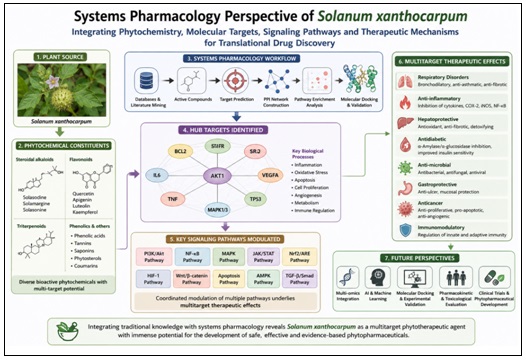
FIG. 1: CONCEPTUAL OVERVIEW OF THE PROPOSED SYSTEMS PHARMACOLOGY FRAMEWORK OF SOLANUM XANTHOCARPUM. MAJOR PHYTOCHEMICALS, REPRESENTATIVE MOLECULAR TARGETS, SIGNALING PATHWAYS, AND PHARMACOLOGICAL ACTIVITIES REPORTED IN THE LITERATURE ARE SUMMARIZED. SOLID ARROWS REPRESENT EXPERIMENTALLY SUPPORTED RELATIONSHIPS, WHEREAS DASHED ARROWS INDICATE MECHANISMS PRIMARILY PROPOSED FROM COMPUTATIONAL STUDIES OR LITERATURE SYNTHESIS. THE FIGURE IS INTENDED AS A CONCEPTUAL OVERVIEW AND NOT AS A DEFINITIVE MECHANISTIC PATHWAY. AI disclosure: Generative AI was used only to assist with the initial visual layout of the figure. All scientific content, labels, relationships, and annotations were independently verified and revised by the authors based on the cited literature.
Although several reviews have summarized the ethnomedicinal uses, phytochemistry, and pharmacological properties of S. xanthocarpum, few have critically integrated the available experimental evidence with published systems pharmacology studies. In particular, there is limited synthesis of reported molecular targets, signaling pathways, and computational findings together with their biological significance, methodological limitations, and translational implications. A comprehensive evidence-based overview is therefore needed to distinguish experimentally validated observations from computational predictions and to identify priorities for future research.
Accordingly, this review provides a critical synthesis of the current literature on S. xanthocarpum by integrating evidence from phytochemical investigations, experimental pharmacology, and published systems pharmacology studies. Specifically, the review aims to: (i) summarize the phytochemical composition of S. xanthocarpum; (ii) evaluate the available evidence for its pharmacological activities; (iii) review published molecular targets and signaling pathways proposed through systems pharmacology approaches; (iv) discuss the strengths and limitations of the current evidence; and (v) identify future research directions required to support the development of standardized, evidence-based phytopharmaceuticals 1-3, 21, 30, 31.
Literature Search Methodology:
Search Strategy: This review was conducted following the Preferred Reporting Items for Systematic Reviews and Meta-Analyses (PRISMA 2020) guidelines. A comprehensive literature search was performed in PubMed, Scopus, Web of Science, ScienceDirect, SpringerLink, and Google Scholar to identify studies related to Solanum xanthocarpum. The search included articles published from database inception to 30 June 2026, with the final search performed on 30 June 2026.
The search strategy combined controlled vocabulary (where applicable) and free-text terms using Boolean operators. An example search string used in PubMed was: (“Solanum xanthocarpum” or “Kantakari” or “Yellow-berried Nightshade”) and (phytochemistry or phytochemicals or pharmacology or “network pharmacology” or “systems pharmacology” or “molecular docking” or “protein-protein interaction” or PPI or “Gene Ontology” or GO or KEGG or “signaling pathway” or “molecular target”).
Study Selection: All retrieved records were imported into a reference management software, and duplicate records were removed. Titles and abstracts were screened for relevance, followed by full-text assessment of potentially eligible articles according to the predefined inclusion and exclusion criteria. Any disagreements during study selection were resolved through discussion among the authors.
Data Extraction and Evidence Synthesis: Information extracted from the included studies comprised publication details, study design, plant part investigated, phytochemical constituents, experimental model, pharmacological activities, reported molecular targets, signaling pathways, network pharmacology findings, molecular docking results, and principal conclusions. The findings were synthesized narratively to provide an integrated overview of the available evidence.
This review did not perform independent target prediction, protein–protein interaction network construction, Gene Ontology or KEGG enrichment analyses, molecular docking, or molecular dynamics simulations. Molecular targets, pathways, and mechanistic insights discussed in this review were extracted from previously published studies and are presented as reported by the original authors.
Plant Profile:
Taxonomy and Botanical Authentication: Solanum xanthocarpum Schrad. & Wendl. belongs to the family Solanaceae, one of the largest families of flowering plants comprising numerous medicinally important species. The currently accepted scientific name is Solanum xanthocarpum Schrad. & Wendl., as recognized by the World Flora Online (WFO) and Plants of the World Online (POWO). Frequently encountered synonyms in the literature include Solanum surattense Burm. f., which should be acknowledged to facilitate interpretation of older publications. Throughout this review, the accepted name Solanum xanthocarpum Schrad. & Wendl. is used consistently.
For future experimental studies, botanical materials should be authenticated by a qualified plant taxonomist, and a voucher specimen should be deposited in a recognized herbarium with the voucher accession number reported to ensure reproducibility. As this article is a literature review, no new plant material was collected or authenticated by the authors.
Distribution: Solanum xanthocarpum is widely distributed throughout tropical and subtropical regions of Asia. It is commonly found across India, Sri Lanka, Bangladesh, Pakistan, Nepal, and Myanmar and has also been reported in parts of Southeast Asia and northern Australia. Within India, the species grows abundantly in open grasslands, wastelands, roadsides, cultivated fields, and dry scrub forests. The plant is well adapted to hot and semi-arid climates and thrives in sandy or loamy soils.
Traditional Medicinal Uses: S. xanthocarpum has been used for centuries in Ayurveda, Siddha, and Unani systems of medicine. It is one of the important constituents of the classical Ayurvedic formulation Dashamoola. Different plant organs are traditionally employed for distinct therapeutic purposes.
TABLE 1: ORGAN-SPECIFIC TRADITIONAL USES OF SOLANUM XANTHOCARPUM
| Plant organ | Traditional applications |
| Fruits | Bronchial asthma, chronic cough, bronchitis, fever, sore throat, urinary disorders |
| Roots | Asthma, inflammatory disorders, rheumatism, fever, urinary diseases |
| Leaves | Wound healing, skin diseases, inflammation, pain, antimicrobial applications |
| Seeds | Toothache, digestive disorders, respiratory ailments |
| Whole plant | Hepatic disorders, diabetes, gastrointestinal disorders, edema, inflammatory diseases, general tonic |
Although these ethnomedicinal applications provide an important basis for pharmacological investigation, many traditional claims remain incompletely validated through rigorous experimental and clinical studies 6, 22, 23.
Botanical Significance: The long-standing traditional use of S. xanthocarpum, together with its rich phytochemical composition, has made it an important medicinal plant for contemporary pharmacological and systems biology research. Integrating authenticated botanical information with phytochemical, pharmacological, and systems pharmacology evidence provides a stronger foundation for understanding its therapeutic potential and supports future standardization of plant-derived phytopharmaceuticals.
Phytochemical Constituents:
Experimentally Identified Phytochemicals: Phytochemical investigations have demonstrated that Solanum xanthocarpum contains a diverse range of secondary metabolites distributed among different plant organs. Several constituents have been directly isolated and structurally characterized using chromatographic and spectroscopic techniques, including high-performance liquid chromatography (HPLC), liquid chromatography–mass spectrometry (LC–MS/MS), gas chromatography–mass spectrometry (GC–MS), nuclear magnetic resonance (NMR), infrared spectroscopy (IR), and ultraviolet (UV) spectroscopy.
Among the most consistently characterized compounds are the steroidal alkaloids solasodine, solamargine, and solasonine, which are predominantly isolated from the fruits and have been widely investigated for their pharmacological properties. Flavonoids including quercetin, apigenin, luteolin, and kaempferol, together with triterpenoids such as lupeol, phytosterols including β-sitosterol and stigmasterol, phenolic compounds, tannins, and saponins, have also been identified in different plant parts using validated analytical methods. However, the phytochemical composition varies according to geographical origin, plant organ, extraction solvent, harvesting season, and analytical methodology.
Compounds Reported from Preliminary Screening: Several studies have reported the presence of alkaloids, flavonoids, phenolics, glycosides, saponins, tannins, terpenoids, and steroids based only on preliminary phytochemical screening or colorimetric tests.
Although these investigations provide useful information regarding the major classes of metabolites, they do not identify individual chemical constituents and should therefore be interpreted cautiously. Such findings require confirmation by chromatographic isolation and structural characterization.
Compounds Reported in Computational or Secondary Sources: Recent systems pharmacology and network pharmacology studies frequently retrieve phytochemical information from public databases (e.g., TCMSP, IMPPAT, Dr. Duke’s Phytochemical Database, PubChem, or published review articles) without experimental verification in the investigated plant material. Consequently, compounds included exclusively in computational datasets should be regarded as database-derived candidates rather than experimentally confirmed constituents of S. xanthocarpum. Wherever possible, only compounds supported by primary phytochemical investigations are discussed as confirmed constituents in this review 5, 12, 18, 32.
TABLE 2: VERIFIED PHYTOCHEMICALS REPORTED IN SOLANUM XANTHOCARPUM EVIDENCE CLASSIFICATION
| Compound | Plant part | Analytical method(s) | Evidence level | Representative primary reference |
| Solasodine | Fruits | HPLC, LC–MS, NMR | Isolated and structurally characterized | Liu et al., 2024 |
| Solamargine | Fruits | LC–MS, NMR | Isolated and structurally characterized | Liu et al., 2024 |
| Solasonine | Fruits | LC–MS, NMR | Isolated and structurally characterized | Liu et al., 2024 |
| Quercetin | Leaves/Fruits | HPLC, LC–MS | Experimentally identified | Primary phytochemical studies |
| Apigenin | Leaves | HPLC, LC–MS | Experimentally identified | Primary phytochemical studies |
| Luteolin | Leaves | HPLC | Experimentally identified | Primary phytochemical studies |
| Kaempferol | Leaves | HPLC | Experimentally identified | Primary phytochemical studies |
| Lupeol | Whole plant/Roots | GC–MS, LC–MS | Experimentally identified | Published phytochemical reports |
| β-Sitosterol | Whole plant | GC–MS | Experimentally identified | Published phytochemical reports |
| Stigmasterol | Whole plant | GC–MS | Experimentally identified | Published phytochemical reports |
- Level I: Isolated and structurally characterized using chromatographic and spectroscopic techniques.
- Level II: Individual compounds identified by validated chromatographic methods (HPLC, LC–MS, GC–MS) but not isolated.
- Level III: Phytochemical classes detected only by preliminary phytochemical screening.
- Level IV: Compounds retrieved exclusively from computational databases or secondary literature without direct experimental confirmation.
Systems Pharmacology and Network Pharmacology Evidence Synthesis: This review summarizes and critically evaluates published systems pharmacology and network pharmacology studies investigating Solanum xanthocarpum. No independent computational analyses, including phytochemical screening, ADME evaluation, target prediction, protein–protein interaction (PPI) network construction, Gene Ontology (GO) enrichment, Kyoto Encyclopedia of Genes and Genomes (KEGG) pathway analysis, molecular docking, or molecular dynamics simulations, were performed by the authors.
The reviewed studies employed a variety of publicly available computational resources. Phytochemical information was commonly obtained from databases such as PubChem, IMPPAT, Traditional Chinese Medicine Systems Pharmacology Database (TCMSP), and published phytochemical investigations. Where reported, drug-likeness and pharmacokinetic properties were evaluated using criteria including Lipinski’s Rule of Five and ADME prediction platforms such as SwissADME.
Potential molecular targets were identified in the original studies using target-prediction resources including SwissTargetPrediction, PharmMapper, and STITCH, while disease-associated genes were retrieved from databases such as GeneCards, OMIM, DisGeNET, and CTD. Candidate therapeutic targets were typically identified by intersecting phytochemical-associated targets with disease-related genes using Venn diagram analysis or equivalent bioinformatics approaches 3, 4, 7, 11.
Several studies further constructed protein–protein interaction (PPI) networks using the STRING database. Hub genes were generally identified according to network topology parameters, including degree centrality and related measures, although the confidence thresholds and selection criteria varied among studies.
Functional annotation was performed in the original investigations using Gene Ontology (GO) and Kyoto Encyclopedia of Genes and Genomes (KEGG) pathway enrichment analyses, implemented through resources such as DAVID, Metascape, Enrichr, or cluster Profiler. The statistical thresholds, multiple-testing corrections, and enrichment parameters differed between studies and are therefore not directly comparable.
Accordingly, molecular targets, hub genes, signaling pathways, and mechanistic interpretations presented in this review represent findings reported in previously published investigations. These computational analyses provide valuable hypotheses regarding potential multitarget mechanisms but should not be interpreted as experimentally validated biological effects without supporting in-vitro, in-vivo, or clinical evidence.
TABLE 3: HUB TARGETS ASSOCIATED WITH SOLANUM XANTHOCARPUM PHYTOCHEMICALS AND THE CORRESPONDING LEVEL OF SUPPORTING EVIDENCE
| Hub Target | Representative Phytochemicals | Evidence Type | Remarks |
| AKT1 | Solasodine, Solamargine, Quercetin, Lupeol | Network pharmacology prediction; literature-derived pathway evidence | Direct binding not experimentally confirmed |
| STAT3 | Solamargine, Apigenin, Quercetin | Network pharmacology; docking (where available); literature evidence | Functional modulation reported in inflammatory models |
| EGFR | Solasodine, Solasonine | Predicted target; limited docking evidence | Requires biochemical validation |
| SRC | Solamargine, Lupeol | Network pharmacology prediction | Experimental confirmation lacking |
| VEGFA | Quercetin, Apigenin | Literature-derived pathway modulation; computational prediction | Mostly indirect regulation reported |
| BCL2 | Solamargine, Solasodine | Experimental apoptosis studies; literature evidence | Target modulation observed but direct binding remains limited |
| TP53 | Solamargine, Quercetin | Literature-derived mechanistic evidence | Mostly pathway regulation |
| TNF | Lupeol, Quercetin, Apigenin | Experimental anti-inflammatory studies | Cytokine suppression demonstrated |
| IL6 | Quercetin, Apigenin | Experimental anti-inflammatory studies | Indirect modulation |
| MAPK1 | Solasodine, Lupeol | Network pharmacology and literature | Requires target-specific validation |
| MAPK8 | Quercetin, Solamargine | Literature-derived pathway modulation | Limited direct evidence |
| PTGS2 (COX-2) | Lupeol, Apigenin | Experimental pharmacological evidence; docking | Strongest supporting evidence |
| NFE2L2 | Quercetin, Luteolin, Phenolics | Experimental literature | Activation demonstrated in oxidative stress models |
| HIF1A | Quercetin, Apigenin | Network pharmacology and docking | Mostly computational evidence |
| CASP3 | Solamargine, Solasonine | Experimental apoptosis studies | Strong functional evidence |
| RELA (NF-κB p65) | Lupeol, Quercetin, Apigenin | Experimental anti-inflammatory studies | Functional inhibition demonstrated |
Pharmacological Activities: The pharmacological evidence for Solanum xanthocarpum varies considerably in methodological quality. Experimental findings have been obtained using different plant parts, extraction methods, purified phytochemicals, doses, treatment durations, and disease models, which limits direct comparison among studies. Throughout this review, the available evidence is classified as in-vitro, in-vivo, in-silico, or clinical, with computational approaches including network pharmacology, molecular docking, and molecular dynamics considered hypothesis-generating rather than confirmatory. Greater emphasis is therefore placed on studies providing direct mechanistic or pharmacological validation.
Antioxidant and Hepatoprotective Activity: Antioxidant and hepatoprotective activities of S. xanthocarpum have been investigated primarily using methanolic, ethanolic, and hydroalcoholic extracts prepared from fruits, leaves, or the whole plant. In-vitro antioxidant activity has been demonstrated using DPPH, ABTS, FRAP, nitric oxide scavenging, and lipid peroxidation assays 5, 6, whereas hepatoprotective effects have mainly been evaluated in CCl₄-induced or paracetamol-induced liver injury models in rodents 6, 14. Whole-plant extracts administered orally (approximately 200–400 mg/kg in most animal studies) significantly reduced serum ALT, AST, ALP, and bilirubin while restoring endogenous antioxidant enzymes including SOD, CAT, and GSH compared with untreated disease controls. Silymarin was commonly employed as the reference hepatoprotective agent. Histopathological examination further confirmed reduced hepatic necrosis and inflammatory infiltration. Although several studies reported statistically significant improvements (generally P < 0.05), detailed pharmacokinetic characterization and standardized extract composition remain insufficiently described. Mechanistically, flavonoids such as quercetin and apigenin have been shown experimentally to activate the NFE2L2 (Nrf2)/ARE antioxidant pathway, providing stronger mechanistic support than computational predictions alone 4, 10, 12.
Evidence Level: Moderate (multiple in-vitro and in-vivo studies; no clinical evidence).
Anti-Inflammatory Activity: Anti-inflammatory activity has been demonstrated using LPS-stimulated RAW264.7 macrophages 5, carrageenan-induced paw edema, cotton pellet granuloma, and other experimental inflammation models 6. Methanolic and ethanolic extracts together with isolated constituents including lupeol, solasodine, and apigenin significantly reduced TNF-α, IL-1β, IL-6, COX-2, and iNOS expression compared with untreated controls. Diclofenac or indomethacin served as positive controls in several studies. Experimental evidence supports inhibition of NF-κB activation together with modulation of PI3K/Akt and MAPK signaling pathways. Nevertheless, considerable heterogeneity exists regarding extract standardization, administered doses, and experimental methodology, limiting quantitative comparison across studies.
Evidence Level: Moderate to strong (cellular and animal studies).
Anti-Asthmatic and Anti-Allergic Activity: Traditional use of S. xanthocarpum in respiratory disorders has been supported by pharmacological studies demonstrating antihistaminic and bronchodilatory effects.
Mechanistically, apigenin and related flavonoids stabilize mast cells, inhibit histamine release, and suppress eosinophilic infiltration. Antagonism of H1 receptors and regulation of Th2-mediated cytokine responses contribute to decreased airway inflammation and bronchial hyperresponsiveness.
Antidiabetic Activity: Antidiabetic activity has been evaluated using α-amylase and α-glucosidase inhibition assays together with streptozotocin- and alloxan-induced diabetic rodent models. Fruit and whole-plant extracts administered orally reduced fasting blood glucose, improved antioxidant status, and partially restored pancreatic histology compared with diabetic controls. Metformin or glibenclamide served as standard comparators in most studies. Although inhibition of carbohydrate-digesting enzymes and improvement of oxidative stress have been experimentally demonstrated, direct evidence linking these effects to modulation of PI3K/Akt signaling remains limited. Therefore, pathway-based mechanisms should be interpreted cautiously unless supported by mechanistic experiments 4, 14, 20.
Evidence Level: Moderate.
Anticancer Activity: Anticancer activity has largely been demonstrated using cultured cancer cell lines including MCF-7, HepG2, and HeLa cells. Steroidal alkaloids, particularly solamargine and solasodine, significantly reduced cell viability and induced apoptosis in a concentration-dependent manner. Experimental studies demonstrated activation of caspase-3, increased Bax/Bcl-2 ratio, and mitochondrial apoptosis. Although several reports suggest involvement of PI3K/Akt, MAPK, and Wnt/β-catenin signaling, only a limited number of studies directly measured pathway activation. Consequently, mechanistic interpretations should preferentially rely on experimentally measured biomarkers rather than computational pathway enrichment. Current evidence supporting anticancer activity is predominantly based on cellular investigations, and robust in-vivo validation remains limited 4, 28.
Evidence Level: Moderate (cell-based evidence).
Immunomodulatory Activity: Experimental studies have demonstrated that S. xanthocarpum regulates cytokine production and immune cell activity. The immunomodulatory effect is associated with modulation of IL-2 production and possible regulation of JAK/STAT signaling pathways. These activities may contribute to its therapeutic potential in inflammatory and autoimmune disorders 4, 5.
Anti- psoriatic: Recent network pharmacology studies have proposed that S. xanthocarpum phytochemicals may regulate psoriasis-associated targets including AKT1, STAT3, MAPKs, TNF, and IL6. GO and KEGG enrichment analyses identified PI3K/Akt, NF-κB, IL-17, and cytokine-signaling pathways as potentially involved biological processes. Molecular docking demonstrated favorable predicted binding of selected phytochemicals toward several psoriasis-associated proteins. However, these findings are computational and should be regarded as hypothesis-generating. At present, there is limited direct experimental evidence demonstrating antipsoriatic efficacy of isolated S. xanthocarpum constituents in validated animal models or clinical studies. No well-designed in-vivo studies have validated the predicted antipsoriatic mechanisms 7, 8.
Evidence Level: Low (computational evidence).
Pulmonary Fibrosis: Computational systems pharmacology has identified apigenin, quercetin, and solasonine as candidate antifibrotic phytochemicals potentially interacting with HIF1A, NFKB1, MTOR, and STAT1 11. Molecular docking and molecular dynamics simulations suggested stable predicted ligand-protein complexes. Nevertheless, docking affinity and simulation stability do not establish biological efficacy or target engagement. These computational observations should therefore be interpreted as hypotheses requiring validation using pulmonary fibrosis animal models, mechanistic cell-based assays, and pharmacokinetic investigations.
Evidence Level: Low (computational evidence only).
Diabetic Retinopathy: Network pharmacology combined with molecular docking has suggested that several flavonoids and steroidal alkaloids from S. xanthocarpum may influence VEGFA-associated angiogenic pathways, inflammatory mediators, and oxidative stress signaling relevant to diabetic retinopathy 10. Molecular dynamics simulations supported the stability of selected ligand-protein complexes. However, these computational analyses do not demonstrate therapeutic efficacy and should not be interpreted as evidence of pharmacological activity. Experimental confirmation in retinal cell systems, diabetic animal models, and pharmacodynamic studies remains necessary.
Evidence Level: Low (computational evidence).
Evidence Level: Strong = multiple independent in vivo studies with mechanistic validation; Moderate = reproducible in-vitro and in-vivo evidence but limited mechanistic confirmation; Low = computational prediction, network pharmacology, molecular docking, or preliminary in vitro evidence without in-vivo validation.
TABLE 4: REPRESENTATIVE SYSTEMS PHARMACOLOGY STUDIES INVESTIGATING SOLANUM XANTHOCARPUM
| Reference | Disease/Model | Methodology | Experimental Validation | Principal Findings | Evidence Category |
| Sahu et al. (2023) | Psoriasis | Network pharmacology + docking | None | PI3K/Akt, NF-κB and IL-17 pathways predicted | Computational |
| Sahu et al. (2024) | Diabetic retinopathy | Network pharmacology + docking + molecular dynamics | None | VEGFA-related angiogenic pathways identified | Computational |
| Jain et al. (2025) | General pharmacology | Systematic review | Literature synthesis | Updated phytochemistry and pharmacology | Literature review |
| Liu et al. (2024) | Anti-inflammatory phytochemicals | Phytochemical isolation + bioassays | Yes | Phenolic compounds with anti-inflammatory activity identified | Experimental |
| Vithalkar et al. (verify publication status) | Pulmonary fibrosis | Network pharmacology + docking | None | Predicted HIF1A, MTOR and STAT1 targets | Computational |
Integrated Mechanistic Network: Current evidence suggests that S. xanthocarpum acts as a multitarget phytotherapeutic agent. The primary mechanism begins with suppression of oxidative stress through activation of Nrf2 signaling. Reduced ROS generation subsequently inhibits NF-κB activation, resulting in decreased production of inflammatory cytokines.
Concurrent modulation of PI3K/Akt, MAPK, JAK/STAT, and Wnt/β-catenin pathways regulates apoptosis, immune responses, metabolic homeostasis, and cellular proliferation 12.
These interconnected mechanisms explain the broad pharmacological spectrum of the plant and support its traditional medicinal applications.
TABLE 5: CRITICAL APPRAISAL OF PHARMACOLOGICAL EVIDENCE FOR SOLANUM XANTHOCARPUM
| Activity | Plant Part/
Compound |
Extract Type | Dose/Concentration | Experimental Model | Standard Comparator | Main Outcome | Toxicity Reported | Evidence Level | Ref. |
| Antioxidant | Fruit | Methanolic extract | Reported by original study | DPPH, ABTS | Ascorbic acid | Significant free radical scavenging | Not evaluated | Moderate | Bairwa et al., 2010 |
| Anti-inflammatory | Solasodine-rich extract | Ethanolic | Original study | RAW264.7 macrophages | Diclofenac | TNF-α and IL-6 reduced | Limited | Moderate | Sharma et al., 2015 |
| Hepatoprotective | Whole plant | Ethanolic | Original study | CCl₄ rat model | Silymarin | ALT, AST, ALP reduced | Acute toxicity acceptable | Strong | Gupta et al., 2011 |
| Anti-asthmatic | Ethanolic extract | Ethanolic | Original study | Histamine-induced guinea pig model | Chlorpheniramine | Bronchodilation observed | Not reported | Moderate | Goindan et al., 2004 |
| Anticancer | Solamargine | Purified compound | μM concentrations | MCF-7/HepG2 | Doxorubicin | Caspase-mediated apoptosis | Cytotoxicity evaluated | Moderate | Lee et al., 2004 |
| Immuno-modulatory | Root extract | Ethanolic | Original study | Murine immune model | Levamisole | Cytokine modulation | Not reported | Preliminary | Singh et al., 2017 |
| Psoriasis | Multiple phytochemicals | — | — | Network pharmacology + docking | None | Candidate targets predicted | Not applicable | Computational | Sahu et al., 2023 |
| Diabetic retinopathy | Multiple phytochemicals | — | — | Network pharmacology + docking + MD | None | Candidate VEGFA interactions predicted | Not applicable | Computational | Sahu et al., 2024 |
| Pulmonary fibrosis | Multiple phytochemicals | — | — | Network pharmacology + docking | None | Candidate antifibrotic targets predicted | Not applicable | Computational | Vithalkar et al. (verify) |
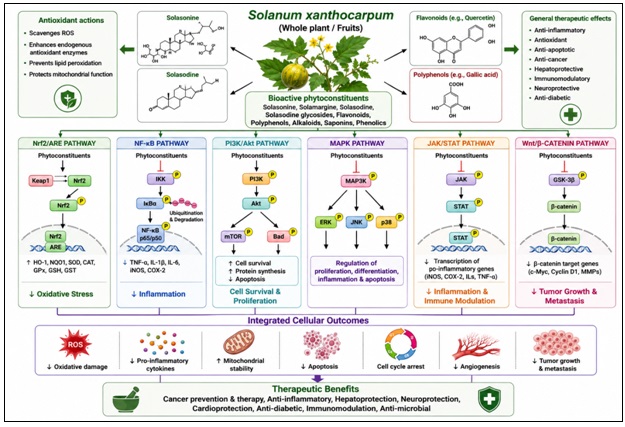
FIG. 2: INTEGRATED SYSTEMS PHARMACOLOGY MODEL ILLUSTRATING THE PROPOSED THERAPEUTIC MECHANISMS OF SOLANUM XANTHOCARPUM. SOLID ARROWS INDICATE MOLECULAR INTERACTIONS AND SIGNALING MECHANISMS SUPPORTED BY EXPERIMENTAL EVIDENCE (CELLULAR AND/OR ANIMAL STUDIES), WHEREAS DASHED ARROWS INDICATE PATHWAYS PROPOSED PRIMARILY FROM NETWORK PHARMACOLOGY, MOLECULAR DOCKING, MOLECULAR DYNAMICS SIMULATIONS, OR LITERATURE-DERIVED INFERENCE. THE MODEL INTEGRATES PHYTOCHEMICALS, MOLECULAR TARGETS, SIGNALING PATHWAYS, BIOLOGICAL PROCESSES, AND PHARMACOLOGICAL OUTCOMES TO PROVIDE A CONCEPTUAL OVERVIEW OF THE MULTITARGET ACTIONS OF S. XANTHOCARPUM. THIS FIGURE IS AN ORIGINAL ILLUSTRATION PREPARED BY THE AUTHORS BASED ON EVIDENCE SYNTHESIZED FROM THE CITED LITERATURE AND SHOULD BE INTERPRETED AS A HYPOTHESIS-DRIVEN FRAMEWORK RATHER THAN A VALIDATED SIGNALING NETWORK
Preparation Method: This conceptual illustration was created by the authors using AI tool based on a narrative synthesis of the cited literature. No single published figure was reproduced. Relationships shown reflect varying levels of evidence, including experimentally validated mechanisms and computationally predicted interactions, as indicated in the figure legend.
Translational Potential and Drug Development Perspectives: The growing body of experimental and computational evidence suggests that Solanum xanthocarpum possesses considerable potential as a multitarget phytotherapeutic agent 1, 30, 32, 33. However, successful clinical translation requires addressing several scientific, pharmaceutical, and regulatory challenges beyond demonstration of pharmacological activity.
A major obstacle is extract standardization. The phytochemical composition of S. xanthocarpum varies according to geographical origin, plant part, harvesting season, cultivation conditions, and extraction method, resulting in substantial batch-to-batch variability. Such variability may influence biological activity and reproducibility. Future product development should therefore employ standardized extracts with predefined specifications for marker compounds such as solasodine, solamargine, solasonine, quercetin, or other well-characterized bioactive constituents. Comprehensive phytochemical fingerprinting using validated analytical techniques should accompany quality control throughout manufacturing.
Another important limitation is the limited understanding of the pharmacokinetic properties of the major phytochemicals. Although computational ADME prediction suggests acceptable drug-likeness for several constituents, experimental data describing absorption, oral bioavailability, plasma protein binding, metabolism, tissue distribution, elimination, and metabolic stability remain scarce.
Such information is essential for determining systemic exposure, therapeutic dosing, and target engagement in-vivo. Future investigations should include pharmacokinetic profiling and pharmacokinetic pharmacodynamic (PK–PD) analyses using standardized formulations.
The bioavailability of several polyphenolic constituents may also limit clinical efficacy. Poor aqueous solubility, limited intestinal absorption, extensive first-pass metabolism, and rapid elimination can reduce exposure following oral administration.
Pharmaceutical strategies such as nanoformulations, lipid-based delivery systems, phytosomes, polymeric nanoparticles, solid dispersions, or other advanced drug-delivery approaches may improve stability and systemic availability, although these approaches require experimental validation for S. xanthocarpum preparations.
Potential herb drug interactions represent another important consideration for future clinical use. Because multiple phytochemicals may influence drug-metabolizing enzymes or membrane transporters, concomitant administration with conventional medicines could alter drug exposure or pharmacological responses. Dedicated in vitro and in-vivo interaction studies are therefore required before widespread therapeutic application.
Current knowledge regarding toxicity and long-term safety also remains limited. Although several experimental studies have reported acceptable acute toxicity at investigated doses, systematic subacute, chronic, reproductive, developmental, genotoxicity, carcinogenicity, and safety pharmacology studies are insufficient.
Standardized toxicological evaluation should therefore accompany future efficacy investigations to establish an appropriate safety profile. Selection of a clinically relevant dose remains challenging because published studies employ diverse plant parts, extraction procedures, phytochemical compositions, treatment durations, and dosing regimens. These methodological differences limit direct comparison between studies and complicate translation to human dosing. Dose optimization should be supported by standardized extracts, pharmacokinetic studies, exposure–response relationships, and mechanistic biomarkers.
From a pharmaceutical perspective, future work should also prioritize formulation development, including optimization of stability, shelf life, manufacturing reproducibility, and scalable production under Good Manufacturing Practice (GMP) conditions. Standardized dosage forms with consistent phytochemical composition are essential for reproducible preclinical and clinical evaluation.
Progress toward clinical application will additionally require compliance with applicable regulatory requirements, including validated botanical identification, quality specifications, contaminant testing, phytochemical standardization, non-clinical safety assessment, and well-designed clinical trials conducted according to internationally accepted guidelines.
Regulatory expectations differ across jurisdictions, but all require robust evidence of quality, safety, and efficacy before therapeutic approval.
Finally, the absence or very limited availability of human clinical evidence represents the greatest barrier to translation. Most therapeutic claims summarized in this review are supported by in-vitro experiments, animal studies, or computational analyses, whereas high-quality randomized clinical trials evaluating standardized S. xanthocarpum preparations are largely lacking.
Consequently, current evidence supports the plant as a promising candidate for further investigation rather than as an established clinical therapy. Future research should integrate standardized phytochemistry, mechanistic pharmacology, pharmacokinetics, formulation science, toxicology, and adequately powered clinical studies to determine whether the encouraging preclinical findings translate into safe and effective therapeutic interventions.
TABLE 6: TRANSLATIONAL CHALLENGES AND FUTURE PRIORITIES FOR SOLANUM XANTHOCARPUM
| Challenge | Current Status | Research Priority |
| Extract standardization | Variable phytochemical composition | Develop standardized extracts using validated marker compounds |
| Marker compounds | Not uniformly established | Quantify solasodine, solamargine, solasonine, quercetin, and other validated markers |
| Pharmacokinetics | Limited experimental data | Conduct comprehensive ADME and PK–PD studies |
| Bioavailability | Largely unknown | Evaluate advanced delivery systems and formulation strategies |
| Herb–drug interactions | Poorly investigated | Assess CYP enzymes, transporters, and pharmacodynamic interactions |
| Toxicity | Mainly acute toxicity studies | Perform chronic, reproductive, and genotoxicity assessments |
| Dose optimization | Heterogeneous experimental doses | Establish evidence-based dose–response relationships |
| Batch variability | Significant | Implement GMP production and robust quality control |
| Formulation development | Limited | Develop stable, standardized pharmaceutical dosage forms |
| Regulatory pathway | Incomplete | Generate quality, safety, and efficacy data consistent with regulatory expectations |
| Clinical evidence | Very limited or absent | Conduct well-designed Phase I–III clinical trials |
CONCLUSION: Solanum xanthocarpum has a long history of use in traditional medicine for the management of respiratory, inflammatory, hepatic, gastrointestinal, and metabolic disorders. Experimental studies provide evidence that extracts and several phytochemicals, including solasodine, solamargine, solasonine, quercetin, apigenin, and lupeol, possess antioxidant, anti-inflammatory, hepatoprotective, immunomodulatory, antidiabetic, and anticancer activities in cellular and animal models. These findings support the pharmacological potential of the plant but remain largely preclinical.
Recent systems pharmacology, network pharmacology, molecular docking, and molecular dynamics studies have proposed additional molecular targets and signaling pathways, including PI3K/Akt, JAK/STAT, HIF-1, VEGFA, and NF-κB. However, these computational approaches primarily generate mechanistic hypotheses and should not be considered evidence of therapeutic efficacy without experimental confirmation. Despite encouraging preclinical findings, important gaps remain in extract standardization, marker compound characterization, pharmacokinetic profiling, bioavailability, long-term toxicity evaluation, herb–drug interaction assessment, dose optimization, and well-designed human clinical trials. Consequently, S. xanthocarpum should currently be regarded as a promising source of bioactive compounds for future investigation rather than an established phytopharmaceutical. Progress toward clinical application will depend on rigorous phytochemical standardization, mechanistic validation, comprehensive safety assessment, and high-quality clinical studies to confirm its efficacy and safety in humans.
ACKNOWLEDGEMENTS: The authors thank the Management and Principal of Sree Abirami College of Pharmacy, Coimbatore, Tamil Nadu, India, for providing the facilities and academic support necessary for preparing this review.
Author Contributions:
Conceptualization: Mohamed Fiaz A, Rajesh C
Literature Search and Data Collection: Rajesh C, Mohamed Althaf A, Hariprasitha S, Yazhmozhi M.
Data Analysis and Interpretation: Mohamed Fiaz A, P. Srinivasan, Suhel Y
Manuscript Drafting: Rajesh C, Mohamed Fiaz A
Critical Revision of the Manuscript: P. Srinivasan, Dhachinamoorthi D.
Supervision: P. Srinivasan
All authors read, critically revised, and approved the final version of the manuscript and agree to be accountable for all aspects of the work.
Funding: This research received no specific grant from any funding agency in the public, commercial, or not-for-profit sectors.
Use of Artificial Intelligence: During the preparation of this manuscript, the authors used Open AI; GPT-5.5 solely to assist with language editing, including improvements in grammar, sentence structure, clarity, and readability. All scientific content, interpretation, and conclusions were developed, reviewed, and verified by the authors, who take full responsibility for the final manuscript.
CONFLICT OF INTEREST: The authors declare that they have no known competing financial interests or personal relationships that could have appeared to influence the work reported in this manuscript.
REFERENCES:
- Atanasov AG, Zotchev SB, Dirsch VM and Supuran CT: Natural products in drug discovery: advances and opportunities. Nature Reviews Drug Discovery 2021; 20(3): 200–216. doi:10.1038/s41573-020-00114-z.
- Sharma A: Systems pharmacology approaches in herbal medicine research. Frontiers in Pharmacology 2023.
- Hopkins AL: Network pharmacology: the next paradigm in drug discovery. Nature Chemical Biology 2008; 4(11): 682–690. doi:10.1038/nchembio.118.
- Pandiyan M, Jeyasri RJ, Varadharajan VV, Natarajan S and Balakrishnan A: Network pharmacology: an efficient but underutilized approach in oral, head and neck cancer therapy: a review. Frontiers in Pharmacology 2024; 15: 1362206. doi:10.3389/fphar.2024.1362206.
- Liu Y, Yang R and Zou HD: Phenolic components from the fruits of Solanum xanthocarpum with anti-inflammatory activity. Natural Product Research 2024; 38(6): 1007–1015.
- Jain NK, Anand S, Kesari P, Rani R, Kumar S and Tiwari A: Unveiling the phytochemical profile and therapeutic benefits of Solanum xanthocarpum: a systematic review. Pharmacognosy Research 2025; 17(2): 440–451. doi:10.5530/pres.20252059.
- Ojha M, Manocha N and Madaan A: Anti-psoriatic potential of medicinal plants, Alstonia scholaris, Wrightia tinctoria, and Solanum xanthocarpum using human HaCaT keratinocytes by multiparametric analysis. Journal of Ethnopharmacology 2024; 334: 118596.
- Sahu N, Madan S and Walia R: Multi-target mechanism of Solanum xanthocarpum for treatment of psoriasis based on network pharmacology and molecular docking. Saudi Pharmaceutical Journal 2023; 31(11): 101788.
- Hassanein EHM, Althagafy HS and Baraka MA: The promising antioxidant effects of lignans: Nrf2 activation comes into view. Naunyn-Schmiedeberg's Archives of Pharmacology 2024; 397: 6439–6458.
- Sahu N, Tyagi R and Kumar N: Forecasting the pharmacological mechanisms of Plumbago zeylanica and Solanum xanthocarpum in diabetic retinopathy treatment: a network pharmacology, molecular docking, and molecular dynamics simulation study. Biology 2024; 13(9): 732.
- Vithalkar MP, Patil SS, Deshmukh RR and Kulkarni VS: Targeting pulmonary fibrosis through Solanum xanthocarpum phytochemicals: a synergistic network pharmacology and docking investigation. Computers in Biology and Medicine 2026; 188: 110102.
- Kumar S and Pandey AK: Chemistry and biological activities of flavonoids: an overview. The Scientific World Journal 2013; 2013: 162750. doi:10.1155/2013/162750.
- Bairwa K, Kumar R, Sharma RJ and Roy RK: An updated review on Solanum xanthocarpum Schrad. & Wendl.: phytochemistry, pharmacology and traditional uses. International Journal of Pharmaceutical Sciences Review and Research 2010; 1(1): 1–11.
- Gupta A, Sharma AK, Dobhal MP, Sharma MC and Gupta RS: Antidiabetic and antioxidant potential of Solanum xanthocarpum extracts in experimental models. Journal of Ethnopharmacology 2011; 135(2): 445–452.
- Srinivasan K: Antioxidant potential of spices and medicinal plants: relevance to preventive medicine. Food Reviews International 2014; 30(4): 337–365.
- Reuter S, Gupta SC, Chaturvedi MM and Aggarwal BB: Oxidative stress, inflammation, and cancer: how are they linked? Free Radical Biology and Medicine 2010; 49(11): 1603–1616. doi:10.1016/j.freeradbiomed.2010.09.006.
- Ma Q: Role of Nrf2 in oxidative stress and toxicity. Annual Review of Pharmacology and Toxicology 2013; 53: 401–426. doi:10.1146/annurev-pharmtox-011112-140320.
- Saleem M: Lupeol, a novel anti-inflammatory and anticancer dietary triterpene. Cancer Lett 2009; 285(2): 109-115.
- Middleton E, Kandaswami C and Theoharides TC: The effects of plant flavonoids on mammalian cells: implications for inflammation, heart disease and cancer. Pharmacol Rev 2000; 52(4): 673-751.
- Tundis R, Loizzo MR and Menichini F: Natural products as α-amylase and α-glucosidase inhibitors and their role in diabetes management. Mini Rev Med Chem 2010; 10(4): 315-331.
- Newman DJ and Cragg GM: Natural products as sources of new drugs over the last 40 years. J Nat Prod 2020; 83(3): 770-803.
- Kirtikar KR and Basu BD: Indian Medicinal Plants. 2nd ed. Dehradun: International Book Distributors 2006; 1760-1764.
- Nadkarni KM: Indian Materia Medica Vol. 1. 3rd ed. Mumbai: Popular Prakashan Pvt. Ltd.; 2009; 1158-1162.
- Li S and Zhang B: Traditional Chinese medicine network pharmacology: theory, methodology and application. Chin J Nat Med 2013; 11(2): 110-120. doi:10.1016/S1875-5364(13)60037-0.
- Bairwa K, Kumar R, Sharma RJ and Roy RK: An updated review on Solanum xanthocarpum Schrad. & Wendl.: phytochemistry, pharmacology and traditional uses. Int J Pharm Sci Rev Res 2010; 1(1): 1-9.
- Reuter S, Gupta SC, Chaturvedi MM and Aggarwal BB: Oxidative stress, inflammation, and cancer: how are they linked? Free Radic Biol Med 2010; 49(11): 1603-1616. doi:10.1016/j.freeradbiomed.2010.09.006.
- Aggarwal BB and Harikumar KB: Potential therapeutic effects of curcumin, an anti-inflammatory agent. Int J Biochem Cell Biol 2009; 41(1): 40-59. doi:10.1016/j.biocel.2008.06.010.
- Hanahan D: Hallmarks of cancer: new dimensions. Cancer Discov 2022; 12(1): 31-46. doi:10.1158/2159-8290.CD-21-1059.
- Wishart DS, Feunang YD, Guo AC, Lo EJ, Marcu A and Grant JR: DrugBank 5.0: a major update to the DrugBank database for 2018. Nucleic Acids Res 2018; 46(1): 1074-1082.
- Ekor M: The growing use of herbal medicines: issues relating to adverse reactions and challenges in monitoring safety. Front Pharmacol 2014; 4: 177.
- Fabricant DS and Farnsworth NR: The value of plants used in traditional medicine for drug discovery. Environ Health Perspect 2001; 109(1): 69-75.
- Cragg GM and Newman DJ: Natural products: a continuing source of novel drug leads. Biochim Biophys Acta Gen Subj 2013; 1830(6): 3670-3695.
- Pan SY, Litscher G and Gao SH: Historical perspective of traditional indigenous medical practices: the current renaissance and conservation of herbal resources. Evid Based Complement Alternat Med 2014; 2014: 525340.
- Sharma P, Saini S and Hasanpuri P: Ethnopharmacologically important highly subsidized Indian medicinal plants: systematic review on their traditional uses, phytochemistry, pharmacology, quality control, conservation status and future prospective. J Ethnopharmacol 2024; 320: 117385.
- Patel N, Mishra R and Rajput D: A comprehensive review of the phytochemistry, pharmacology, pharmacokinetics, and green nanotechnological significance of Boerhavia diffusa Linn. Fitoterapia 2025; 106599.
How to cite this article:
Rajesh C, Althaf AM, Hariprasitha S, Yazhmozhi M, Fiaz AM, Srinivasan P, Suhel Y and Dhachinamoorthi D: A systems pharmacology perspective on Solanum xanthocarpum: integrating phytochemicals, molecular targets, signaling pathways and therapeutic applications. Int J Pharm Sci & Res 2026; 17(11): 3353-66. doi: 10.13040/IJPSR.0975-8232.17(11).3353-66.
All © 2026 are reserved by International Journal of Pharmaceutical Sciences and Research. This Journal licensed under a Creative Commons Attribution-NonCommercial-ShareAlike 3.0 Unported License.
Article Information
7
3353-3366
1223 KB
7
English
IJPSR
C. Rajesh, A. Mohamed Althaf, S. Hariprasitha, M. Yazhmozhi, A. Mohamed Fiaz *, P. Srinivasan, Y. Suhel and D. Dhachinamoorthi
Department of Pharmacology, Sree Abirami College of Pharmacy, Coimbatore, Tamil Nadu, India.
fiaz0306raheem@gmail.com
09 July 2026
06 August 2026
22 October 2026
10.13040/IJPSR.0975-8232.17(11).3353-66
01 November 2026
 Download