




DEVELOPMENT AND VALIDATION OF A GREEN STABILITY-INDICATING RP-HPLC METHOD FOR VONOPRAZAN FUMARATE WITH AGREE-BASED GREENNESS ASSESSMENT
HTML Full TextDEVELOPMENT AND VALIDATION OF A GREEN STABILITY-INDICATING RP-HPLC METHOD FOR VONOPRAZAN FUMARATE WITH AGREE-BASED GREENNESS ASSESSMENT
Prerana Bendgude *, Shrikrishna Baokar and Rajendra N. Patil
Department of Pharmaceutical Chemistry, Delonix Society’s Baramati College of Pharmacy, Barhanpur, Tal Baramati, Pune, Maharashtra, India.
ABSTRACT: Aim: The present study aimed to develop and validate a simple, rapid, accurate, precise, stability-indicating, and environmentally friendly RP-HPLC method for the quantitative estimation of Vonoprazan Fumarate (VPZ) in pharmaceutical dosage forms and to evaluate its greenness using AGREE-based assessment tools. Study Design: Experimental analytical method development and validation study based on ICH guidelines. Place and Duration of Study: Department of Pharmaceutical Chemistry and Department of Pharmaceutical Analysis, Delonix Society’s Baramati College of Pharmacy, Maharashtra, India. The study was carried out during the academic research period of 2025–2026. Methodology: Chromatographic separation was performed on C18 column (250 × 4.6 mm, 5 µm) with an isocratic mobile phase of methanol and aqueous phase containing 1% HCl (70:30 v/v) at a flow rate of 1.0 mL/min. Detection was carried out at 268 nm. The developed method was validated for specificity, linearity, accuracy, precision, robustness, ruggedness, limit of detection (LOD) and limit of quantification (LOQ) as per ICH requirements. Forced degradation studies were performed under acid, base, oxidative, thermal and photolytic stress conditions to assess the method’s ability to indicate stability. AGREE and AGREEprep metrics were used to assess greenness. Results: The technique showed a clear symmetric peak at about 3.3 min retention time. The method showed good linearity over the concentration range of 5–25 µg/mL with a correlation coefficient (r2) of 0.9991. The recoveries were in the range 98% to 102% as per accuracy surveys. %RSD readings for intra-day and inter-day precision were 0.63% and 0.98%, respectively. The results revealed that the LOD and LOQ were 1.58µg/mL and 5.220 µg/mL, respectively. Robustness and ruggedness studies gave acceptable values of %RSD below 2%. The specificity and stability-indicating nature of the method was proved by forced degradation studies. The greenness assessment results were 0.73 and 0.62 for AGREE and AGREEprep, respectively. Conclusion: The developed RP-HPLC method is simple, precise, accurate, stability-indicating, and environmentally sustainable, making it suitable for routine quality control analysis of Vonoprazan Fumarate in pharmaceutical formulations.
Keywords: RP-HPLC, Vonoprazan fumarate, Method development and validation, Forced degradation, Green analytical chemistry
INTRODUCTION: The development and validation of analytical procedures are essential to the advancement of pharmaceutical research and the assurance of the effectiveness, safety, and quality of therapeutic medicines 1.
Vonoprazan, a potassium competitive acid blocker, represents a significant advancement in treating acid-related conditions, serving as a viable alternative to the most effective proton pump inhibitors.
Its effectiveness in treating Helicobacter pylori infection, peptic ulcer disease, and gastroesophageal reflux illness is well-documented 2. A more potent inhibitor of acid secretion is vonoprazan. It starts working quickly, has less anti-secretory variability, is safer, and is more tolerable 3-4. Eighty percent of the protein binding is inactivated through liver metabolites, primarily by (CYP) 3A4, and passed out through urine (67%) and feces (31%). Vonoprazan has a half-life of 7.1 hrs. It is consumed orally. It is used to treat erosive oesophagitis, duodenal ulcers, and stomach ulcers 5. When compared to proton pump inhibitors, which necessitate several dose schedules to produce comparable therapeutic results, vonoprazan's quick and sustained acid suppression offers a substantial advantage 6.
RP-HPLC, or reverse-phase high-performance liquid chromatography, is a popular analytical way because of its excellent resolution, repeatability, and sensitivity 7. Vonoprazan is often formulated as VPZ, a modification that substantially enhances its stability and solubility characteristics. The formulation's components, including the solubilizing agent, buffering agent, pH-modulating agent, and solvent, collectively contribute to the drug's improved solubility and prolonged stability throughout its shelf life 8. Currently, VPZ lacks formal recognition in any established pharmacopoeia. This underscores the critical need for a transparent and efficient high-performance liquid chromatography (HPLC) method to evaluate its quality and safety profile. Given its high sensitivity and capacity to manage complex mixtures, reversed-phase HPLC (RPHPLC) is employed for this purpose. By providing accurate and reliable results, and being accepted by regulatory agencies, this method ensures the sustained safety and effectiveness of pharmaceutical products 9.
Over the length of the pharmaceutical product's lifecycle, each of these elements ensures the method's reliability and consistency. In recent years, the use of Design of Experiments (DoE) and Quality by Design (QbD) approaches has increased in method development, with the goal of improving understanding and control of methods 10. Furthermore, regulatory bodies like the US FDA and EMA strongly recommend using stability-indicating assays to assess the integrity of active pharmaceutical ingredients (APIs) in their formulations during the drug approval process 11. The idea of "green analytical chemistry" (GAC) forces analytical chemists to take safety, health, and environmental concerns into account.
The greenness of Analytical processes is a complex, multivariate parameter that is difficult to measure 12-13.
MATERIALS AND METHODS:
Material: Vonoprazan fumarate API gifted by Cipla ltd., Vocab tablet 10mg, HPLC grade methanol, HPLC grade water, HCL.
Instruments: Double beam UV-vis Spectrophotometer (Shimadzu 1900i), HPLC System (JASCO), Sonicator (LABQUEST BY BOROSIL), Weighing balance (WENSAR), pH meter(AE MAX), Vaccume filter (BORO 017), UV chamber, Hot air oven (REMI).
Method Development:
Preparation of Mobile Phase: The mobile phase was a mixture of methanol and aqueous phase of 1% hydrochloric acid in the ratio of 70:30 (v/v). The aqueous phase was prepared by adding 0.1mL of hydrochloric acid to 500 mL of purified water and mixed well. The individual mobile phase components were filtered through a 0.45µ m membrane filter and degassed by sonication for 15 minutes before their use. The prepared mobile phase was mixed in the required proportion, equilibrated with the chromatographic system and used for analysis. Fresh mobile phase was prepared every day to ensure consistent chromatographic performance.
Preparation of Standard Stock Solution: 25 mg of pure med (VPZ) was weighed exactly and transferred into a 25 mL volumetric flask. It was sonicated for 5-10 minutes to dissolve in methanol: water (pH 3) then diluted to the volume to prepare stock solution of 1000 μg/mL and filtered through Whatman paper or 0.45 μm membrane filter.
Preparation of Sample Solution: Accurately weigh 10 mg of API and dissolve in 100 mL volumetric flask in methanol: water (70:30, pH 3). Sonicate for 15–20 min, cool and dilute to volume, filter through 0.45 µm filter and then dilute to 5–25 µg/mL for RP-HPLC analysis.
Selection of Detection Wavelength: The detection wavelength was determined by scanning a diluted standard solution across the ultraviolet spectrum, specifically from 200 to 400 nm. The wavelength of 268 nm was carefully chosen for subsequent analysis, as it exhibited the highest absorbance λmax, demonstrating both exceptional sensitivity and accuracy 14.
Selection of Mobile Phase and Chromatographic Conditions: The chromatographic conditions were optimized for the column, mobile phase, pH and flow rate for better resolution. The C18 column with methanol: water (1% HCl, 70:30 v/v, pH 3) resulted in a sharp and symmetric peak. Detection at 268 nm provided a good sensitivity and the method was found to be reproducible and system suitable for routine analysis of RP-HPLC 15.
Optimization of Mobile Phase: During method development, various chromatographic parameters such as column type, flow rate, wavelength and pH were optimized.
A C18 column, flow rate of 1.0 mL/min, detection wavelength of 268 nm and mobile phase pH 3 (adjusted with 1% HCl) provided sharp symmetrical peak with acceptable retention time and good chromatographic performance. Thus, these conditions were selected for further validation studies.
TABLE 1: OPTIMIZED PARAMETERS
| Sr. no. | Mobile phase | Ratio | RT | Peak shape | Observation |
| 1 | Methanol: Water (1%HCL) | 75:25 | Very low | distorted | Very fast elute poor peak resolution, slight peak distortion |
| 2 | 60:40 | Moderate | Slightly asymmetric | Improved peak shape but inadequate resolution and symmetry | |
| 3 | 50:50 | high | symmetric | Better peak symmetry but increased retention time and broadening | |
| 4 | 70:30 | 3.3 | Sharp and symmetric | Sharp, well defined symmetric peak with good resolution and acceptable retention time |
Method Validation:
Specificity: We tested the RPHPLC method's specificity by injecting blank, placebo, std, and trial solutions. There was no interfering at the analyte's rt, and the peak purity was within acceptable limits. This shows that the method is specific and can accurately measure the drug even when other substances are present 16.
Linearity: The linearity of the RPHPLC method was tested with the range of 5–25 μg/mL of standard solutions by triplicate injection. The calibration curve of concentration versus mean peak area was found to be highly linear with r2 value close to 1, indicates the method is suitable for accurate quantifications 17-18.
Range: The current method determined the range to be 5 to 25 µg/mL, as the drug exhibited satisfactory linearity, stable peak area response, and acceptable system suitability parameters within this concentration range. The method showed both precision and accuracy across the entire range of values, demonstrating its usefulness for routine quantitative analysis of the drug 19.
Precision: Precision, which indicates the consistency and agreement of results obtained from repeated evaluations of the same sample, is expressed as %RSD. This encompasses repeatability, intermediate precision, and duplicability, as outlined by ICH guidelines. In the context of RP-HPLC, precision is evaluated through multiple injections a %RSD value under 2% suggests confirming the precision of the method and its suitability for routine use.
Intraday Precision: The precision within a single day was assessed by making six identical injections of a 20 µg/mL standard solution on the same day. The %RSD of the peak areas remained below 2%, thereby demonstrating the method's commendable repeatability and consistency.
Interday Precision: Inter-day precision was assessed through the examination of six replicate injections of a 20 µg/mL standard solution, conducted across three successive days. The relative standard deviation (%RSD) values obtained each day remained below 2%, demonstrating the method's good reproducibility and reliability 20.
Accuracy: Accuracy was evaluated by recovery studies at 80%, 100%, and 120% levels. The % recovery was within 98–102% with %RSD less than 2%, establishing the method’s accuracy and reliabilitywithout interference from other components 21.
System Suitability: Following the attainment of system equilibrium, a std solution, exhibiting a absorption of 20 µg/mL, was formulated and afterward subjected to analysis. A total of six injections were performed, and both the retention time and peak area were meticulously documented. The system's reliability was confirmed, as evidenced by a %RSD of 2% or less. These findings, in conjunction with the observed values for theoretical plates and the tailing factor, further substantiated the system's proper functionality.
Limit of Detection: Following the system's equilibration, three injections of a 10 µg/mL solution were made. The analyte showed a consistent response, with a signal-to-noise ratio of about 3:1. This confirmed the method's sensitivity and helped to establish the limit of detection. The 10 µg/mL solution, injected three times, consistently produced a noise to signal ratio of about 1:3. This confirmed the limit of detection.
Limit of Quantification: After the solution had reached equilibrium, three injections of 10 µg/mL were made. The %RSD was within limits, and the signal-to-noise ratio was about 10:1, which confirmed the limit of quantification (LOQ).
Robustness: The method's robustness was assessed through minor alterations to the flow rate (0.8 mL/min), the wavelength (265 nm), and the mobile phase creation (72:28). A 20 µg/mL solution was analyzed in triplicate under each set of conditions. The results demonstrated no significant deviations, and the %RSD values remained within suitable thresholds, thereby confirming the method's reliability and consistent performance.
Ruggedness: Ruggedness was assessed by examining a 20 µg/mL solution across various parameters, including different analysts, days, and instruments. The %RSD values fell within acceptable ranges, thus suggesting the method's reproducibility and consistency under typical variations.
Assay of Marketed Formulation: Twenty tablets of Vocab® tablets containing 10 mg of Vonoprazan Fumarate were weighed and powdered finely. A quantity of powder equivalent to 10 mg of Vonoprazan Fumarate was weighed accurately and transferred to a 100 mL volumetric flask. About 70 mL of mobile phase was added and sonicated for 15 min to ensure complete extraction of the drug. The volume was made up to the mark with the mobile phase and filtered through 0.45 μm membrane filter. An appropriate dilution was made using mobile phase to get a concentration within the linearity range. The resulting solution was injected into the RP-HPLC system under optimized chromatographic conditions and the chromatograms were recorded.
Stability Indicating Study 22-23: Stability-indicating methods (SIMs) are analytical techniques designed to identify and quantify degradation products, impurities and the active pharmaceutical ingredient (API) within drug substances or products, while avoiding interference. These methods ensure the safety, efficacy, and quality of pharmaceuticals throughout their shelf life by isolating the API from excipients, process-related impurities, and potential degradants under stress conditions, including heat, light, acid, base, or oxidation.
Acid Degradation: 1 mL of stock solution was added to the solvent and 0.1 N HCl and kept for 15 min then neutralized with 0.1 N NaOH and diluted to 10 mL. After filtration, analysis by RP-HPLC showed significant degradation by additional peaks and decreased peak area at ~3.3 min.
Base Degradation: One millilitre of the standard stock solution, three millilitres of solvent and one millilitre of 0.1 N NaOH were combined. The mixture was then allowed to stand for fifteen minutes at room temperature. The solution was then neutralised with the addition of 1 mL of 0.1 N HCl and diluted to a final volume of 10 mL. It was analysed by RP-HPLC after filtration. The data showed a significant decrease with more peaks and a smaller peak area at about 3.3 minutes of retention time.
Oxidative Degradation: Oxidative degradation was performed by mixing 1 mL of the standard stock solution with 3 mL of a solvent and 1 mL of 3% hydrogen peroxide. This mixture was then kept at room temperature for 15 minutes. The volume was made up to 10 mL, filtered, and analyzed by RP-HPLC. The results showed a moderate amount of breakdown, with some small extra peaks and a slight decrease in the peak area around a retention time of about 3.3 minutes.
Thermal Degradation: Thermal degradation of the drug sample was achieved by subjecting it to 110°C for a duration of three hours within a hot air oven. Following cooling, the sample underwent dissolution, dilution, filtration and subsequent analysis via RP-HPLC. The analytical outcomes indicated a degree of degradation, characterized by the emergence of minor additional peaks and a slight reduction in peak area, specifically at an approximate retention time of 3.3 minutes.
Method Greenness Evaluation 24-25: The environmental effect of the new method was assessed using the 12 principles of green chemistry. Specifically, the GAPI, analytical eco-scale, and AGREE tools were used for this evaluation.
The method used a Methanol and water (1%HCL) as the mobile phase, requiring 25mL of methanol for each injection water and Methanol served as the solvents. During sample preparation, a total of 60 mL of methanol was utilized as a solvent. Penalty points were calculated for each reagent, solvent and instrument in the analytical eco-scale evaluation. Furthermore, the AGREE and GAPI tools were employed to evaluate the toxicity of the solvents, instruments, and sample preparation techniques, utilizing a color-coded pictogram to represent greenness levels, ranging from green to red.
RESULTS AND DISCUSSION:
Selection of Detection Wavelength: It was noted that each drug demonstrated appreciable absorbance at 268 nm.
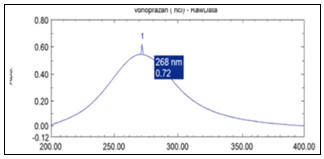
FIG. 1: λMAX OF VPZ268
Chromatogram and System Suitability Parameters of Drug:
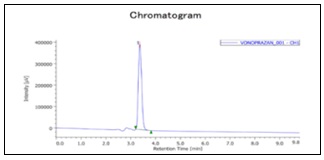
FIG. 2: STANDARD CHROMATOGRAM OF VPZ
Method Validation:
Linearity: These results were then suitably diluted with mobile phase to produce solutions with VPZ concentrations ranging from 5 to 25 µg/ml. Correlation coefficient (r2) for calibration curve of (VPZ) 0.9991.
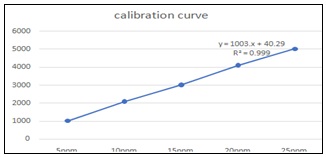
FIG. 3: CALIBRATION CURVE OF VPZ
Accuracy: The result of accuracy shown in Table 2.
TABLE 2: ACCURACY STUDY OF VPZ
| Level | Theoretical conc. (µg/ml) | Area | Practical Conc. (µg/ml) | % Recovery | Average | Std Dev | % RSD | |
| Sample | Std. | |||||||
| 80 % | 10ppm | 8ppm | 1927262 | 7.86 | 98.25 |
1961443 |
31728.54 |
1.61 |
| 1989955 | 8.11 | 101.37 | ||||||
| 1967111 | 8.02 | 100.25 | ||||||
| 100 % | 10ppm | 10ppm | 2161251 | 10.16 | 101.9 |
2127452 |
30068.14 |
1.41 |
| 2103674 | 9.89 | 98.86 | ||||||
| 2117431 | 9.95 | 99.52 | ||||||
| 120 % | 10ppm | 12ppm | 2405252 | 11.89 | 99.13 |
2426320 |
19684.62 |
0.81 |
| 2429467 | 12.02 | 100.13 | ||||||
| 2444241 | 12.09 | 100.74 | ||||||
Precision: Six injections of the std solution were made in order to evaluate precision. The result of precision report in Table 3. % RSD was found to be 0.63% for VPZ
TABLE 3: INTRADAY PRECISION STUDY OF VPZ
| Conc. | No. of replicates | SD | %RSD | |||||
| 1 | 2 | 3 | 4 | 5 | 6 | |||
| 20ppm | 4834997 | 4884718 | 4900364 | 4901969 | 4835668 | 4857790 | 30692.75 | 0.63 |
Interday Precision: The statistics for day 1 interday precision for VPZ is presented in Table 4. % RSD was found to be 0.98% for VPZ.
TABLE 4: INTERDAY PRECISION STUDY OF VPZ
| Conc. | No. of replicates | SD | %RSD | |||||
| 1 | 2 | 3 | 4 | 5 | 6 | |||
| 20ppm | 5261213 | 5150960 | 5302217 | 5366368 | 5353079 | 5363996 | 52223.81 | 0.98 |
Specificity: Specificity in formation shown in Table 5 which indicates that there is no interference from VPZ in sample mixture.
TABLE 5: SPECIFICITY STUDY OF VPZ
| Concentration | Pure Sample peak area | Sample peak area |
| 20µg/ml | 4074456 | 4095647 |
Limit of Detection and Quantification: The LOD for VPZ was confirmed to be 1.58 µg/ml. The LOQ for VPZ was confirmed to be 5.220 µg/ml. The obtained LOD and LOQ results a represented in Table 6.
TABLE 6: LOD AND LOQ STUDY OF VPZ
| Parameters | VPZ |
| Slope | 1003.2 |
| LOD | 1.58 |
| LOQ | 5.220 |
Robustness: The findings of the robustness study are reported in Table 7. The % RSD was noticed to be 0.62-1% for VPZ.
TABLE 7: ROBUSTNESS STUDY OF VPZ
| Sr. no. | Factor | Level | Peak Area*±SD | %RSD |
| 1 | Change in Flow rate ± 0.2 ml/min | 0.8 | 3539132 ± 21983.09 | 0.62 |
| 2 | Variation in Detection Wavelength (nm) ± 2 nm | 265 | 4085935 ± 40630.23 | 1.00 |
| 3 | Alteration in Mobile Phase ratio ± 5% | 72:28 | 3666059 ± 27704.03 | 0.76 |
Ruggedness: The found results for ruggedness are summarized in Table 8. The % RSD was noted to be 0.75-1.20% for VPZ.
TABLE 8: RUGGEDNESS STUDY OF VPZ
| Sr. no. | Factor | Level | Peak Area*±SD | % RSD |
| 1 | Alteration in analyst | Analyst 1 | 3597248 ± 42339.45 | 1.18 |
| Analyst 2 | 3790112 ± 45399.53 | 1.20 | ||
| 2 | Variation in day | Day 1 | 3710923 ± 31018.04 | 0.83% |
| Day 2 | 3614006 ± 27400.81 | 0.75% |
System Suitability:
TABLE 9: SYSTEM SUITABILITY STUDY OF VPZ
| Injection | RT | No. of theoretical plates | Tailing factor |
| 1 | 3.367 | 3445 | 1.11 |
| 2 | 3.358 | 3317 | 1.14 |
| 3 | 3.344 | 3498 | 1.10 |
| 4 | 3.339 | 3486 | 1.12 |
| 5 | 3.321 | 3419 | 1.11 |
| 6 | 3.332 | 3442 | 1.12 |
| Mean | 3.344 | 3434.50 | 1.11 |
| SD | 0.017 | 65.63 | 0.015 |
Assay of Marketed Formulation: (Vocab Tablet 10mg).
TABLE 10: ASSAY STUDY OF VPZ
| Injection | Peak area |
| 1 | 5643280 |
| 2 | 5673889 |
| 3 | 5619472 |
| Mean | 5645547 |
| SD | 27220.5 |
| %RSD | 0.48 |
Stability Indicating Study 26: Stressors such as acidic, basic, thermal, photolytic, and oxidative environments were applied to the medication. A 1 mL sample of the filtered stock solution was transferred to a 10 mL volumetric flask for the forced deterioration investigations. The volume was then adjusted to 10 mL using the appropriate diluent.
The drug demonstrated enhanced degradation when subjected to alkaline conditions. Sample solutions, each at a concentration of 20 μg/mL, were prepared for each stress condition and then exposed to the corresponding stressors.
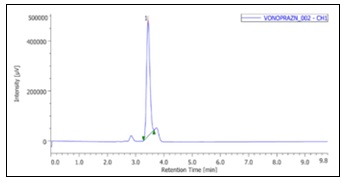
FIG. 4: ACID DEGRADATION
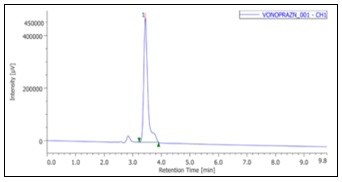
FIG. 5: BASIC DEGRADATION
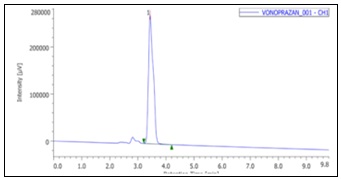
FIG. 6: OXIDATION DEGRADATION
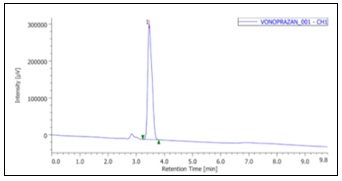
FIG. 7: THERMAL DEGRADATION
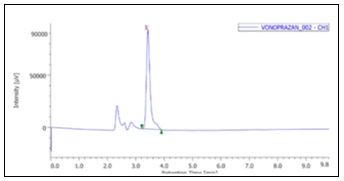
FIG. 8: PHOTOLYTIC DEGRADATION
TABLE 11: DEGRADATION STUDY OF VPZ
| Sr. no. | Degradation Condition | %Degradation |
| 1 | Acidic degradation | 7.16 |
| 2 | Basic degradation | 11.43 |
| 3 | Oxidative degradation | 5.35 |
| 4 | Thermal degradation | 8.78 |
| 5 | Photolytic degradation | 6.59 |
Greenness Analysis: With an AGREE score of 0.73 and AGREEprep score of 0.62, the approach showed moderate greenness, demonstrating a balance between practicality, sustainability, and efficiency for pharmaceutical quality control.
Agree: The sustainability of the analytical methods is evaluated by applying the 12 principles of green analytical chemistry considering waste, energy utilisation and reagent toxicity. The HPLC method developed in this study showed good greenness with excellent analytical performance, including reduced waste generation, energy consumption and solvent consumption as demonstrated by its AGREE score of 0.73 27.
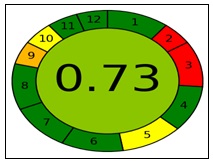
FIG. 9: PICTOGRAM OF AGREE
AGREEPrep: A sustainability metric, employing a 0–1 scale, evaluates ten impact categories, including solvent use, waste generation, energy consumption, and sample size; results are presented as a pictogram. The method under investigation achieved a score of 0.62, thereby recommending both commendable efficiency and economic feasibility. The green pictogram, which emphasizes reduced solvent usage, negligible waste production, and effective source allocation, validates its appropriateness for environmentally conscious routine analysis 28.
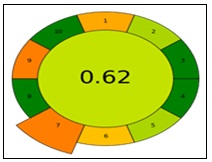
FIG. 10: PICTOGRAM OF AGREEPREP
CONCLUSION: The developed RP-HPLC method for VPZ was simple, rapid, precise and accurate and fulfilled the ICH validation criteria with excellent linearity, sensitivity and specificity. It had short retention time, good peak symmetry and stability-indicating ability in forced degradation studies. The method was also acquired to be good in terms of greenness with lesser solvent consumption and waste generation, thus making it reliable, economical and suitable for routine pharmaceutical analysis.
ACKNOWLEDGEMENT: I would like to express my deep appreciation to my research supervisor for his advice and help in this study. I am also thankful to my department instructors, friends and co-workers for their support and cooperation. I would like to express my sincere gratitude to my family for their constant support which made it possible for me to do this research.
CONFLICTS OF INTEREST: Nil
REFERENCES:
- Baokar S, Patil R and Pandey AN: analytical method development and validation of biguanide, empagliflozin, and linagliptin by RP HPLC. Int J Sci Res Chemi 2024; 9(7): 285-291.
- Vinayagam S, Mittal N and Kaushal J: "Vonoprazan: A Promising Advancement in Proton Pump Inhibitor Therapy." International Journal of Basic & Clinical Pharmacology 2024; 13(4): 573-579.
- Zuberi BF, Ali FS, Rasheed T, Bader N, Hussain SM and Saleem A: Comparison of vonoprazan and amoxicillin dual therapy with standard triple therapy with proton pump inhibitor for helicobacter pylori eradication: A Randomized Control Trial. Pak J Med Sci 2022; 38(4): 965-969.
- Sakurai Y, Shiino M, Okamoto H, Nishimura A, Nakamura K and Hasegawa S: Pharmacokinetics and safety of triple therapy with Vonoprazan, amoxicillin, and clarithromycin or metronidazole: a phase 1, open-label, randomized, crossover study. Advances in Therapy 2016; 33: 1519-35.
- Sampath S and Elavarasan V: RP –HPLC method development & validation for simultaneous estimation of amoxicillin, clarithromycin and vonoprazan in tablets. JETIR 2024; 11(4).
- Zhang M, Xiao Y and Chen M: "The Role of Vonoprazan in Patients with Erosive Esophagitis," Therapeutic Advances in Gastroenterology 2022; 15: 175628482211226.
- Baokar SB, Patil RN and Pandey AN: Bioanalytical method development and validation for the estimation of metformin and empagliflozin in blood plasma by using rp-HPLC, Research J Pharm and Tech 2025; 18(8):
- Ashwinkumar Matta and Raja Sundarajan: Green Analytical Stability Indicating UHPLC Method for the Quantification of Related Impurities in Vonoprazan Formulation Applying Analytical Quality by Design, Separation Science Plus 2025; 8: 70032.
- El-Masry AA & Zeid AM: Nano-scale analytical insights for determination of vonoprazan and aspirin in a recently approved combined preparation utilizing nucleophilic substitution reaction, along with evaluation approaches for both greenness and whiteness. Microchemical Journal 2024; 197: 109788.
- Rao RN & Nagaraju V: An overview of the recent trends in development of HPLC methods for pharmaceutical analysis. Journal of Pharmaceutical and Biomedical Analysis 2006; 44(2): 337–346.
- Armenta S, Garrigues S and de la Guardia M: TrAC, Trends Anal. Chem 2008; 27: 497−511.
- Tobiszewski M, Marc M, Gałuszka A and Namiesnik J: Molecules 2015; 20: 10928−10946.
- Laxman Sawant: Quantitative HPLC Analysis of Ascorbic Acid and Gallic Acid in Phyllanthus emblica. J Anal Bioanal Techniques 2010; 1: 111.
- Yadav Vidushi and Bharkatiya Meenakshi: A review on HPLC method development and validation. RJLBPCS 2017; 170.
- Dhara K. Patel and Mitali Dalwadi: A review on high performance liquid chromatography. International Journal of Pharmaceutical Research and Applications 2023; 8(1): 2531-2536.
- Nikam Pooja, Baokar Shrikrishna, Undare Santosh and Patil RN: Spectrophotometric Method Development and Validation of Prazosin. Res J Science and Tech 2016; 8(1):
- Chandran S & Singh RP: Comparison of various international guidelines for analytical method validation. Die Pharmazie - An International Journal of Pharmaceutical Sciences 2007; 62(1): 4-14.
- Kollipara S, Bende G, Agarwal N, Varshney B & Paliwal J: International Guidelines for Bioanalytical Method Validation: A Comparison and Discussion on Current Scenario. Chromatographia 2011; 73(3–4): 201–217.
- Nirmal AK: Method development and validation by RP-HPLC method. IJARIIE 2025; 11(1):
- González AG & Herrador MÁ: A practical guide to analytical method validation, including measurement uncertainty and accuracy profiles. TrAC Trends in Analytical Chemistry 2007; 26(3): 227-238.
- Nipanikar Madhuri, Shrikrishna Baokar, Undare Santosh and Patil RN: Ultraviolet spectrophotometric method for determination of glipizide in bulk and tablet dosage formulation, Research Journal of Pharmaceutical Dosage Forms and Technology 2016; 8(1):
- Pawar AKM and Sreelatha Gangu: A RP HPLC- PDA Method Development and Validation of Amoxicillin, Vonoprazan Clarithromycin in Bulk and Pharmaceutical Dosage Forms - A Stability Study. Int J Pharm Sci Rev Res ISSN: 0976 – 044X, 2025; 85(1): 101-105.
- Bhukya VN, Beda DP, Gubbiyappa KS and Pathuri R: "Combined green analytical principles and quality by design for ultraperformance liquid chromatography analytical method development, the characterization and in-silico toxicity prediction of ixazomib degradation products using mass spectrometry." Green Analytical Chemistry 2024; 8: 100105.
- Koel M: "Developments in analytical chemistry initiated from green chemistry." Sustainable Chemistry for the Environment 2024; 5: 100078.
- Bhukya VN and Beda DP: "Implementation of green analytical principles to develop and validate the HPLC method for the separation and identification of degradation products of panobinostat, and its characterization by using LC-QTOF-MS/MS and its in-silico toxicity prediction using admet software." Green Analytical Chemistry 2024; 8: 100090.
- International Council for Harmonisation (ICH). (2023). ICH harmonised guideline validation of analytical procedures Q2(R2). Retrieved from www.ich.org.
- Pena-Pereira F, Wojnowski W & Tobiszewski M: AGREE Analytical GREEnness Metric Approach and Software. Analytical Chemistry 2020; 92(14): 10076–10082.
- Wojnowski W, Tobiszewski M. Pena-Pereira F & Psillakis E: AGREEprep – Analytical greenness metric for sample preparation. Trends in Analytical Chemistry 2022; 149: 116553.
How to cite this article:
Bendgude P, Baokar S and Patil RN: Development and validation of a green stability-indicating RP-HPLC method for vonoprazan fumarate with agree-based greenness assessment. Int J Pharm Sci & Res 2026; 17(10): 3070-78. doi: 10.13040/IJPSR.0975-8232.17(10).3070-78
All © 2026 are reserved by International Journal of Pharmaceutical Sciences and Research. This Journal licensed under a Creative Commons Attribution-NonCommercial-ShareAlike 3.0 Unported License.
Article Information
20
3070-3078
756 KB
5
English
IJPSR
Prerana Bendgude *, Shrikrishna Baokar and Rajendra N. Patil
Department of Pharmaceutical Chemistry, Delonix Society’s Baramati College of Pharmacy, Barhanpur, Tal Baramati, Pune, Maharashtra, India.
krishnabaokar@gmail.com
09 June 2026
15 June 2026
20 June 2026
10.13040/IJPSR.0975-8232.17(10).3070-78
01 October 2026
 Download