




EVALUATION OF PRESCRIBING PATTERN OF ANTI-MICROBIAL AGENTS USED IN OPHTHALMOLOGY OUTPATIENT DEPARTMENT AT TERTIARY CARE HOSPITAL
HTML Full TextEVALUATION OF PRESCRIBING PATTERN OF ANTI-MICROBIAL AGENTS USED IN OPHTHALMOLOGY OUTPATIENT DEPARTMENT AT TERTIARY CARE HOSPITAL
S. Srivastava * and A. Yuwnate
Department of Pharmacology, Govt. Medical College, Akola, Maharashtra, India.
ABSTRACT: Introduction: Many antimicrobials have been developed for eye infections in the past years. The purpose of drug utilization studies is to examine the prescribing habits of ophthalmologists in a tertiary care teaching hospital. They are a subset of pharmaco-epidemiological exercise. Aim and Objective: To analyze pattern of antimicrobial drugs at ophthalmology OPD. Method: This was observational study for prescription pattern of outpatient and analyzed over a period of 3 months from June 2025 to August 2025 using a predesigned case record form for each patient. Patient consent and Institutional Ethics Committee approval were obtained. Result: A total of 266 participants were enrolled in the study among them the most common complaint was blurred vision in 92(34.58%) followed by eye watering in 64(24.06%). Most common indication for antimicrobial was infective conjunctivitis in 112 (42.11%). Total number of drugs prescribed was 578 so the average number of drugs per prescription is 2.17. Out of 578 drugs 156(26.99%) were antimicrobials. Fluoroquinolones (FQ) 128(82.05%) out of 156 antimicrobials was maximum prescribed antibacterial, and ciprofloxacin (46.20%) was the most commonly used antibacterial. While lubricant was leading prescribed medicine with 218 (37.72%) out of 578 drugs prescribed Maximum prescribed dosage form was eye drop 356(61.59%) and polypharmacy was seen in 7.51%. No ADRs were reported. Summary: The common prescription errors were minimum with rational use of antimicrobials and there was less evidence of polypharmacy directing towards reducing the development of antibiotic resistance. Conclusion: Periodic auditing of the prescription will help to measure the impact of intervention and in the era of rapidly developing antibiotic resistance, our finding may help to improve the practice of rational drug prescription and patient care.
Keywords: Antimicrobial agents, Drug utilization, Pharmacoepidemiology, Ophthalmology
INTRODUCTION: Drug utilization research, as defined by the World Health Organization (WHO), encompasses the marketing, distribution, prescription, and usage of medications within a society, with a particular focus on the subsequent medical, social, and economic impacts. The indiscriminate use of topical non-steroidal anti-inflammatory drugs, antibiotics, and other medications can lead to various adverse effects, including local irritation damaging the conjunctiva and cornea, and even severe systemic side effects.
Furthermore, microbial susceptibility patterns to antibiotics have significantly changed over the past two to three decades, with increasing resistance to various antibiotic agents by microorganisms causing ocular infections becoming increasingly prevalent 1. To enhance therapeutic effectiveness and reduce the emergence of resistance, it is essential to conduct regular evaluations of drug utilization patterns 2, 3. Periodic auditing of prescribing practices plays a crucial role in promoting the judicious use of medications. Furthermore, the WHO emphasizes the significance of antimicrobial usage as one of the key indicators in assessing drug utilization 4.
To improve prescription quality and identify deficiencies, the World Health Organization (WHO) developed standard drug use indicators in response to rising healthcare costs and irrational drug prescribing 5.
These indicators serve as introspective and critical tools, guiding prescribers to enhance their practices and positively impact patient healthcare delivery, as supported by drug utilization studies and WHO guidelines 6.
Objective: To evaluate the prescribing pattern of antimicrobial agents in ophthalmology OPD patients with respect to indication, drug class distribution, dosage forms, NLEM adherence, generic versus brand prescribing, polypharmacy, and rationality of antimicrobial use.
MATERIAL AND METHOD: This hospital-based, prospective, observational The study was conducted in the Outpatient Department (OPD) of Ophthalmology at the Government Medical College (GMC) in Akola, Maharashtra, India. The investigation was carried out over a three-month period, spanning from June 2025 to August 2025 (For Sample collection, Data analysis & report writing). After the approval of Institutional ethics committee- reference number–125(b)/22/05/2025
Newly registered patient visiting ophthalmology outpatient department for curable complaints were included in the study. Inclusion criteria encompassed all new patients who attended the ophthalmology outpatient department and willingly provided informed consent to participate in the study. This broad inclusion extended to individuals of any gender male, female, or transgender and across all age groups.
Exclusion criteria, on the other hand, were carefully defined to maintain the integrity of the study design. Patients admitted as inpatients were excluded, as their treatment regimens often differ significantly from those in outpatient settings. Emergency cases were also omitted, since their prescriptions are typically influenced by acute clinical needs rather than routine prescribing patterns. Postoperative patients were excluded to avoid confounding factors related to surgical prophylaxis or recovery protocols. Similarly, follow‑up visits were not considered, as they may involve continuation or modification of prior prescriptions rather than new prescribing decisions. Finally, any patient who declined to provide consent was excluded, in keeping with ethical standards and respect for patient autonomy.
Together, these criteria ensured that the study focused specifically on new, outpatient encounters in ophthalmology, providing a clear and unbiased view of antimicrobial prescribing practices in this setting.
Data were recorded in predesigned case record form containing relevant patient information along with the detail of the drugs prescribed. Written, informed and valid consent was obtained. In English, Hindi and regional language (Marathi) from all study participants. Any sort of interference was not done in the management of patient and only the proceedings were observed.
Itching with blurring of vision, cases of red eye with blurring of vision, pain and discharge from eye, swelling, discomfort and foreign body sensation will be included. The data will be collected in the pre designed case record form and will be analyzed and expressed as percentage. Data was analyzed according to the World Health Organization (WHO) indicators.
The evaluation and categorization of antimicrobial treatment will be carried out based on the literature obtained from standard textbooks, National Treatment Guidelines for Antimicrobial Use in Infectious Diseases (2016) and All India Ophthalmological Society guidelines.
RESULT: A total of 266 patients attending the ophthalmology outpatient department of Government Medical College, Akola, were enrolled in the study. Participants represented all age groups and genders; the largest age cohort was 61–70 years (58/266; 21.8%), followed by 51–60 years (44/266; 16.5%). Overall, 155 (58.3%) of the participants were female and 111 (41.7%) were male Table 1, 2.
The most frequent presenting complaint was decreased/blurred vision (92/266; 34.6%), followed by watering of the eye (64/266; 24.1%) and itching (32/266; 12.0%) Table 3.
On clinical evaluation, infective conjunctivitis was the predominant diagnosis, accounting for 112/266 (42.1%) of cases; other common diagnoses included refractive errors (78/266; 29.3%) and cataract (46/266; 17.28%) Table 4.
Antimicrobials were prescribed primarily for infective conjunctivitis but were also issued in a subset of patients with refractive errors and cataract when clinical signs such as redness, watering, itching, or perioperative considerations suggested an associated infective or prophylactic indication.
Across the 266 encounters, clinicians prescribed a total of 578 drug items, yielding a mean of 2.17 drugs per prescription. Of these, 156 (26.99%) were antimicrobial agents. The overall distribution of prescribed drug classes showed that lubricants comprised the largest share (218/578; 37.7%), followed by antimicrobials (156/578; 26.99%), mydriatics (82/578; 14.2%), NSAIDs (56/578; 9.7%), and vitamins (32/578; 5.5%) Table 5, Fig. 1.
Within the antimicrobial group, fluoroquinolones predominated, representing 128/156 (82.05%) of antimicrobial prescriptions. The agent‑wise breakdown of the 156 antimicrobial items was: ciprofloxacin 72/156 (46.2%), moxifloxacin 42/156 (27.0%), amoxiclav 22/156 (14.1%), gatifloxacin 14/156 (9.0%), doxycycline 4/156 (2.6%), and tobramycin 2/156 (1.3%) Fig. 2. Topical therapy was the dominant route of administration: eye drops accounted for 118/156 (75.64%) of all dosage forms, ointments for 12/156 (7.69%), and oral formulations for26/156 (16.67%); the majority of antimicrobials were therefore delivered topically Fig. 3.
Assessment of prescribing quality indicators revealed that 254/578 (43.9%) of drugs were prescribed by generic name while 324/578 (56.1%) were prescribed as brand products. 356/578 (61.6%) of prescribed items were listed in the National List of Essential Medicines (NLEM). Fixed‑dose combinations accounted for 48/578 (8.3%) of items, with 530/578 (91.7%) being single‑agent prescriptions. Polypharmacy, defined in this study as more than five drugs per prescription, was observed in 20/266 (7.5%) of prescriptions. No adverse drug reactions were reported during the study period. Collectively, these results characterize the prescribing profile in a tertiary ophthalmology outpatient setting: a moderate mean number of drugs per encounter, predominant use of topical lubricants and fluoroquinolone antimicrobials (notably ciprofloxacin and moxifloxacin), moderate adherence to NLEM, and a low observed rate of polypharmacy. These findings provide a quantitative baseline to inform targeted interventions aimed at improving guideline concordant antimicrobial use and stewardship.
TABLE 1: AGE DISTRIBUTION OF PATIENTS
| Age | Out of 266 | % |
| <21 | 13 | 4.9 |
| 21-30 | 40 | 15.03 |
| 31-40 | 40 | 15.03 |
| 41-50 | 27 | 10.15 |
| 51-60 | 44 | 16.54 |
| 61-70 | 58 | 21.81 |
| 71-80 | 40 | 15.03 |
| >80 | 4 | 1.51 |
TABLE 2: GENDER DISTRIBUTION OF PATIENTS
| Sex | Out of 266 | % |
| Male | 111 | 41.73 |
| Female | 155 | 58.27 |
TABLE 3: PATTERN OF CHIEF COMPLAINTS OF PATIENTS
| Chief complaints | Out of 266 | % |
| Decrease of vision | 92 | 34.58 |
| Watering of eye | 64 | 24.06 |
| Itching | 32 | 12.03 |
| Redness | 24 | 9.02 |
| Swelling | 16 | 6.02 |
| Trauma | 16 | 6.02 |
| Pain in eye | 14 | 5.26 |
| Foreign body sensation | 8 | 3.01 |
TABLE 4: PATTERN OF FINAL DIAGNOSIS OF PATIENTS
| Diagnosis | Out of 266 | % |
| Infective conjunctivitis | 112 | 42.11 |
| Refractive errors | 78 | 29.32 |
| Cataract | 46 | 17.28 |
| Chalazion | 8 | 3.01 |
| Pseudophakia | 8 | 3.01 |
| Glaucoma | 6 | 2.25 |
| Nasal ptyrigium | 4 | 1.50 |
| Nodular lesion on eye lid | 2 | 0.76 |
| Pthysis bulbi | 2 | 0.76 |
TABLE 5: PATTERN OF PRESCRIBED DRUGS
| Drug class used | Out of 578 drugs | % |
| Antimicrobial | 156 | 26.99 |
| Lubricant | 218 | 37.72 |
| Mydriatics | 82 | 14.18 |
| NSAIDS | 56 | 9.68 |
| Vitamins | 32 | 5.54 |
| Steroids + AMA | 12 | 2.09 |
| Ocular decongestant | 8 | 1.38 |
| Anti glaucoma drugs | 8 | 1.38 |
| Anti HTN | 6 | 1.04 |
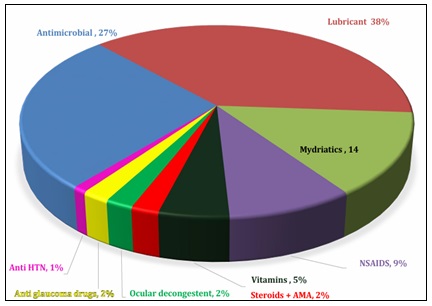
FIG. 1: PATTERN OF PRESCRIBED DRUGS
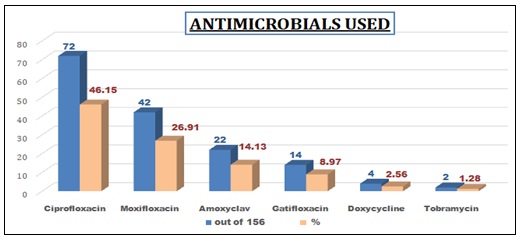
FIG. 2: PATTERN OF AMA PRESCRIBED
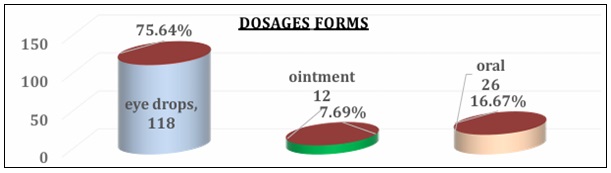
FIG. 3: PATTERN OF DOSAGES FORM FOR PRESCRIBED DRUGS
DISCUSSION: Drug utilization studies are a crucial methodological approach for assessing healthcare facilities and serving as quality indicators. They help identify patterns of drug use, their implications, and outcomes. Additionally, such studies provide data on the availability and utilization of medicines, thereby promoting rational drug use. The present study aims to analyze prescription patterns and conduct a drug utilization review in the ophthalmology department, with the expectation of enhancing the quality of prescriptions issued by physicians
The present study was a prospective, observational study. Study was conducted from June 2025 to August 2025 at Ophthalmology outpatient department at Tertiary care hospital. Total 266 patients were included in this study.
In our study, we found that out of a total of 266 patients, the majority belonged to the 61–70 years age group (58 patients), followed by 51–60 years (44 patients). The 21–30 years and 31–40 years groups each included 40 patients, while the 71–80 years group also had 40 patients. The 41–50 years group comprised 27 patients, whereas ≤20 years accounted for 13 patients, and >80 years had the least (4 patients). In similar study by Sahran D et al 7 (2024) showed that patient identification details were incomplete in 23% of prescriptions, including missing name (1.28%), age (10.88%).
Out of 266 patients, 155 were females and 111 were males, showing a female predominance. Thapa R et al 8 (2019) found that among 900 patients, 47.7% were male and 52.3% female, with an average of 2.43 ± 0.039 medicines per prescription.
Conjunctivitis was the most common diagnosis (112 patients), followed by refractive error (78 patients) and cataract (46 patients). Chalazion and pseudophakia had 8 patients each. Other conditions like glaucoma, nasal pterygium has 6 and 4 patients respectively while nodular lesion on eye lid and phthisis bulbi had 2 patient each. In similar study by Santra R et al 9 (2023) observed that Conjunctivitis was the most common diagnosis (22.8%), followed by external hordeolum (16%), cataract (12%), blepharitis (10%), and dacryocystitis (10%). Among 266 patients, a total of 578 drugs were prescribed. Antimicrobials accounted for 156 prescriptions, lubricants for 218, mydriatics for 82, NSAIDs for 56, multivitamins for 32, steroids + AMA for 12, ocular decongestant and anti-glaucoma drugs 8 each and anti-hypertensive for 6 prescriptions. In similar study by Santra R et al 9 (2023) observed that moxifloxacin, a fluoroquinolone, was the most frequently prescribed antibiotic (42.08%), followed by broad-spectrum chloramphenicol (20.8%) and aminoglycosides (16.8%).
In our study, out of 266 patients observed, 156 antimicrobial agents (27%) were prescribed. In similar study by Sefah IA et al 10 (2024) explore that antimicrobial resistance (AMR) is a growing public health concern, worsened by inappropriate antibiotic use for common eye infections.
Out of156 AMA administrations, 130 were topical and 26 were oral, with statistical significance. Sahran D et al 7 (2024) showed that drug prescription indicators showed that correct dose and strength were mentioned in only 1.12% of prescriptions, and the route of administration was missing in 2.72%. In our study, among 156 prescribed AMA were evaluated, in that Ciprofloxacin was used in 72 patients, Moxifloxacin in 42 patients, Amoxiclav in 22 patients, Gatifloxacin in 14 patients, and Tobramycin in 2 patients. Topno et al 11 and Mohanty et al 12 shows similar prescribing patterns.
The most common chief complaint of the patient was decrease of vision (34.58%) followed by watering of eyes (24.06%) then itching (12.03%) and redness (9.02%). The most common Indication for the use of antimicrobials was infective conjunctivitis (42.11%) followed by refractive errors (29.32%) due to watering of eyes, itching and redness also given in some patients with cataract (17.28%) for per operative prophylaxis.
Lubricants (37.72%) were used maximum then antimicrobials (26.99%) are used followed by mydriatics (14.18%) and NSAIDS (9.68%). Most commonly prescribed antimicrobial was Ciprofloxacin (46%) followed by Moxifloxacin (27%) then Amoxiclav (14%) Followed by Gatifloxacin (9%) Doxycycline (3%) and Tobramycin (1%)
Eye drop prescribed was75.64% maximum used doses form of the drug followed by Ointment 7.69% and last oral drugs 16.67%. No IV drugs were prescribed in OPD patients.
In our study, among 266 prescriptions total of 156 AMA are prescribed, in that127 patients received single AMA, 10 patients received two AMA, and 3 patients received three AMA, while Polypharmacy (more than 5 drugs per prescriptions) seen in 20 prescriptions counting to 7.51%. Whereas 254 drugs were generic (43.82%) and 324 were prescribed in brand names (56.18%). Also 244prescriptions were having monotherapy and 20prescription having fixed-dose combinations. Topno et al 11 and Mohanty et al 12 also shows lower incidence of FDC. 356 drugs were from NLEM and 222 drugs were not in NLEM.
In our study, among 266 prescriptions, a total of 578 drugs were prescribed, giving an average of 2.17 drugs per prescription.
Limitations of the Study: In spite of every sincere effort my study has some lacunae. The notable short comings of this study are: It was a quantitative type of study and the present study does not evaluate duration of drug therapy, appropriate choices of antibiotics in particular disease and calculation of cost are some limitations of present study.
CONCLUSION: India continues to face one of the highest burdens of infectious diseases globally, and irrational or inappropriate use of antimicrobial agents has contributed significantly to the growing challenge of antimicrobial resistance. This prospective, observational study conducted in the ophthalmology outpatient department of a tertiary care teaching hospital evaluated prescribing patterns among 266 patients over a three‑month period (June–August 2025).
The analysis revealed that fluoroquinolones, particularly ciprofloxacin and moxifloxacin, were the most frequently prescribed antimicrobials, with topical eye drops being the predominant dosage form. Lubricants accounted for the largest share of overall prescriptions, while polypharmacy was observed in only a small proportion of encounters. Moderate adherence to the National List of Essential Medicines and a relatively balanced use of generic versus brand prescribing were noted. Importantly, no adverse drug reactions were reported during the study period.
These findings highlight that prescribing practices in this setting were largely rational, with limited evidence of polypharmacy and minimal prescription errors. However, the use of antimicrobials in conditions such as refractive errors and cataract requires clearer justification to ensure alignment with guideline‑based recommendations. Periodic prescription audits, coupled with reinforcement of national and international treatment guidelines, are essential to sustain rational antimicrobial use, minimize inappropriate prescribing, and curb the emergence of resistance.
Recommendations: To strengthen antimicrobial stewardship in ophthalmology, future studies should expand beyond quantitative prescription audits to include qualitative assessments of prescribing rationale, duration of therapy, and cost analysis. Incorporating diagnosis‑specific appropriateness tables aligned with national and international guidelines will provide clearer insights into rational versus irrational use.
Multicentred studies across diverse regions would help capture variations in prescribing behaviour and resistance trends, thereby informing broader policy recommendations. Integration of electronic prescription monitoring systems and periodic feedback to clinicians could further enhance adherence to the National List of Essential Medicines and promote generic prescribing.
Finally, long‑term surveillance of antimicrobial resistance patterns in ocular pathogens, coupled with patient outcome data, will be critical to guide evidence‑based interventions. Such measures will not only improve patient care but also contribute meaningfully to the global effort against antimicrobial resistance.
ACKNOWLEDGEMENTS: The authors thank the Department of Pharmacology, & Department of Ophthalmology, Govt. Medical College, Akola, for their support.
CONFLICT OF INTEREST: The authors declare that there is no conflict of interest.
REFERENCES:
- Maini R, Verma KK, Biswas NR and Agrawal SS: Drug utilization study in dermatology in a tertiary hospital in Delhi. Indian J Physiol Pharmacol 2002; 46: 107-10.
- Nepalese National Formulary. Edition 1st 1997.
- Suman RK, Deshmukh YA and Ray I: Gore vs Drug Utilization studies in glaucoma patient at MGM Medical College & Hospital. Int J Sci Res 2013; 7(2): 433–5.
- Topno I, Chennama B, Yugandhar B and Balakrishnan S: Antibiotic prescribing pattern in ophthalmology outpatient department in a tertiary care hospital. J Pharmacol Pharmacother 2012; 3(2): 190–1.
- World Health Organization and International Network for Rational use of Drugs. How to Investigate Drug use in Health Facilities: Selected Drug Use Indicators (1993): 1: 1–87.
- Biswas NR, Jindal S, Siddiquei MM and Maini R: Patterns of prescription" and drug use in ophthalmology in a tertiary hospital in Delhi. BJCP 2001; 51(3): 267–9.
- Sahran D, Seth S, Gupta SK, Dada T and Pandey RM: Prescription audit of the outpatient department of an ophthalmic tertiary care public sector hospital. Journal of Marine Medical Society 2024; 26(1): 73-8.
- Thapa R and Singh S: A study on medicine utilization pattern in outpatient Departments of Tertiary Care Centre in Kathmandu. Nepal Medical C J 2019; 21(4): 319-26.
- Santra R, Dutta J, Bhadury A, Barua N, Maji A and Maji S: Assessment of Antimicrobial Prescribing in Ophthalmology Outpatient Department of a Tertiary Care Hospital. www. ijphrd. com. 2023; 14(3): 205.
- Sefah IA, Quagraine AM, Kurdi A, Mudenda S and Godman B: Audit of antibiotic utilization patterns and practice for common eye infections at the ambulatory clinic of a teaching hospital in Ghana: Findings and implications. Plos one 2024; 19(10): 0313019.
- Mohanty and Mohaptra S: Drug utilization pattern of topical ocular antimicrobials in a tertiary care hospital. Indian J Pharm 2003; 35: 399.
How to cite this article:
Srivastava S and Yuwnate A: Evaluation of prescribing pattern of anti-microbial agents used in ophthalmology outpatient department at Tertiary Care Hospital. Int J Pharm Sci & Res 2026; 17(10): 3092-98. doi: 10.13040/IJPSR.0975-8232.17(10).3092-98.
All © 2026 are reserved by International Journal of Pharmaceutical Sciences and Research. This Journal licensed under a Creative Commons Attribution-NonCommercial-ShareAlike 3.0 Unported License.
Article Information
22
3092-3098
696 KB
5
English
IJPSR
S. Srivastava * and A. Yuwnate
Department of Pharmacology, Govt. Medical College, Akola, Maharashtra, India.
sugandhasrivastava171@gmail.com
18 May 2026
11 June 2026
19 June 2026
10.13040/IJPSR.0975-8232.17(10).3092-98
01 October 2026
 Download