




FORMULATION AND EVALUATION OF RESVERATROL LOADED NANOGEL FOR ONYCHOMYCOSIS
HTML Full TextFORMULATION AND EVALUATION OF RESVERATROL LOADED NANOGEL FOR ONYCHOMYCOSIS
Kanishka Lakhmani * and Rita Lala
Department of Pharmaceutics, Principal K. M. Kundnani College of Pharmacy, Colaba, Mumbai, Maharashtra, India.
ABSTRACT: Nail plate disorders account for 10% of all dermatological disorders having an impact on 20-25% of population worldwide. Nail bed infections are difficult to treat due to shorter nail residence time of topically applied formulation and unavailability of novel formulations in the market for antimicrobial drug. Increased occurrence of onychomycosis in recent times and because of involvement of occupation, socio-economic status, climate, gender, age and genetic and immune factors it is need of hour to explore the newer formulation with better efficacy. The goal of this study was to use the topical nanoemulsion in gel form for onychomycosis. As, topically applied product is more acceptable than oral product but topically applied product have its own disadvantages. To overcome those nanoemulsion in gel form was prepared. Nanoemulsion was developed using low energy emulsification technique. Nanoemulsion was found to have drug content of 98.03±0.265, globule size 230±0.2 and zeta potential of -0.3mV, converted to a gel using apt polymer. Nanogel thus formed showed better permeation through hoof nail and was having antifungal effect against the required microbes.
Keywords: Resveratrol, Nanoemulsion, Nanogel, Nail disorders, Onychomycosis
INTRODUCTION: The human nail plate is a protective covering of the human body, made up of keratin, which is arranged across the nail plate and provides hardness. Onychomycosis, a chronic fungal nail infection impacts population worldwide. It involves infection in any part of the nail, be it the plate area, matrix or bed. Trichophyton mentagrophytes, Trichophyton rubrum are the causative microorganisms. Diabetes, smoking, HIV-AIDS, and peripheral vascular arterial disease are the contributing factors for Onychomycosis.
Roughening, splitting, thickening, the occurrence of irregular surface, or any kind of discoloration or, at times detachment of the nail plate from the nail bed are the symptoms of nail infection. Drug delivery is mainly affected due to altered thickness of keratin. To increase drug permeation across nail, nanobased drug delivery systems are being developed in recent time such as nanoparticles, nanoemulsions, dendrimers, nanogels, nano-vesicles, etc.
Scientists, have developed itraconazole and terbinafine microemulsion for onychomycosis with better efficacy than conventional formulation. Hydrogels are also formulated due to their water-holding capacity, soft nature and biocompatibility. They are formed by the physical or chemical cross-linking of polymers.
Smart polymers having thermo-responsive properties are also being utilized to ensure sol-to-gel transition with changing temperatures 3, 4, 6, 7, 14.
Due to increase in antimicrobial drug resistance there is need for repurposed drug. Based on this fact and literature review resveratrol was chosen as antifungal agent for the studies 16.
MATERIALS AND METHODS:
Materials: Resveratrol 99% pure was purchased from Vital herbs, Delhi. Various oils such as Capryol 90, Labrafill M 1944CS, Labrafac were received as gift samples from Gatteffosse, India. All the required reagents of AR grade were purchased from authentic source.
Solubility Analysis: The solubility of drug was analyzed in different oils and surfactants, using validated UV–spectrophotometric method. The UV–Visible spectrophotometer (Shimadzu-UV-1700) was set in the range of 200–800 nm to analyze the drug content at 306 nm for drug release studies from the formulated preparation 9.
Preparation of Nanoemulsion by Low Energy Emulsification: Nanoemulsion was prepared by low energy emulsification technique using PIT method. Two phases, 20% oily phase containing oil soluble surfactant and aqueous phase containing non ionic surfactant were heated separately up to 80degree, with constant stirring followed by mixing of the two phases and cooling with continued stirring at 150-200rpm to get the nanoemulsion 8.
The Resulting NE was evaluated for the following Characteristics:
Globule size & Zeta Potential: Globule size and zeta potential measurements were carried out using Horiba SZ 100 instrument after apt dilution. All the measurements were taken in triplicates 10.
Drug Content: In order to determine the resveratrol content in liquid nanoemulsions, nanoemulsions were suitably diluted with methanol and analysed at 306 nm using the validated UV method 11.
TEM: Transmission electron microscopy of drug-loaded nanoemulsion was studied using TEM. One drop of NE was placed on a carbon coated grid placed on a filter paper in a petri plate and it was dried in a desiccator for 30 to 45 minutes. It was then loaded in the transmission electron microscope and scanned for the observation of oil globules. The observations were recorded by photography 12.
Entrapment Efficiency: The entrapment efficiency was evaluated to know the entrapmentability of nanoemulsion and the amount of resveratrol. The required amount of drug loaded nanoemulsion was dispersed in solvent and centrifuged for 10 min at 15,000 rpm. The supernatant was withdrawn and the un-entrapped amount of drug in supernatant was evaluated using UV spectrophotometer 15.
The given equation was used to calculate %EE
% EE = Total drug added - Total free drug/Total drug added
Fourier Transform Infrared Spectroscopy (FT-IR): IR spectra of drug loaded and drug free nanoemulsions were observed. The potassium bromide pellets of all the samples were prepared and then analyzed in a range of 400–4000 cm-1 using Shimadzu IR spectrophotometer 12.
Preparation of Nanogel: Nanogel preparation was done by direct dispersion method. In this method, Carbopol 940 was used in 0.5 to 5% range as a gelling agent. Carbopol was soaked in water for 15min. Then it was stirred on magnetic stirrer, once dissolved completely, nanoemulsion was added and the pH was adjusted with TEA till gel was formed 10.
Evaluation of Nanogel:
pH, Viscosity and Spreadability: Any alterations in pH values of a formulation affect the ionization of drugs (be it acidic or basic) affecting nail permeability. The pH of the prepared formulation was calculated using the pH meter. The pH determination was carried out at room temperature. In a beaker, 10 ml formulation was taken and pH was determined with the help of a pH probe by dipping into the formulations. Viscosity determination was done using Brookfield viscometer. 50g of undiluted sample was taken in sample holder, with spindle LV viscosity measurements were taken. For spreadability gel was sandwitched between two glass plates with 125g weight on upper plate for 1 min. Spreading diameter was measured.
In-vitro Drug Release Studies: The nanogel containing formulation was subjected to in-vitro drug release studies to determine the amount of drug released from formulation. PBS 7.4+ethanol (7:3) was used as release medium at 37 degree with 100rpm stirring speed. Dialysis membrane-60 was used-Gel containing 10mg of drug was used.1ml was withdrawn at defined time points & replaced with fresh medium. UV method was used for drug analysis.
Transungual Permeation Studies: Hoof membrane from goat was freshly collected from the local butchery. Prior to use, the membrane was soaked in PBS pH 7.4 for 24 h. The membrane was then carefully mounted on the diameter of the Franz cell. PBS:ethanol (7:3) was filled in the receptor compartment of the cell, and plain gel equivalent to 10mg of plain drug and drug loaded gel was added to the donor compartment. This setup was then kept at 100 rpm for 10 h, temperature maintained at 37 °C. All the openings were sealed with parafilm to prevent loss by evaporation.1 mL sample was taken out at regular intervals of 0, 1, 2, 4, 6, 8, 10h, and sink conditions were maintained by immediately adding the same amount of solvent back. The absorbance was taken with UV spectrophotometer 17.
Zone of Inhibition Studies: In-vitro antifungal activity was determined using the cylinder plate method, MTCC 296 T. rubrum and ATCC 9129 T. mentagrophytes fungi were used for the studies 10, 12. Sabouraud Dextrose Broth (15.6 gm) was dissolved in 1200 ml of sterile distilled water. After autoclaving at 121°C for 15 minutes, 0.1 ml of each pure fungus culture was pipetted into the Sabouraud dextrose broth. Each test fungi in Sabouraud dextrose broth was incubated for 12 hours at 37 °C for the growth. Desired turbidity of each fungal suspensions was adjusted to 1.5 x10^8 CFU/mL using 0.5 McFarland standard. Sabouraud Dextrose Agar plates were prepared with reference to the manufacturer's instructions. Sabouraud Dextrose Agar was poured aseptically 20-25 ml into sterile Petri plates and allowed it to solidify. A sterile swab was dipped into the fungal suspension. The entire surface of the agar plate was then swabbed evenly to ensure a uniform lawn of fungal growth. The process was repeated once more to ensure an even distribution of the inoculum. After the plates dried, they were divided into four equal quadrants. A hole was then bored at the center of each quadrant on the agar surface using a sterile cork borer. 0.1ml of each diluted test solution was added to the respective well. Without inverting, the petri plates were kept for incubation. After the observation period of 48-72 hours plates were evaluated for zones of inhibition.
RESULTS AND DISCUSSIONS:
Solubility Analysis: Determining solubility of drug in different excipients is an important step in nanoemulsion formulation, as it impacts drug loading and entrapment efficiency of nanoemulsion. Solubility of resveratrol in different oils and surfactants was carried out. Table 1 and Table 2 shows the solubility of resveratrol in different oils and surfactants.
TABLE 1: SOLUBILITY OF DRUG IN DIFFERENT OILS
| Oils | Solubility (mg/ml) |
| oil 1 | 8.54±0.28 |
| oil 2 | 9.31±0.19 |
| oil 3 | 8.18±0.15 |
| oil 4 | 9.22±0.34 |
| oil 5 | 34.55±0.21 |
| oil 6 | 30.78±0.10 |
| oil 7 | 4.92±0.17 |
| oil 8 | 6.28±0.38 |
| oil 9 | 8.92±0.32 |
| oil 10 | 10.08±0.22 |
| oil 11 | 7.89±0.09 |
| oil 12 | 8.1±0.25 |
| oil 13 | 13.98±0.41 |
| oil 14 | 35.12±0.20 |
TABLE 2: SOLUBILITY OF DRUG IN DIFFERENT SURFACTANTS
| Surfactants | Solubility mg/g |
| S1 | 11.25±0.10 |
| S2 | 50.55±0.29 |
| S3 | 20.05±0.22 |
| S4 | 39.04±0.06 |
| S5 | 35.39±0.32 |
| S6 | 101.33±0.21 |
| S7 | 25.09±0.45 |
| S8 | 22.16±0.72 |
Preparation of Nanoemulsion: NE was prepared using low energy emulsification technique using phase inversion temperature consisting of 20% oily phase with oil soluble surfactant, aqueous phase with non ionic surfactant.
Evaluation of Physiochemical Properties of Drug-Loaded Nanoemulsion:
Particle Size, Polydispersity Index (PDI), and Zeta Potential Analysis: The size of the prepared NE, their PDI and particle size was noted to be 230±0.2 nm which is a prerequisite as this size range results in better permeability, while the PI was found to be 0.366, indicating monodisperse globules. Zeta potential or surface charge evaluates the stability of the dispersed system. It reveals the extent of particle coagulation occurring as a result of electrostatic repulsion. For formulating nanoemulsion, non-ionic surfactants are utilized due to less toxicity and compatibility. NE showed a zeta potential of -0.3mV
Morphological Examination via Transmission Electron Microscopy: The NE was confirmed via TEM analysis. The results of TEM is shown in the Fig. 1.
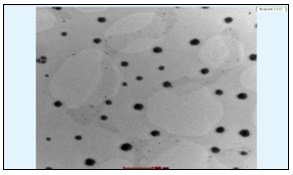
FIG. 1: TEM OF NANOEMULSION
Entrapment Efficiency and Drug Content Determination: Drug content and entrapment efficiency are used to estimate the quantity of drug present in the formulation. It was found to be as 98.03±0.265 and 97.99±0.155.
Fourier Transform Infrared Spectroscopy (FT-IR): The FTIR analysis of drug loaded formulation was done to check the interactions between excipients and drug. Fig. 2 shows FTIR for drug loaded formulation.
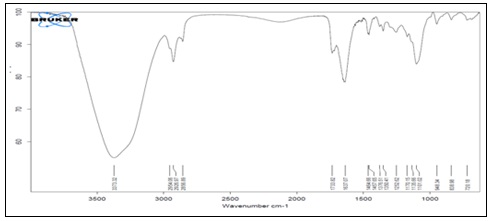
FIG. 2: IR SPECTRA
Preparation of Drug Loaded Gel: The nanogel was prepared using carbapol Fig. 3. The formulation was viscous and homogenous with an acceptable pH value which ensured no skin or nail irritation upon application.
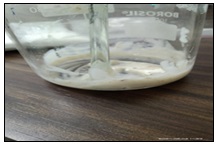
FIG. 3: NANOGEL OF RESVERATROL
Evaluation of Nanogel:
pH, Viscosity and Spreadability: pH of gel was found to be 6.9±0.01. The viscosity for nanogel was found to be 89.23±1.09 Pa.s. Spreadability diameter was 1.8cm. Consistency of a gel is important for ease of application and retention thus affecting the patience compliance.
In-vitro Drug Release Studies: It was carried out to evaluate the release of drug from the formulation. It was observed that in 10 hrs more than 80% of drug is released from the prepared formulation.
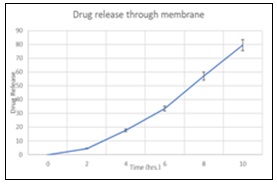
FIG. 4: IN-VITRO RELEASE STUDIES
Transungual Permeation Study: Transungual permeation study was carried out to evaluate the drug permeation through Hoof nail. Hoof nail was used as it is similar in composition to that of the human nail, mostly made up of keratin and it shows gel like behavior. Cumulative amount permeated through nail is shown in Table 3 and Fig. 5. Flux was found to be 1.158 and permeability coefficient was found to be 0.1158. Cumulative amount permeated was higher than the plain drug.
TABLE 3: DATA REPRESENTING PERMEATION STUDIES
| Time (hr) | Cumulative amt permeated for nanogel | Cumulative amount permeated for plain drug |
| 0 | 0.011±0.006 | 0 |
| 2 | 0.531±0.240 | 0.111±0.010 |
| 4 | 0.835±0.085 | 0.577±0.205 |
| 6 | 2.262±0.220 | 1.009±0.102 |
| 8 | 3.618±0.270 | 1.278±0.162 |
| 10 | 4.178±0.433 | 1.496±0.193 |
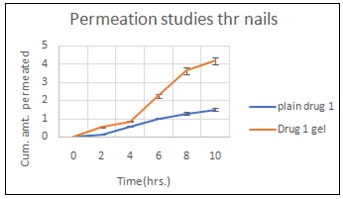
FIG. 5: PERMEATION STUDIES
Zone of Inhibition Studies: In-vitro antifungal activity was determined using the cylinder plate method. Formulation was found to be effective against the T. rubrum and T. mentagrophytes.
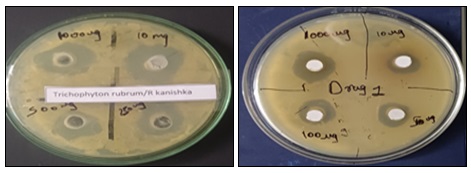
FIG. 6: ANTIFUNGAL STUDIES
CONCLUSION: The goal of this study was to develop and evaluate the nanogel for resveratrol with better permeation characteristics. Developed nanogel shown to have promising characteristics for nail disorders having better permeation than plain drug. Microbial studies proved that the formulation is having efficacy against T. mentagrophytes and T. rubrum causative microbes for onychomycosis.
ACKNOWLEDGMENTS: The authors express their sincere gratitude to Gatteffosse, India for providing the gift samples of excipients.
CONFLICTS OF INTERESTS: None.
REFERENCES:
- Walters KA: Permeability characteristics of the human nail plate. Int J Cosmet Sci 1983; 5: 231–246.
- Gupchup GV: Structural characteristics and permeability properties of human nail. J Cosmet Sci 1999; 50: 363–385.
- Murdan S: Drug delivery to the nail following topical application. Int J Pharm 2002; 236: 1–26.
- Khanna S: Pharmacotherapeutic principles of Ungual drug delivery System. Int J Drug Dev Res 2012; 4(3): 9–18.
- Uwe Wollina: The Diagnosis and Treatment of Nail Disorders. Dtsch Arztebl Int 2016; 113(29-30): (509–518). 10.3238/arztebl.2016.0509
- Gupta AK: Novel investigational therapies for onychomycosis: an update. Expert Opinion on Investigational Drugs 2016. 10.1517/13543784.2016.1142529.
- Shanbhag PP: Drug delivery through nails: Present and future. New Horizons in Translational Medicine 2017; 3: 252–263.
- Jintapattanakit A: Preparation of nanoemulsions by phase inversion temperature (PIT) method Pharm Sci Asia 2018; 45(1): 1-12.
- Vasconcelosa T: Multicomponent selfnano emulsifying delivery systems of resveratrol with enhanced pharmacokinetics profile. European Journal of Pharmaceutical Sciences 2019; 137: 105011.
- Khurana B: QbD based exploration of resveratrol loaded polymeric micelles based carbomer gel for topical treatment of plaque psoriasis: In-vitro, ex-vivo and in-vivo Journal of Drug Delivery Science and Technology 2020; 59: 101901.
- Kotta S: Coconut oil-based resveratrol nanoemulsion: Optimization using response surface methodology, stability assessment and pharmacokinetic evaluation. Food Chemistry 2021; 357: 129721.
- Kesharwani P: Itraconazole and Difluorinated-Curcumin Containing Chitosan Nanoparticle Loaded Hydrogel for Amelioration of Onychomycosis. Biomimetics 2022; 7: 206.
- Muthukumar M: Formulation development of antimicrobial nail lacquer by transungual delivery system for the treatment of paronychia. Int J Pharm Sci Rev Res ISSN: 0976 – 044X, 82(2), September – October 2023
- Lakhmani K and Lala: Drug delivery through nails: an overview research. J Pharm and Tech 2024; 17(9).
- Murdan S: Nail varnish as a drug delivery vehicle. Department of Pharmaceutics, School of Pharmacy Brunswick Square, London 29-39.
- Salehi B: Resveratrol: A Double-Edged Sword in Health Benefits Biomedicines 2018; 6: 91.
- Dobler D: Comparative Ungual Drug Uptake Studies: Equine Hoof Membrane vs. Human Nail Plate Pharmaceutics 2022; 14: 2552.
- Neamah MJ and Al-Akkam EJ: Characterization and animal skin irritations investigation of vemurafenib microemulsion-based hydrogel using oily ionic liquid. Iraqi J Vet Med 2024; 48: 81–92.
How to cite this article:
Lakhmani K and Lala R: Formulation and evaluation of resveratrol loaded nanogel for onychomycosis. Int J Pharm Sci & Res 2026; 17(8): 2547-52. doi: 10.13040/IJPSR.0975-8232.17(8).2547-52.
All © 2026 are reserved by International Journal of Pharmaceutical Sciences and Research. This Journal licensed under a Creative Commons Attribution-NonCommercial-ShareAlike 3.0 Unported License.
Article Information
33
2547-2552
749 KB
328
English
IJPSR
Kanishka Lakhmani * and Rita Lala
Department of Pharmaceutics, Principal K. M. Kundnani College of Pharmacy, Colaba, Mumbai, Maharashtra, India.
deepsshikha.s@gmail.com
29 June 2026
17 July 2026
20 July 2026
10.13040/IJPSR.0975-8232.17(8).2547-52
01 August 2026
 Download