




IMIDAZOLIDINEDIONE AND STRUCTURALLY RELATED COMPOUNDS AS POSSIBLE HUMAN MAO-B INHIBITORS FOR PARKINSON’S DISEASE: AN IN-SILICO ASSESSMENT
HTML Full TextIMIDAZOLIDINEDIONE AND STRUCTURALLY RELATED COMPOUNDS AS POSSIBLE HUMAN MAO-B INHIBITORS FOR PARKINSON'S DISEASE: AN IN-SILICO ASSESSMENT
Thomas Kurian
Department of Pharmaceutical Chemistry, Government Medical College, Kottayam, Kerala, India.
ABSTRACT: The study described here is based on an in-silico approach to rank seven thiazolo-imidazoles and similar compounds, selected using Chem-mimic and PubChem similarity indices, for Parkinson's disease bioactivity, with the receptor target PDB ID 2V5Z. An AI-based approach using DiffDock-L and Alfa Flow NeuroSnap AI was used for docking and dynamic simulation studies. Sprint-AI was used for ranking and bioactivity assessment. The physical disabilities associated with Parkinson’s disease include paucity of movement, muscle stiffness, and tremor at rest. It is a progressive neurodegeneration of the substantia nigra with neuronal loss in the pars compacta. Levodopa was used to treat Parkinson's disease. This resulted in improved memory, temporary sleeplessness, and a feeling of heaviness. Anticholinergics were used before Levodopa. A monoamine oxidase inhibitor was used to increase dopamine levels. Imidazole scaffolds, with or without a sulfur atom in the ring system, proved useful for PD treatment. Imidazoles possess neuroprotective activity that reduces neuroinflammation associated with PD. They inhibit PDE10A, which is associated with PD neuroinflammation. The sulfur atom helps with BBB penetration. Prediction: AI-ADMET from NeuroSnap performed the pharmacokinetic prediction. Most of the compounds complied with the Lipinski Rule of 5 and met toxicity parameters. The best predicted activity was observed for 3-amino-5,5-diphenyleimidazole-2,5-diene. The reference compound for redocking was Sufanimide (-8.73). Further lead optimization and clinical studies are required to develop analogs of this hit compound.
Keywords: Parkinson's, Docking, Dynamics, Pharmacokinetics, Diff-dock
INTRODUCTION: Parkinsonism is associated with reduced dopamine levels in the basal ganglia and thalamus 1. Parkinsonism emerges as a complex network disorder, with abnormal activity in groups of neurons in the basal ganglia that affects excitability, oscillatory activity, synchrony, and sensory responses involved in the planning and execution of movements 2.
Because it catalyzes the breakdown of dopamine in the brain, monoamine oxidase-B (MAO-B) is a proven therapeutic target in Parkinson's disease. Safinamide, rasagiline, and selegiline are examples of selective MAO-B inhibitors that increase dopamine availability and alleviate motor symptoms 3.
Finding new MAO-B inhibitors is therefore still a desirable approach to developing Parkinson's disease medications. In the present study, seven Imidazoles were selected based on structural similarity identified through ChemMine and PubChem fingerprint searches. The in-silico molecular docking was performed using the AI platform Diff-Dock from NeuroSnap AI.
The molecular dynamics simulation was based on Alfa flow AI. This method captures conformational flexibilities, positional distribution, and higher-order ensemble observables for unseen proteins. Diff Dock L uses Autodock VINA to predict protein-Ligand interactions with high accuracy. It is based on Machine Learning and AI. ADMET- AI is an online platform for identifying and predicting pharmacokinetic parameters. Lipinski rule of five, B.B.B. penetration, Lipophilicity, etc. are predicted by Bioactivities Predictor. SPRINT AI ranks the Ligands based on the likelihood of bioactivity when tested in-vivo. The software is based on AI and machine learning.
MATERIALS AND METHODS: Based on fingerprint similarity to documented imidazole-containing neuroactive chemicals, seven structurally related compounds were found using PubChem similarity search and ChemMine Tools. For docking investigations, compounds with at least 80% structural similarity were chosen.
Molecular Docking: Molecular docking was performed using the AI docking algorithm DiffDock, integrated into the NeuroSnap AI molecular design platform. The docking workflow comprised receptor preparation, ligand optimization, structure conversion, docking prediction, and selection of the best binding poses through binding affinity. To validate the docking protocol, redocking analysis was performed. SPRINT AI ranked the ligands based on in-vivo bioactivity predictions. The software is based on AI and machine learning.
ADMET Prediction: The Integrated NeuroSnap AI platform for ADMET prediction was used to predict pharmacokinetic properties. The parameters evaluated are included. The selected compounds were subjected to ADMET predictions to assess blood–brain barrier permeability, oral bioavailability, CYP1A2 inhibition, lipophilicity (logP), hydrogen-bond donor capacity, and compliance with the Lipinski Rules.
Alpha Flow AI M. D Simulations: The conformational landscape of protein target 2V5Z, Human MAO-B in Complex with a selective. The inhibitor Safinamide was explored using an artificial intelligence-based structure-generation platform. The amino acid and FASTA sequence files were downloaded from the RCSB website. The sequence was uploaded, and the program was run to generate confirmations for 10-50 structures that represent the dynamic conformational space at varying levels of flexibility and include energetically plausible protein conformations. The dynamic behavior of the protein ensemble was evaluated by calculating the root mean square fluctuation RMSF profiles to identify rigid and flexible regions. The resulting ensemble was subsequently used in the discovery study.
RESULTS AND DISCUSSION:
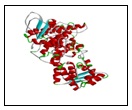
FIG. 1: STRUCTURE OF HUMAN MAO B IN COMPLEX WITH THE SELECTIVE INHIBITOR SAFINAMIDE
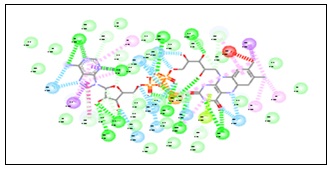
FIG. 2: BINDING SITES OF HUMAN MAO B IN COMPLEX WITH THE SELECTIVE INHIBITOR SAFINAMIDE
TABLE 1: MOLECULAR DOCKING RESULTS -DIFFDOCK –L (AI-DRIVEN)
| Ligand Cid | Chemical structure | Binding energy * |
| Safinamide (ref) | 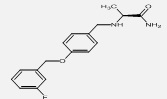 |
-8.73994
|
| 2-(2,5-dioxo-4,4-diphenylimidazolidin-1-yl)acetamide
|
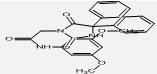 |
-6.9872 |
|
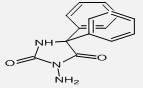
3-amino-5,5-diphenylimidazolidine-2,4-dione |
 |
-7.5490 |
| (2S)-2-amino-3-(4-hydroxyphenyl)propanoic acid | 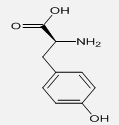 |
-6.2137 |
| 1,1-dioxo-1,2-benzothiazol-3-one(Saccharin) | 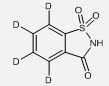 |
-4.555 |
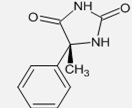
| (5R)-5-methyl-5-phenylimidazolidine-2,4-dione
|
 |
-6.8141 |
*Least B.E indicates max stability & bioactivity.
TABLE 2: MOLECULAR DYNAMIC SIMULATIONS ALPHA FLOW AI
| Confirmation Rank | Model ID | *Mean pLDDT | **Uniqueness | ***RMSD Best |
| 1 | 3 | 83.327 | 29.103 | 0 |
| 2 | 5 | 81.617 | 26.6 | 26.83 |
| 3 | 6 | 79.568 | 25.829 | 31.792 |
| 4 | 2 | 75.043 | 23.865 | 28.272 |
| 5 | 0 | 73.371 | 25.526 | 26.145 |
| 6 | 9 | 73.17 | 25.866 | 28.955 |
| 7 | 1 | 71.006 | 26.265 | 28.638 |
| 8 | 8 | 70.527 | 25.707 | 26.553 |
| 9 | 7 | 68.622 | 26.472 | 33.911 |
| 10 | 4 | 68.579 | 27.113 | 30.826 |
*The pLDDT score reflects AlphaFold's confidence in the predicted structure. 90 = Very high confidence, 80–90 = Good confidence, 70–80 = Moderate confidence, <70 = Low confidence. ** Uniqueness measures how different a conformation is from other generated conformations. *** RMSD measures structural deviation from the best-ranked model.
TABLE 3: ADMET PREDICTIONS BY ADMET-AI
| Ligand | MW | LogP | HBA | HBD | Lipinski | QED | Stereo Centers | TPSA (Ų) | CYP2C19_Veith | BBB Martin | Bio-availability |
| Safinamide (Reference) | 302.349 | 2.3681 | 3 | 2 | 4 | 0.825 | 1 | 64.35 | 0.8006 | 0.9348 | 0.9778 |
| 2-(2,5-dioxo-4,4-diphenylimidazolidin-1-yl)acetamide | 309.325 | 0.9673 | 3 | 2 | 4 | 0.8242 | 0 | 92.5 | 0.0281 | 0.9729 | 0.9825 |
| 3-amino-5,5-diphenylimidazolidine-2,4-dione | 267.288 | 1.3557 | 3 | 2 | 4 | 0.4898 | 0 | 75.43 | 0.127 | 0.9712 | 0.9912 |
| L-Tyrosine | 181.191 | 0.3466 | 3 | 3 | 4 | 0.6277 | 1 | 83.55 | 0.0145 | 0.4823 | 0.8897 |
| Saccharin | 183.188 | 0.1187 | 3 | 1 | 4 | 0.6209 | 0 | 63.24 | 0.0017 | 0.621 | 0.8726 |
| (5R)-5-methyl-5-phenylimidazolidine-2,4-dione | 190.202 | 0.7412 | 2 | 2 | 4 | 0.6416 | 1 | 58.2 | 0.0045 | 0.9865 | 0.9789 |
| 5,5-diphenyl-2-sulfanylideneimidazolidin-4-one | 268.341 | 1.9345 | 2 | 2 | 4 | 0.8178 | 0 | 41.13 | 0.3156 | 0.8633 | 0.9536 |
Molecular docking and dynamic simulation studies were performed on seven ligands containing thiazole and imidazole rings, or on compounds with similar structures, selected using Chem Mimic software and a PubChem fingerprint search. The DiffDock L Software and Alfa- Flow AI used for docking and dynamics are based on artificial intelligence and machine learning. They yielded results comparable to those of conventional algorithm- based models such as AutoDock. DiffDock uses a modern version of AutoDock. Lower binding energy indicates strong, stable binding and maximum biological activity (Anti- Parkinson Activity). Thiazole and imidazole were selected because they have been reported to reduce neuroinflammation and enhance blood- brain barrier penetration 4.
Safinamide, the reference compound used for re- docking, exhibited the strongest binding affinity in in-silico analyses and predictions with SPRINT- AI. It also yielded the best prediction of pharmacokinetic parameters, with a docking score of- 8. 7399 kcal/mol. Among the investigated ligands, to confirm MAO inhibition activity when compared to Safinamide, the ligand 3 – amino- 5, 5 –diphenyl imidazolidine 2, 4- dione demonstrated the highest affinity (7. 549 kcal/mol), followed by 2 – (2, 2,5–dioxo–4, 4,4–diphenyl imidazolidine–1–yl) acetamide (6.9872. 9872 kcal/mol). They may be considered leads in drug discovery studies; they bind to the receptor (2 V 5 Z) pocket with ambient stability. Saccharin exhibited the least binding affinity (- 4. 555 kcal/mol). The ADMET predictions revealed that the drug- like (Log P, BBB permeability, bioavailability, H- bond acceptor, Lipinski rule acceptance). Safinamide displayed a Log P of 2. 365 and a BBB permeability of 0. 9348. Bioavailability score 0. 978, confirming excellent CNS penetration. 5. Parkinson' s disease requires drugs with good CNS penetration. Among ligands, (5 R) -5–methyl–5–phenyl imidazole–2, 4–dione showed the highest BBB penetration (0. 9865), exceeding Reference Safinamide (binding affinity of -7. 549). It shows excellent CNS penetration and a high bioavailability score of 0. 97 or higher, suggesting good oral absorption 6. Lipinski rule violations were only 1 of the five for all ligands. Hydrophilicity and lipophilicity were balanced for all tested compounds.
Dynamics Alpha Flow: Ten conformational models were generated by AlphaFold for the 2V5Z protein. The pLDDT-predicted confidence, uniqueness, and RMSD were tested. Model 3 achieved PLDDT of 83.327, indicating good reliability. PLDDT ranges from 70 to 85, indicating good confidence in predictions. Uniqueness ranges from 23.8 to 29.10, indicating good structural diversity among the generated conformations. RMSD values range from 26 to 34, indicating conformational variation. Compared to the best ligand, Models 0 and 8 exhibited low deviation, indicating greater similarity to the reference conformation. The dynamic study results indicate structural flexibility that preserves the structure's overall integrity and accommodates various ligands.
CONCLUSION: The present work evaluated seven structurally similar drugs against human monoamine oxidase-B (MAO-B), a proven therapeutic target in Parkinson's disease, using AI-assisted molecular docking, conformational ensemble analysis, and ADMET prediction. Among the compounds under investigation, 3-amino-5, 5-diphenylimidazolidine-2, 4-dione showed acceptable expected pharmacokinetic properties and the most favorable docking profile among the tested analogs. The present study investigated thiazolidine-1-imidazoles for anti-Parkinson’s activity using AlphaFold, DiffDock-L, ADMET AI, and Sprint AI to predict pharmacokinetic/dynamic properties and rank ligand bioactivity. Among the investigated ligands, 3–amino–5,5–diphenyl imidazolidine–2,4-dine emerged as the most promising HIT, with superior receptor-binding capability, ADMET, and predicted bioactivities, along with good bioavailability and lower toxicity. The molecular dynamics simulation study indicated that the best-selected ligand (HIT) from the diff-dock analysis was the most stable. The results presented here should be considered preliminary, as they are based solely on computational forecasts. Without experimental validation, the reported compounds cannot be regarded as clinical leads or anti-Parkinson medicines 7. To validate the computational results, additional in-vitro MAO-B inhibition studies, cellular assays, pharmacokinetic evaluation, and in-vivo investigations are needed 8. Further in-vivo/in-vitro, ex-vivo, and clinical trials are needed to establish or optimize the HITs-to-Leads and any future drug candidates for Parkinson’s treatment 9-10.
ACKNOWLEDGEMENT: I acknowledge the help and support of the Professor and Head of the Department of Pharmacy at the Government Medical College, Kottayam, for the facilities provided.
CONFLICT OF INTEREST: There is no conflict of interest in this study.
REFERENCES:
- Shmerling RH: Parkinson's disease. Harvard Health 2025.
- Parkinson's disease: etiology, neuropathology, and pathogenesis. NCBI Bookshelf 2016.
- Parkinson's disease: diagnosis and treatment. Mayo Clinic. 2024.
- García AM, Eltit JM, Martínez A, Pérez DI, Gil C and Campillo NE: Pharmacological tools based on the imidazole scaffold proved the utility of PDE10A inhibitors for Parkinson's disease. Future Med Chem 2017; 9(8): 731-748.
- Pathophysiology of Parkinsonism. Clin Neurophysiol 2008; 119(7): 1459-1474.
- Wiest C, Tinkhauser G, Pogosyan A, Little S and Brown P: The aperiodic exponent of subthalamic field potentials reflects excitation/inhibition balance in Parkinsonism Elife 2023; 12: 82467.
- Jiang W, Zhang Y, Wang X, Li Y, Chen H and Xu Z: Chiral metal-organic frameworks incorporating nanozymes as neuroinflammation inhibitors for managing Parkinson's disease. Nat Commun 2023; 14: 8848.
- Aboulatta L, Mostafa M, Elgendy AY, Abdelsalam M and Hassan M: Efficacy and safety of MAO-B inhibitors safinamide and zonisamide in Parkinson's disease: a systematic review and meta-analysis of randomized controlled trials. CNS Drugs 2023; 37(11): 941-956.
- Hung TY, Lin MW, Chen YC and Wu SN: Safinamide, an inhibitor of monoamine oxidase, modulates the magnitude, gating, and hysteresis of sodium ion current. BMC Pharmacol Toxicol 2024; 25: 52.
- Miebs G, Kaczmarek K, Krawczyk B and Stepniewski M: Beyond the arbitrariness of drug-likeness rules: rough set theory and decision rules in the service of drug design. Appl Sci 2024; 14(21): 9966.
How to cite this article:
Kurian T: Imidazolidinedione and structurally related compounds as possible human MAO-B inhibitors for Parkinson's disease: an in-silico assessment. Int J Pharm Sci & Res 2026; 17(10): 3230-34. doi: 10.13040/IJPSR.0975-8232.17(10).3230-34.
All © 2026 are reserved by International Journal of Pharmaceutical Sciences and Research. This Journal licensed under a Creative Commons Attribution-NonCommercial-ShareAlike 3.0 Unported License.
 Download