




MICROCOCCUS ANTARCTICUS HC-2: OPTIMIZATION AND EVALUATION OF ANTIMICROBIAL METABOLITES
HTML Full TextMICROCOCCUS ANTARCTICUS HC-2: OPTIMIZATION AND EVALUATION OF ANTIMICROBIAL METABOLITES
Krishna Naragani * and C. Srinivasa Reddy
Department of Basic Sciences and Humanity, Chalapathi Institute of Engineering and Technology, Lam, Guntur, Andhra Pradesh, India.
ABSTRACT: Optimization of culture conditions to enhance bioactive metabolite production by Micrococcus antarcticus HC-2 was undertaken in this study. The culture broth, grown in Yeast Extract–Malt Extract–Dextrose (ISP-2) medium and extracted with Ethyl acetate exhibited high antimicrobial activity against test microorganisms, including Gram-negative, Gram-positive bacteria and fungi. For efficient production of secondary metabolites, the optimal pH and temperature were found to be 7 and 30°C, respectively. Compared to other media, the Yeast Extract–Malt Extract–Dextrose broth produced a higher amount of bioactive metabolites. Studies on culture conditions revealed that maximum secondary metabolite synthesis was achieved when lactose (0.5%) and yeast extract (0.5%) were used as carbon and nitrogen sources, respectively.
Keywords: Actinobacteria, Optimization of culture conditions, Environmental parameters, Bioactive metabolites
INTRODUCTION: The microflora is most abundant in soils that are rich in organic matter. Soil represents a unique biological environment for microbial life due to the presence of root exudates. High inputs of organic materials from plant roots, which are essential for microbial growth, provide nutritional support for this microflora 1. Actinobacteria in the rhizosphere may influence plant growth and protect plant roots from the invasion of pathogenic fungi that cause root diseases 2. Terrestrial actinobacteria are the source of nearly 70% of the natural antibiotics currently used in medicine 3.
However, only a small number of characterized actinomycete genera account for the production of more than 20,000 microbial natural products 4. Actinobacteria from the rhizosphere of the medicinal plant Vitex negundo remains largely unexplored.
MATERIALS AND METHODS:
Source of Microorganism: Actinobacterial strains were isolated from the rhizosphere of Vitex negundo in Guntur using the soil dilution plate technique, following pretreatment with calcium carbonate. The strain HC-2 was identified as Micrococcus antarcticus HC-2 through phylogenetic analysis. The gene sequence of this strain has been deposited in the GenBank database of NCBI with the accession number MZ389875 5.
Antimicrobial Assay: The test bacteria and fungi were cultured on nutrient agar (NA) and Czapek–Dox (CD) agar media, respectively.
After the agar solidified, wells of approximately 6 mm in diameter were punched using a sterile cork borer. For the antifungal assay, the test fungus was inoculated onto the solidified CD agar plates. Each well was loaded with 50 ppm of the solvent extract, while the solvent alone served as the control. The inoculated plates were incubated at 30°C for 24 hours for bacteria and 24–72 hours for yeast and filamentous fungi. The diameter of the inhibition zone was then measured 6.
Optimizing the Culture Conditions for Enhanced Production of Bioactive Metabolites: Attempts were made to enhance the production of secondary metabolites by optimizing culture conditions such as pH, temperature, culture media, minerals, and carbon and nitrogen sources. The production of bioactive metabolites by the strain was monitored at regular intervals for up to seven days.
Effect of pH and Temperature on Bioactive Metabolite Production: To determine the influence of initial pH on bioactive metabolite production, the strain HC-2 was cultured in media with initial pH values ranging from 4 to 9 and at temperatures ranging from 20 to 40°C. Biomass and bioactive metabolite production were estimated to identify the optimal pH and temperature, which were then used for further studies 7-8.
Influence of Culture Media on the Production of Bioactive Metabolites: To determine the ideal conditions for maximum production of antimicrobial metabolites by strain HC-2, the organism was cultured in ten different media, including Tryptone Yeast Extract Broth (ISP-1), Yeast Extract–Malt Extract–Dextrose Broth (ISP-2), Oatmeal Broth (ISP-3), Starch Inorganic Salts Broth (ISP-4), Glycerol–Asparagine Broth (ISP-5), Starch Casein Broth (ISP-6), Tyrosine Broth (ISP-7), Nutrient Broth, and Czapek–Dox Broth. Nutritional conditions play an important role in enhancing the production of bioactive metabolites 9-10. Bioactive metabolite production in each medium was evaluated, and the medium that supported optimal production was selected for subsequent studies.
Impact of Carbon and Nitrogen Sources on Bioactive Metabolite Production: The impact of carbon sources on bioactive metabolite production by strain HC-2 was determined by supplementing the production medium (YMD) with different carbon sources, such as dextrose, fructose, lactose, sucrose, galactose, mannitol, xylose, starch, and cellulose. Each carbon source was added separately at a concentration of 0.5% to the optimized medium. The influence of various nitrogen sources on bioactive metabolite production was evaluated by supplementing the medium with different nitrogen sources, including ammonium nitrate, yeast extract, tryptophan, proline, alanine, histidine, cysteine, tyrosine, urea, and peptone. Each nitrogen source was added individually at a concentration of 0.5% to the medium containing the optimized carbon source 11.
Effect of Minerals on Bioactive Metabolite Production: The impact of minerals on the production of bioactive metabolites was studied by supplementing the optimized medium with different minerals, such as KH₂PO₄, K₂HPO₄, MgSO₄, FeSO₄, and ZnSO₄, each at a concentration of 0.05% (w/v) 12.
Antimicrobial Activity against Test Organisms: The antimicrobial metabolites produced by the strain under optimized conditions were tested against bacterial strains, namely Bacillus megaterium (NCIM 2187), Streptococcus mutans (MTCC 497), Staphylococcus aureus (MTCC 3160), Bacillus subtilis (ATCC 6633), Escherichia coli (ATCC 35218) and Pseudomonas aeruginosa (ATCC 9027), as well as fungal strains such as Candida albicans (ATCC 10231) and Aspergillus sp., using the agar diffusion assay 13.
Statistical Analysis: The data obtained on bioactive metabolite production under different microbial culture conditions were statistically analyzed and expressed as mean ± standard error. One-way analysis of variance (ANOVA) was used to assess the significance of the results.
RESULTSANDDISCUSSION:
Effect of Incubation Period on Biomass and Bioactive Metabolite Production: The growth pattern of strain HC-2 was studied in Yeast Extract–Malt Extract–Dextrose broth. The stationary phase of HC-2 extended from 72 to 96 hours of incubation Fig. 1.
Secondary metabolites obtained from four-day-old cultures exhibited high antimicrobial activity against the test microorganisms. Similarly, metabolites produced by four-day-old cultures of Nocardia metallicus VJSY-14 14, Arthrobacter kerguelensis VL-RK_09 15, and Nocardia levis MK-VL_113 16 were reported to be active against test bacteria and fungi.
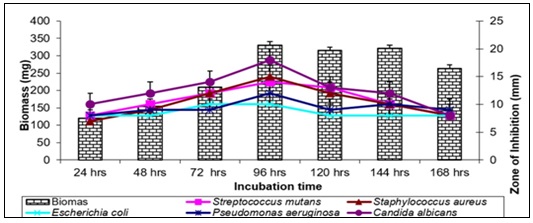
FIG. 1: EFFECT OF INCUBATION TIME ON BIOMASS AND BIOACTIVE METABOLITES PRODUCTION BY THE STRAIN. Data are statistically analyzed and found to be significant at 5%
Impact of Culture Media on Bioactive Metabolite Production by the Strain HC-2: Bioactive metabolite production by the strain was studied in different culture media Fig. 2. Among the ten media tested, Yeast Extract–Malt Extract–Dextrose broth (ISP-2) produced the highest levels of bioactive metabolites, followed by ISP-1 and ISP-6. Similar results were reported for Rhodococcus erythropolis VL-RK_05 17, Rhodococcus erythropolis VLK-12 11, and Pseudonocardia sp. VUK-10 18.
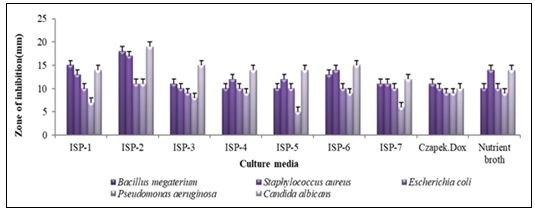
FIG. 2: IMPACT OF CULTURE MEDIA ON BIOACTIVE COMPOUNDS BY THE STRAIN HC-2. Data are statistically analyzed and found to be significant at 5%
Effect of pH and Temperature on Bioactive Metabolite Production: The impact of initial pH on bioactive metabolite production by strain HC-2 was studied by varying the pH of the fermentation broth from 4 to 9. Maximum growth and secondary metabolite production by strain HC-2 were observed at pH 7.0 Fig. 3.
Similarly, the optimal pH for the production of antimicrobial compounds by several actinobacteria, such as Rhodococcus erythropolis VLK-12 11, R. erythropolis VL-RK_05 17, Nocardiopsis flavescens VJMS-18, Nocardiopsis sp. VJRM-8, and Nocardiopsis dassonvillei VJRM-7 19, has been reported to be 7.0.
The production of bioactive metabolites increased with the incubation temperature from 20°C to 30°C Fig. 4. However, a further increase in temperature (above 35°C) resulted in a decreased growth rate and a decline in bioactive metabolite production Fig. 4. The strain HC-2 appeared to be mesophilic in nature. Similar results have been reported for other actinobacterial species 11, 15.
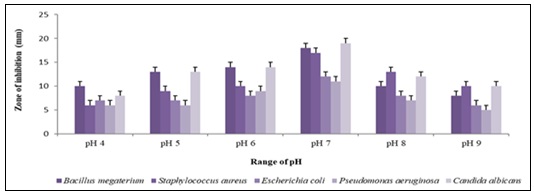
FIG. 3: EFFECT OF PH ON BIOACTVE METABOLITES PRODUCTION BY THE STRAIN HC-2. Data are statistically analyzed and found to be significant at 5%
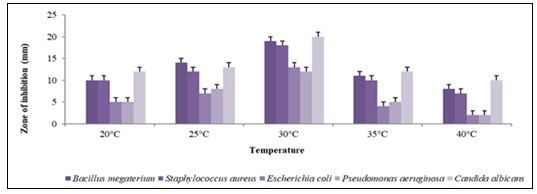
FIG. 4: IMPACT OF TEMPERATURE ON BIOACTIVE METABOLITES PRODUCTION BY THE STRAIN HC-2. Data are statistically analyzed and found to be significant at 5%
Effect of Carbon and Nitrogen Sources on Bioactive Metabolite Production: The effect of carbon and nitrogen sources on the production of bioactive metabolites Fig. 7 by strain HC-2 are shown in Fig. 5 and 7. Significant production of bioactive metabolites was observed in lactose-amended media, followed by dextrose and mannitol. Since the lactose-enriched culture medium supported a high yield of bioactive compounds, different concentrations of lactose (0.1–1%) were tested to determine the optimal concentration. A lactose concentration of 0.5% supported the highest yield of bioactive metabolites Fig. 6. To determine an effective composition of the growth medium, different nitrogen sources were evaluated for their influence on antimicrobial compound production by the strain. Among the nitrogen sources tested, yeast extract, followed by peptone and tryptophan, was found to be most effective for the production of bioactive metabolites. Inorganic nitrogen sources, such as ammonium nitrate and urea, also showed a significant effect on secondary metabolite production by the strain. Since yeast extract enhanced antimicrobial metabolite production by strain HC-2, the influence of different concentrations of yeast extract (0.1–1%) was also evaluated Fig. 8.
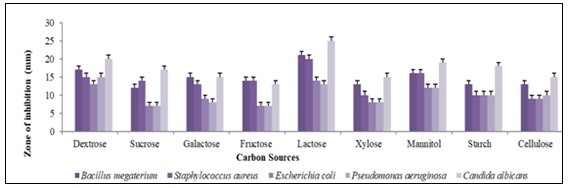
FIG. 5: INFLUENCE OF CARBON SOURCES ON SECONDARY METABOLITES PRODUCTION BY THE STRAIN HC-2. Data are statistically analyzed and found to be significant at 5%
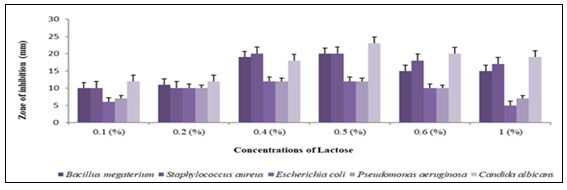
FIG. 6: EFFECT OF DIFFERENT CONCENTRATIONS OF LACTOSE ON SECONDARY METABOLITES PRODUCTION BY THE STRAIN HC-2. Data are statistically analyzed and found to be significant at 5%
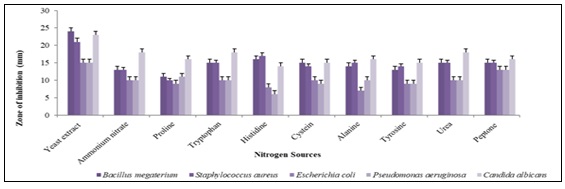
FIG. 7: IMPACT OF NITROGEN SOURCES ON BIOACTIVE METABOLITES PRODUCTION BY THE STRAIN HC-2. Data are statistically analyzed and found to be significant at 5%
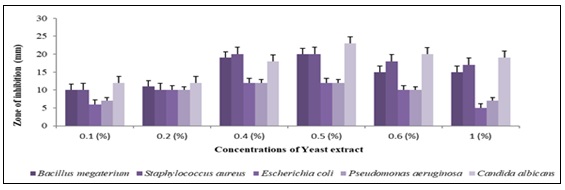
FIG. 8: EFFECT OF DIFFERENT CONCENTRATIONS OF YEAST EXTRACT ON BIOACTIVE COMPOUNDS PRODUCTION BY THE STRAIN HC-2. Data are statistically analyzed and found to be significant at 5%
Effect of Minerals on Bioactive Metabolite Production: The effect of minerals on secondary metabolite production by strain HC-2 is shown in Fig. 9. Among the minerals tested, K₂HPO₄ exhibited the highest rate of bioactive metabolite production, whereas lower antimicrobial metabolite production was observed with MgSO₄ and ZnSO₄. Similar results were reported for Arthrobacter kerguelensis VL-RK-09 15 and Pseudonocardia sp. VUK-10 18.
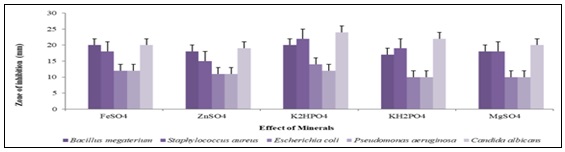
FIG. 9: IMPACT OF MINERALS ON SECONDARY METABOLITES PRODUCTION BY THE STRAIN HC-2. Data are statistically analyzed and found to be significant at 5%
Antimicrobial Activity of Bioactive Compounds under Optimized Conditions: The strain HC-2 was inoculated into the optimized medium (ISP-2) composed of lactose (0.5%), yeast extract (0.5%), malt extract (1%), calcium carbonate (0.2%), and K₂HPO₄ (0.05%) at pH 7.0, and incubated at 30°C for four days. Among the bacteria tested, Bacillus megaterium and Staphylococcus aureus were highly sensitive to the bioactive compounds, followed by Pseudomonas aeruginosa and Bacillus subtilis. Among the fungi, Candida albicans exhibited the highest sensitivity, followed by Aspergillus sp.
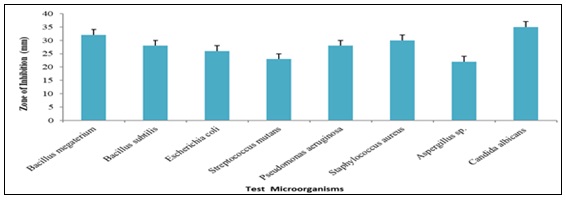
FIG. 10: ANTIMICROBIAL ACTIVITY OF SECONDARY METABOLITES PRODUCED BY THE STRAIN HC-2. Data are statistically analyzed and found to be significant at 5%
CONCLUSION: The strain Micrococcus antarcticus HC-2, isolated from rhizosphere soils, was tested for its antagonistic activity against Gram-positive and Gram-negative bacteria as well as fungi. Attempts were made to optimize culture conditions, including pH, temperature, carbon and nitrogen sources, and minerals, to enhance bioactive metabolite production. The optimized culture medium consisted of lactose (0.5%) as the carbon source, yeast extract (0.5%) as the nitrogen source, and K₂HPO₄ (0.05%) at pH 7.0. The strain, when cultured in this optimized medium at 30°C for four days, exhibited high antimicrobial activity. Among the bacteria tested, Bacillus megaterium was the most sensitive to the metabolites, followed by Staphylococcus aureus and Bacillus subtilis. In the case of fungi, Candida albicans showed the highest sensitivity.
ACKNOWLEDGEMENT: The authors thank the authorities of the Department of Botany, Hindu College, Acharya Nagarjuna University, for providing the facilities to carry out this study.
CONFLICTS OF INTEREST: The authors revealed no potential conflicts of interest, financial or otherwise.
REFERENCES:
- Lynch JM: Introduction: Some consequences of microbial rhizosphere competence for plant and soil. In: Lynch JM (ed.), The Rhizosphere. Wiley and Sons, Chichester 1990; 1–10.
- Yilmaz EI, Yavuz M and Kizil MJ: Molecular characterization of rhizosphere soil Streptomycetes isolated from indigenous Turkish plants and their antimicrobial activity. World Journal of Biotechnology 2008; 24: 1461–1470.
- Atta HM, Bayoumi R, Sehrawi M and Galal GF: Taxonomic studies and phylogenetic characterization of Streptomyces rimosus KH- isolated from Al-Khurmah Governorate, KSA. Researcher 2011; 3: 1223–1255.
- Bull AT and Stach JEM: Marine actinobacteria: New opportunities for natural product search and discovery. Trends in Microbiology 2007; 15: 491–499.
- Naragani K: Isolation and identification of Micrococcus antarcticus HC-2 from the rhizosphere of Vitex negundo Linn. World Journal of Pharmaceutical Science and Research 2025; 4(2): 951–956.
- Naragani K, Indupalli MD and Muvva V: Optimization of cultural conditions to enhance bioactive metabolite production by Streptomyces olivoverticillatus VLK-15. International Journal of Pharmaceutical Sciences and Research 2021; 12: 6715–6720.
- Srinivasan MC, Laxman RS and Deshpande MV: Physiology and nutritional aspects of actinomycetes: An overview. World Journal of Microbiology and Biotechnology 1991; 7: 171–184.
- Saurav K and Kannabiran K: Diversity and optimization of process parameters for the growth of Streptomyces VITSVK 9 sp. isolated from the Bay of Bengal, India. Journal of Natural and Environmental Sciences 2010; 1: 56–65.
- Vilches C, Mendez C, Hardisson C and Salas JA: Biosynthesis of oleandromycin by Streptomyces antibioticus: Influence of nutritional conditions and development of resistance. Journal of General Microbiology 1990; 136: 1447–1454.
- Naragani K, Indupalli MD, Chandra BS and Prasad KVSD: Optimization and evaluation of antimicrobial compounds produced by Streptomyces rubrus VLK-24. International Journal of Pharmaceutical Sciences and Research 2023; 14: 2287–2295.
- Naragani K, Rajesh Kumar M, Usha Kiranmayi M and Vijayalakshmi M: Optimization of culture conditions for enhanced antimicrobial activity of Rhodococcus erythropolis VLK-12 isolated from the south coast of Andhra Pradesh, India. British Microbiology Research Journal 2014; 4: 63–79.
- Naragani K, Indupalli MD and Muvva V: Optimization of cultural conditions to enhance bioactive metabolite production by Streptomyces olivoverticillatus VLK-15. International Journal of Pharmaceutical Sciences and Research 2021; 12(12): 6715–6720.
- Cappuccino JG and Sherman N: Microbiology: A Laboratory Manual. Pearson Education Inc., New Delhi, 2004: 282–283.
- Saba Yasmeen, Vijayalakshmi M and Rajesh Kumar M: Taxonomic characterization of rare actinobacteria isolated from mangrove ecosystem. International Journal of Current Research 2016; 8: 31060–31066.
- Rajesh Kumar M, Vijayalakshmi M, Saidulu K, Naragani K, Usha Kiranmayi M, Kumar Reddy D and Akkewar DM: Antimicrobial profile of Arthrobacter kerguelensis VL-RK 09 isolated from mango orchards. Brazilian Journal of Microbiology 2016; 47: 1030–1038.
- Kavitha A and Vijayalakshmi M: Cultural parameters affecting the production of bioactive metabolites by Nocardia levis MK-VL-113. Journal of Applied Sciences Research 2009; 5: 2138–2147.
- Rajesh Kumar M, Vijayalakshmi M, Naragani K and Hima Bindhu BSSN: Cultural parameters influencing the production of antimicrobial metabolites by Rhodococcus erythropolis VL-RK_05. International Journal of Current Research 2015; 7: 14924–14931.
- Usha Kiranmayi M, Sudhakar P, Sreenivasulu K and Vijayalakshmi M: Optimization of culturing conditions for improved production of bioactive metabolites by Pseudonocardia spp. VUK-10. Mycobiology 2009; 39: 174–181.
- Ragireddypallem R, Muvva V, Mallikarjuna K and Ikkurthi VK: Bioactivity and taxonomic studies of Nocardiopsis dassonvillei and Nocardiopsis species from marine sediments of the Bay of Bengal, India. International Journal of Pharmaceutical Sciences and Research 2020; 11: 1790–1801.
How to cite this article:
Naragani K and Reddy CS: Micrococcus antarcticus HC-2: optimization and evaluation of antimicrobial metabolites. Int J Pharm Sci & Res 2026; 17(8): 2490-96. doi: 10.13040/IJPSR.0975-8232.17(8).2490-96.
All © 2026 are reserved by International Journal of Pharmaceutical Sciences and Research. This Journal licensed under a Creative Commons Attribution-NonCommercial-ShareAlike 3.0 Unported License.
Article Information
24
2490-2496
826 KB
318
English
IJPSR
Krishna Naragani * and C. Srinivasa Reddy
Department of Basic Sciences and Humanity, Chalapathi Institute of Engineering and Technology, Lam, Guntur, Andhra Pradesh, India.
naraganikrishna@gmail.com
08 April 2026
16 May 2026
19 June 2026
10.13040/IJPSR.0975-8232.17(8).2490-96
01 August 2026
 Download