




TEMPORAL EVALUATION OF BEETROOT JUICE SUPPLEMENTATION ON REDOX HOMEOSTASIS IN HIGH ALTITUDE EXPOSED INDIVIDUALS
HTML Full TextTEMPORAL EVALUATION OF BEETROOT JUICE SUPPLEMENTATION ON REDOX HOMEOSTASIS IN HIGH ALTITUDE EXPOSED INDIVIDUALS
Karishma Dohare, Subhasis Bose, Divya Singh and Praveen Vats *
Defence Institute of Physiology and Allied Sciences, Lucknow Road, Timarpur, Delhi, New Delhi, India.
ABSTRACT: High altitude hypoxia exposure contributes in oxidative stress, leading to cellular damage and disrupting normal cellular function. The aim of the present study was to assess the effect of beetroot juice (BRJ) supplementation on oxidative stress, inflammation and neuroendocrine changes imposed in individuals upon high altitude exposure. This was a randomized controlled, longitudinal study conducted at an altitude of 3300m in western Himalayas. A total of 92 individual were assessed during the study (control=40, beetroot juice supplemented=52). 200ml of BRJ was supplemented for 15 days after reaching high altitude. Serum, plasma and saliva samples were collected at sea level (SL) and high altitude (before and after commencement of supplementation) for the measurement of biomarkers of oxidative stress, antioxidants, inflammation, and neuroendocrine function. Exposure to high altitude significantly disrupt the redox homeostasis in both groups. A significant increase (p<0.001) in reactive oxygen species (ROS), c-reactive protein (CRP), interleukin-6 (IL-6) and malondialdehyde (MDA) while a decrease in total antioxidant capacity (p<0.001) was observed in both groups upon high altitude exposure. However, a significant reduction (p<0.05) in MDA, ROS, CRP and IL-6 was evident in BRJ supplemented group compared to the control group at high altitude. A significant improvement in total antioxidant capacity (TAC) (p<0.05) and antioxidant enzymes (p<0.05) (superoxide dismutase, catalase and glutathione peroxidase) was also measured after beetroot supplementation. These findings suggest that BRJ supplementation has the potential to attenuate the oxidative stress and inflammation induced on high altitude exposure and also improve the antioxidant status.
Keywords: High altitude hypoxia, Beetroot, Oxidative stress, Antioxidants
INTRODUCTION: High altitude hypoxia refers to the condition of reduced cellular oxygen availability due to lower barometric pressure with increased altitude. High altitude characteristics are not limited to decreased barometric pressure and lack of oxygen, but also include high velocity winds, cold and dry weather, and high solar radiation 1.
Hypoxia exerts several negative impacts to the body and also affect the daily activities. There are several physiological, biochemical and molecular changes that occurs in response to acclimatization to the harsh environment of high altitude. The primary response to high altitude encounter are hyperventilation, increased heart rate, and increased cardiac output to meet the oxygen demand of the body.
This acclimatization response triggers several mechanisms to regulate the normal function of the body. This stress at high altitude slowdowns the mitochondrial electron transport chain causing electrons leakage, which leads to generation of reactive oxygen species (ROS) and consequently results in oxidative stress. High altitude exposure causes disruption of antioxidant defense system 2. This process causes cellular damage and results in high altitude inflammation and pathologies. High altitude hypoxia affects multiple organ functions like heart, kidney, and liver and stimulates many interconnected pathways, including oxidative stress, inflammatory pathway and a surge in neuroendocrine function. Hypoxia triggers the stress hormone response and stimulates hypothalamic-pituitary-adrenal (HPA) axis and the sympathetic nervous system, which regulates the cortisol and catecholamines (epinephrine, norepinephrine, dopamine) respectively 3. These playa crucial role in maintaining cardiovascular and metabolic adaptation and also modulates the immune function.
There are millions of people living at high altitude and thousand visit every year for different reasons. High altitude adversely affects the people’s health. Therefore, a nutritional strategy is a complementary approach to mitigate the adverse effects of high-altitude exposure. Beetroot (Beta vulgaris), also known as garden beet, is among the high nitrate vegetables and a rich source of organic and inorganic minerals, vitamins and antioxidants 4. Studies have suggested its role in reducing hypertension, oxidative stress, inflammation and in improving the antioxidant capacity, cognitive function and metabolic function 5, 6, 7. Beetroot supplementation also helps in depression and anxiety management by regulation of neurotransmitters 8. In addition, some recent trials suggest that beetroot supplementation helps in reducing systemic inflammation and improves endothelial function. Antioxidant rich supplementation has been proven to be beneficial in reducing the high altitude associated oxidative damage 9. Therefore, in the present, we aimed to explore the effect of high altitude on individuals, focusing on redox homeostatic and neuroendocrine changes, as well as the efficacy of beetroot juice supplementation as a strategy to mitigate the high altitude induced oxidative stress and inflammation.
MATERIAL AND METHOD:
Study Group: The study was conducted on 126 healthy Indian males. This was a randomized controlled study. Participants were randomly allocated to control and beetroot juice supplemented (BRJ) group using simple randomization method. However, the blinding was not performed due to the nature of the study trail. Each group had 63 participants. The participants in both groups were similar in age (control: 27±5.7, BRJ: 28±6.6, mean ± SD) height (control: 172.2±4.6, BRJ: 171.5±4.5, mean ± SD) and weight (control: 67.8±7.0, BRJ: 67.4±7.3, mean ± SD). It has been ensured that none of the participants had prior history of high altitude exposure. Exclusion criteria involves the history or medication of chronic illness like hypertension, cardiovascular disease, neurological disorder or diabetes. All the participants were informed and explained about the study protocol and obtained written, signed consent form from each of the participant. The study protocol was approved by human ethical committee of the Defence Institute of Physiology and Allied Sciences, DRDO, Delhi. Throughout the entire study, all participants had consumed identical food from same mess and engaged in routine physical activity. All the participants were instructed to refrain from smoking and consuming alcohol during the study.
Study Design and Beetroot Juice Supplementation: The study protocol involves measurements at sea level (SL, 122m) before participants were inducted to high altitude (3300m, Western Himalayas) via road. A few participants were withdrawn due to logistic problems and 92 participants (Control: n= 40, BRJ: n= 52) were considered for the study. The CONSORT flow diagram describing the recruitment, allocation of participants, dose and time period of BRJ supplementation Fig. 1. All measures were again recorded on the third day (HA0) of high altitude exposure. Following that, BRJ supplementation was commenced for 15 days, while the control group received no supplementation. All the measures were again recorded and samples were obtained on the 8th (HA1) and 16th (HA2) day of supplementation.
Beetroot supplementation was given in the form of spray dried powder (40gm), packaged in individual sachets. The spray dried beetroot powder contains protein (1.90%), fat (0.41%), crude fibre (0.70%), carbohydrate (93.26%). Each sachet was reconstituted in 200ml of water prior consumption by the participants.
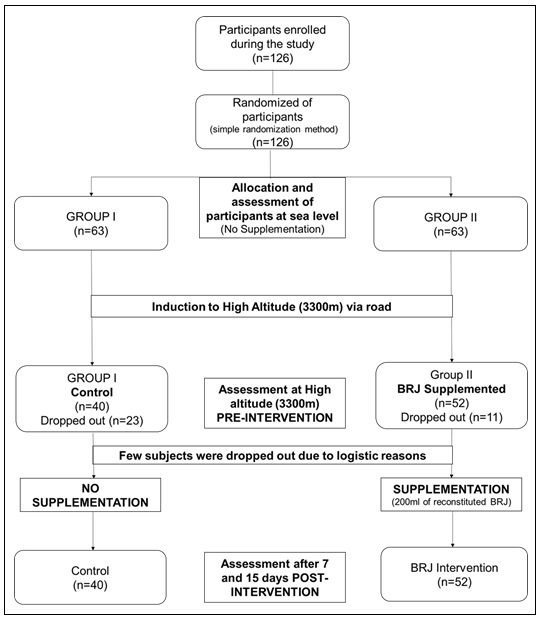
FIG. 1: CONSORT FLOW CHART OF PARTICIPANTS RECRUITED, ALLOCATED, INDUCTED TO HIGH ALTITUDE, NUMBERS FOLLOWED UP AND INCLUDED FOR THE ANALYSIS, DOSE AND TIME OF BRJ SUPPLEMENTATION
Sample Collection: Fasting blood samples were collected in heparinized and serum gel vacutainers from antecubital vein. Samples were collected between 06:00 – 08:00 hrs on each time interval (SL, HA0, HA1 and HA2). Plasma and serum were separated by centrifugation at 3000rpm for 15 min at 4 ºC and stored at -80ºC. Erythrocytes were washed thrice with 150mmol/L ice-cold potassium chloride and stored until use. For estimation of reduced and oxidized glutathione (GSH and GSSG), an aliquot of blood is separately collected immediately after the withdrawal into an equal volume of 10% metaphosphoric acid (MPA) and centrifuged to collect supernatant at 1500rpm for 10 min at 4 ºC. Saliva samples were collected in cotton swab tubes (Salivette, Sarstedt, Germany) after rinsing the mouth with drinking water. Saliva was separated by centrifugation for 10 min at 1500rpm at 4 ºC and stored in -80ºC for further use.
Biochemical Estimation of Oxidative Stress and Antioxidant Biomarkers: ROS was measured in red blood cells (RBC) lysate using 2′, 7′-Dichlorofluorescin diacetate (DCFDA) (Sigma-Aldrich-D6883) dye. Fluorescence was then measured at 485 nm (excitation wavelength) and 535 nm (emission wavelength) using an ELISA plate reader 10.
MDA was measured in plasma by using commercially available assay kit following manufacturer’s protocol (Elabsciences-E-BC-K025-M) to determine the levels of lipid peroxidation. 8-hydroxy-2’-deoxyguanosine (8-OHdG) (Cayman Chemicals-501130), immunoglobulins (IgG-EA0009Hu, IgM-BMS2098, IgA-BMS2096) (BT lab and Invitrogen), and interleukin-6 (Abbkine-KTE6017) were estimated spectrophotometrically using precoated 96-well plates according to the manufacturer’s instructions. C-Reactive Protein (CRP) was measured in serum using Randox kit (Randox Laboratories Ltd., UK).
Superoxide Dismutase (SOD) (Sigma-Aldrich-CS0009), Catalase (CAT) (Cayman Chemicals-707002) and Glutathione peroxidase (GPx) (R&D system-7512-100K) were measured spectrophotometrically in erythrocytes lysate using a commercially available kit following the manufacturer’s instructions. Total antioxidant capacity (TAC) was measured spectrophotometrically in plasma using ferric reducing antioxidant power assay (FRAP) and ABTS (2,2_-azino-di [3-ethylbenzthiazoline sulphonate]) radical cation decolorizing assay. Both the FRAP and ABTS assay measures antioxidant capacity in biological samples, however, they work on different principles. The FRAP assay works via single electron transfer mechanism, primarily sensitive to hydrophilic antioxidants while the ABTS assay acts via both electron transfer and hydrogen atom transfer, thus detecting both hydrophilic and lipophilic antioxidants. Application of both assays provides a more precise representation of antioxidant status in biological sample. FRAP measures the ability of antioxidants to reduce ferric to ferrous ions, forming a coloured complex of Fe2+ - 2,5,6-Tripyridyl-s-triazane (TPTZ) that absorbs at 593 nm 11 while ABTS assay measures the ability of antioxidants to scavenge the ABTS- ⁺ radical cation, leading to decolorization measured at 734 nm 12. The results of FRAP and ABTS assay were estimated against standards of ferrous sulphate hexahydrate and 6-hydroxy-2,5,7,8-tetramethylchroman-2-carboxylic acid (Trolox) respectively. Reduced glutathione (GSH) and oxidized glutathione (GSSG) were estimated fluorometrically in MPA treated blood 13, 14.
Catecholamines and Cortisol Estimation at SL and High Altitude: Plasma catecholamines (Epinephrine, Norepinephrine, Dopamine) were measured using the ACQUITY UPLC H-Class PLUS System (Waters Corporation, USA) equipped with an auto-sampler and an electrochemical detector (ECD). The analysis of catecholamines were performed using Chromsystems commercially available reagent kit for HPLC (Cat no. 5000) along with HPLC column (Cat no. 5100), equilibrated with test chromatogram. The samples were prepared following the manufacturer’s instruction. Samples were pooled in equal aliquot from three individual samples at each time interval. After the preparation 50ul of sample was injected into the system. Catecholamine plasma calibration standard (Cat no. 5009) and endocrine plasma control were run in parallel to the samples.
Salivary cortisol was estimated using commercially available kit according to manufacturer’s protocol (R&D Systems).
Statistical Analysis: The data analysis was performed using Graph Pad Prism software, version 8 (Graph Pad, USA). All the values were averaged and reported as mean ± SEM. The D’Agostino omnibus normality test was performed using Graph Pad Prism software. Repeated Measure two-way ANOVA was used for multiple comparison in two group (i.e. control and BRJ supplemented), followed by Bonferroni post hoc test. An unpaired t-test was applied for intergroup comparison at each time interval. A p value of ≤ 0.05 is considered statistically significant in both the statistics test. Effect size has been calculated using Hedges’g formula to assess the effectiveness of intervention at high altitude.
RESULTS:
Oxidative Stress Biomarkers: ROS levels were increased significantly (p <0.001) in both groups upon induction to high altitude (HA0). As a consequence of high altitude exposure, the levels of ROS remain elevated in the control group during the entire study, while the ROS levels were restored in BRJ supplemented group, and thus a significant decrease in ROS level was observed during high altitude (HA2) stay in comparison to the control group with a small effect size (Hedges’ g = 0.43) Fig. 2A. Similarly, MDA levels were significantly increased (p <0.001) in both groups on HA0 in comparison to SL Fig. 2B. It remained elevated on HA1 in the control group, then a slight decline was observed on HA2. However, the BRJ group showed a decrease (p <0.05) in MDA levels on HA1 (Hedges’ g = 0.70) and HA2 (Hedges’ g = 0.71) relative to control group. A slight increase in 8-OHdG was observed in both the groups which remained elevated (p <0.001) on HA1 and then declined close to SL values on HA2 Fig. 2C. There was no significant difference observed between both the groups during the study.
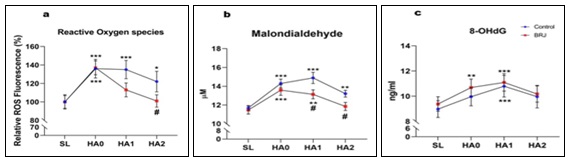
FIG. 2: REPRESENTATION OF OXIDATIVE STRESS BIOMARKER IN CONTROL AND BRJ SUPPLEMENTED GROUP AT SL, HA0, HA1 AND HA2. (A) ROS, (B) MDA, AND (C) 8-OHDG. VALUES ARE EXPRESSED AS MEAN ± SEM. Statistical significance is represented as *p < 0.05, **p < 0.01, ***p < 0.001 in control and BRJ supplemented group at each time interval as compared to SL. #p < 0.05 represents the significance between control and BRJ supplemented group at each time interval.
Immune Response and Inflammatory Biomarker: Immunoglobulins (IgG, IgM and IgA) measured in plasma showed no significant change at any time points in either group Fig. 3. Serum CRP was also measured, and an increase on HA0 was observed in both groups as compared to SL. Afterwards, a decline in CRP levels were observed in both control and BRJ supplemented group, but the decline was significant in BRJ supplemented group relative to control group on HA2 Fig. 3D. Similar results were obtained for interleukin-6 (IL-6) Fig. 3E. The IL-6 levels were significantly reduced in the BRJ supplemented group compared to the control group on HA2, with a moderate effect size (Hedges’ g = 0.92).
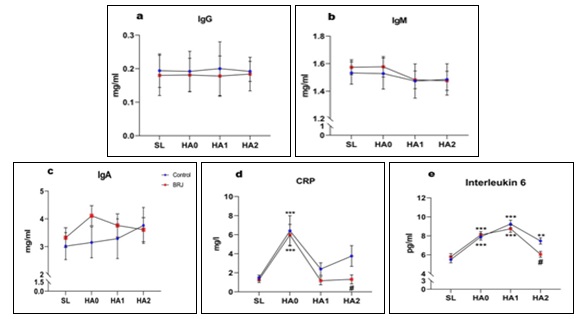
FIG. 3: REPRESENTATION OF IMMUNOGLOBULINS AND INFLAMMATORY BIOMARKERS IN CONTROL AND BRJ SUPPLEMENTED GROUP AT SL, HA0, HA1 AND HA2. (A) IGG, (B) IGM, (C) IGA AND (D) CRP (E) IL-6. Values are expressed as mean ± SEM. Statistical significance is represented as ***p < 0.001 in control and BRJ supplemented group at each time interval as compared to SL. #p < 0.05 represents the significance between Control and BRJ supplemented group at each time interval.
Enzymatic and Non-enzymatic Antioxidants Status: There was no significant difference in SOD activity observed upon induction to high altitude (HA0) in both groups relative to SL Fig. 4A. Following this, control and BRJ group exhibited a gradual increase in SOD activity on HA1 and HA2. In comparison with SL, BRJ group had significant (p <0.001) increase in SOD activity on HA1 and HA2, whereas the control group showed the significant (p <0.001) increase on HA2. The intergroup comparison demonstrated a significant (p <0.05) increase in SOD activity in BRJ group as compared to the control group on HA1 (Hedges’ g = 0.59). Similar results were observed for Catalase in both the groups Fig. 4B. Catalase shown a small effect size (Hedges’ g = 0.42) on HA1. GPx activity was elevated (p <0.001) in both groups upon high altitude exposure (HA0) in compared with SL Fig. 4C. Thereafter, a slight decline in GPx activity was observed in both groups on HA1 and HA2, but it remained higher in the control group than in the BRJ supplemented group (p <0.05). TAC was measured using FRAP Fig. 5A and ABTS radical cation decolorizing assay (figure 5b). Upon exposure to high altitude (HA0), both groups exhibited a decrease (p <0.001) in antioxidant status compared to SL. The decrease in antioxidant capacity remained constant in control group at all time interval; on the other hand, the BRJ supplemented group had increased antioxidant activity compared to the control group on HA1 and HA2 (p <0.05). The antioxidant capacity calculated using ABTS assay showed a moderate effect of intervention on HA1 (Hedges’ g = 0.65) and a large effect on HA2 (Hedges’ g = 0.98). However, the effect size calculated for TAC performed via FRAP assay showed a moderate effect on HA1 (Hedges ’g = 0.43) and HA2 (Hedges’ g = 0.48).
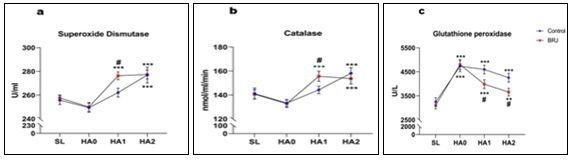
FIG. 4: REPRESENTATION OF ENZYMATIC ANTIOXIDANT BIOMARKER IN CONTROL AND BRJ SUPPLEMENTED GROUP AT SL, HA0, HA1 AND HA2. (A) SOD, (B) CATALASE, AND (C) GPX. Values are expressed as mean ± SEM. Statistical significance is represented as **p < 0.01, ***p < 0.001 in control and BRJ supplemented group at each time interval as compared to SL. #p < 0.05 represents the significance between control and BRJ supplemented group at each time interval
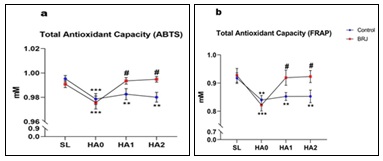
FIG. 5: REPRESENTATION OF TOTAL ANTIOXIDANT CAPACITY IN CONTROL AND BRJ SUPPLEMENTED GROUP AT SL, HA0, HA1 AND HA2. (A) FRAP, (B) ABTS. Values are expressed as mean ± SEM. Statistical significance is represented as **p < 0.01, ***p < 0.001 in control and BRJ supplemented group at each time interval as compared to SL. #p < 0.05 represents the significance between control and BRJ supplemented group at each time interval.
Redox Status: GSH levels decreased significantly (p <0.001) in both groups upon induction to HA Fig. 6A. Thereafter, the GSH levels increased in both groups during HA stay. No significant difference was observed in GSH levels between the groups at any time interval. GSSG levels, on the other hand, were found increased on HA0compared to SL in both groups Fig. 6B. The BRJ group exhibited a significant (p <0.05) decrease in GSSG level on HA1 and HA2 in comparison to the control group. GSH/GSSG ratio decreased significantly (p <0.001) upon high altitude (HA0) exposure in both groups. There was a significant (p <0.05) increase in the GSH/GSSG ratio on HA0 and HA1 in BRJ supplemented group as compared to the control group.
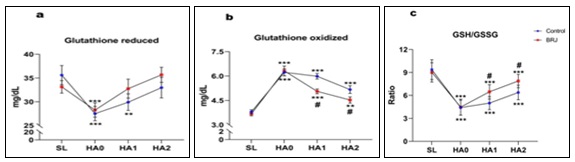
FIG. 6: REPRESENTATION OF REDOX STATUS IN CONTROL AND BRJ SUPPLEMENTED GROUP AT SL, HA0, HA1 AND HA2. (A) GSH, (B) GSSG, AND (C) GSH/GSSG. Values are expressed as mean ± SEM. Statistical significance is represented as **p < 0.01, ***p < 0.001 in control and BRJ supplemented group at each time interval as compared to SL. #p < 0.05 represents the significance between control and BRJ supplemented group at each time interval.
Catecholamines and Cortisol: The results for catecholamines and cortisol are represented in Table 1. There was no significant change in epinephrine, norepinephrine, and dopamine measured on HA0 and HA1 in the control and BRJ supplemented group compared to SL values. However, a slight (p <0.05) increase was observed for epinephrine in control group while, no change was observed in the BRJ supplemented group on HA2. Both groups showed a significant (p <0.001) increase in norepinephrine and dopamine on HA2 compared to SL. No significant difference was observed between the groups at any time point during HA stay. No changein salivary cortisol levels was observed in either group upon HA induction. However, a significant (p <0.001) increase was measured during high altitude stay in both groups. No significant difference was observed between the two groups at any time interval.
TABLE 1: COMPARATIVE CHANGES IN CATECHOLAMINES AND CORTISOL IN CONTROL AND BR SUPPLEMENTED GROUP AT SEA LEVEL AND HIGH ALTITUDE
| Parameters | Group | SL | HA0 | HA1 | HA2 |
| Epinephrine
(ng/L) |
Control | 24.43 ± 3.11 | 25.45 ± 1.89 | 26.88 ± 1.10 | 35.07 ± 7.2* |
| BRJ supplemented | 23.57 ± 1.87 | 24.41 ± 1.11 | 27.78 ± 1.22 | 28.63 ± 3.66 | |
| Norepinephrine
(ng/L) |
Control | 186.1 ± 28.12 | 228.8 ± 24.25 | 236.5 ± 16.33 | 371.1 ± 56.87 *** |
| BRJ supplemented | 181.7 ± 16.95 | 208.2 ± 14.91 | 228.2 ± 21.04 | 328.2 ± 34.67 *** | |
| Dopamine (ng/L) | Control | 89.28 ± 26.01 | 95.43 ± 13.64 | 107.71 ± 18.13 | 213.64 ± 19.14 *** |
| BRJ supplemented | 109.38 ± 24.45 | 90.41 ± 10.17 | 128.34 ± 9.32 | 225.66 ± 19.16 *** | |
| Cortisol (ng/ml) | Control | 10.53 ± 0.23 | 11.21 ± 0.28 | 13.76 ± 0.58 *** | 12.75 ± 0.6 *** |
| BRJ supplemented | 10.80 ± 0.33 | 11.10 ± 0.26 | 14.84 ± 0.66 *** | 13.64 ± 0.58 *** |
Values are represented as mean ± SEM. Statistical significance in control and BRJ supplemented group in comparison to SL measurements is represented as **p < 0.01, ***p <0.001 for each time interval. Statistical significance between control and BRJ supplemented groupis represented as #p < 0.05at that particular time interval.
DISCUSSION: Oxidative stress results from an imbalance between the generation of oxidants and the elimination of free radicals by the system, induced by any stressful condition. This leads to cellular damage and so affects the cellular function. One such stressful condition is the encounter of high-altitude hypoxia, which adversely affects the redox homeostasis either by elevating ROS generation or by reducing the effective antioxidant response of cells 15. The reduced levels of oxygen at high altitude triggers the mitochondrial electron transport chain leaks 16. This leakage leads to overproduction of superoxide, hydrogen peroxide, and other ROS, overwhelms the system, and causes damage to cells, protein, lipid and DNA. Therefore, introducing the nutraceuticals, rich in antioxidants like phytochemicals and flavonoids is an effective approach to mitigate against the oxidative stress induced at high altitude 17. Beetroot is a rich source of nitrate and other bioactive compounds, confers antioxidant and inflammatory properties, and research shows that the administration of antioxidant rich supplementation helps to attenuate oxidative stress 18. In a randomized control trial at high altitude, the intervention of antioxidant rich food significantly improves the antioxidant capacity but also suppress the expression of some of the systemic inflammatory biomarkers in elite athletes 19.
In this longitudinal study, we explored the effect of HA hypoxia on redox homeostasis and the efficacy of BRJ supplementation in reducing oxidative stress and elevating the endogenous antioxidants at high altitude. To the best of our knowledge, no published study to date has investigated the role of beetroot supplementation in subsiding oxidative stress in lowlanders expending to high altitude. Therefore, this study represents the first longitudinal investigation exploring the modulatory effect of beetroot juice on redox homeostasis at high altitude. In this study, it has been observed that induction to high altitude exhibited increase in ROS, lipid peroxides, oxidative DNA damage and inflammation in bothgroups. The levels of enzymatic and non-enzymatic antioxidants besides ROS were also altered upon HA exposure (HA0) in both groups, reflecting redox imbalance. These findings are similar to previous research 20, 21, suggesting that exposure of high altitude hypoxia exerts oxidative imbalance in lowlanders.
The main findings of the study demonstrated reduction in oxidative stress, inflammation and improvement in endogenous antioxidants in the BRJ supplemented group at high altitude. We observed a signification reduction in ROS and lipid peroxides in BRJ supplemented group on HA1 compared to the control group, while no significant difference was found between the group for oxidative DNA damage during the study. We also found a significant increase in the activity of SOD and catalase in the BRJ supplemented group compared to the control group. The levels of GPx were initially increased upon exposure to high altitude in bothgroups, but decreased significantly in the BRJ supplemented group during the high altitude stay. These results are in the agreement with previous studies. Kujawska reported that the pretreatment with beetroot in carbon tetrachloride induced rats, not only diminishes the oxidative stress but also restore the antioxidant capacity 22. Similarly, another study reported the role of beetroot supplementation in restoringantioxidant capacity by showing the increase in SOD and CAT after beetroot supplementation 23.
Similar to the enzymatic pool of antioxidants, disruption of non-enzymatic antioxidants was also observed. The glutathione redox system is the main regulatory mechanism to regulate the cellular redox balance. GSH levels decreased upon high altitude exposure, but improved in both the groups during HA stay. GSSG levels, on the other hand, increased upon induction to HA but later decreased significantly in the BRJ supplemented group compared to the control group. Accordingly, GSH/GSSG ratio was found increased in BRJ supplemented group compared to control group on HA1 and HA2. The initial decline in GSH indicates its enhanced utilization by GPx, leading to an increase in GSSG levels. These results are supported by previous studies 24. The GPx levels decreased significantly in the BRJ supplemented group during the stay after the restoration of SOD and catalase. The ability of BRJ to restore the redox homeostasis might be attributed through different mechanism, including the quenching of free radical, nitric oxide synthesis, increased activity of antioxidant enzymes and suppression of inflammatory markers. In the present investigation, BRJ supplementation exhibited a significant increase in TAC compared to the control group at high altitude. These findings are in line with prior studies, which reported the similar results 5,25. Another study conducted on diabetic patients showed the increase in total antioxidant capacity post beetroot consumption26. Although, our results are consistent with many of the prior research, some studied reported that supplementing with beetroot had a null effect, increased lipid peroxidation or in-effective in highly trained individuals 27, 28, 29. The discrepancy in the results could be due to difference in the type of stress, the duration and dose of beetroot supplementation, the characteristics of the population, and the methodology applied.
Oxidative stress adversely affects humoral immunity. We also measured the immune response during the study to explore the effect of high altitude hypoxia, but observed no significant changes in IgG, IgM and IgA levels at any time point of the study.
During the study, the BRJ supplemented group had significantly lower CRP and IL-6 levels than the control group at high altitude, suggesting the role of BRJ in reducing systemic inflammation. The results are consistent with previous findings, suggesting the role BRJ in reducing the systemic inflammation 5, 25. The stress caused at high altitude triggers the hypothalamic pituitary adrenal (HPA) axis and sympatho adrenomedullary system (SAM). Catecholamines were measured by HPLC. No significant change was observed in epinephrine, norepinephrine and dopamine on HA0 and HA1 in both the groups. These results are similar with previous studies 30. However, their levels increased on HA2 in both the groups.
CONCLUSION: In conclusion, our study suggests beneficial impact of beetroot juice supplementation in amelioration of oxidative stress and restoration of endogenous antioxidants at high altitude. The antioxidant and anti-inflammatory impact of beetroot supplementation has been studies in different individuals (healthy, diseased and athletes) at SL. However, this was the first longitudinal study reporting the impact of beetroot juice supplementation over the period of 15 days in large number of cohorts. These findings are particularly helpful for soldiers, athletes, hikers, and pilgrims seeking to improve their health and performance, hampered due to high altitude induced oxidative stress.
ACKNOWLEDGEMENT: We are very thankful to the Defence Institute of Physiology and Allied Sciences (DIPAS), the Defence Research and Development Organization (DRDO) and the Director (DIPAS) for providing funds and necessary support for the study (project OPEX- DIP-274). We are also thankful to the participants who took part in this study
Authorship Contribution Statement: Karishma Dohare: Conceptualization, Methodology, Validation, Formal analysis, Investigation, Sample collection, Data curation, Writing-original draft. Divya Singh: Data curation, Study planning, Sample collection. Praveen Vats: Conceptualization, Methodology, Data curation, Writing- review and editing, Supervision, and Project administration. Subhasis Bose: Sample collection.
CONFLICT OF INTEREST: The authors declare no known competing financial interest or personal relationship to influence the work reported in the manuscript.
REFERENCES:
- Zhang ZA, Sun Y, Yuan Z, Wang L, Dong Q, Zhou Y, Zheng G, Aschner M, Zou Y and Luo W: Insight into the Effects of High‐Altitude Hypoxic Exposure on Learning and Memory. Oxidative Medicine and Cellular Longevity 2022; 2022(1): 4163188. https://doi.org/10.1155/2022/4163188
- Vats P, Singh VK, Singh SN and Singh SB: Glutathione metabolism under high-altitude stress and effect of antioxidant supplementation. Aviation, Space, And Environmental Medicine 2008; 79(12): 1106-11. https://doi.org/10.3357/ASEM.2305.2008
- Fischetti F, Fabris B, Zaccaria M, Biagi A, Calci M, Candido R, Bortoletto M and Carretta R: Effects of prolonged high-altitude exposure on peripheral adrenergic receptors in young healthy volunteers. European Journal of Applied Physiology 2000; 82(5): 439-45. https://doi.org/10.1007/s004210000239
- Mudgal D, Singh S and Singh BR: Nutritional composition and value added products of beetroot: A review. Journal of Current Research in Food Science 2022; 3(1): 01-9.
- Asgary S, Afshani MR, Sahebkar A, Keshvari M, Taheri M, Jahanian E, Rafieian-Kopaei M, Malekian F and Sarrafzadegan N: Improvement of hypertension, endothelial function and systemic inflammation following short-term supplementation with red beet (Beta vulgaris L.) juice: a randomized crossover pilot study. Journal of Human Hypertension 2016; 30(10): 627-32.https://doi.org/10.1038/jhh.2016.34
- Aliahmadi M, Amiri F, Bahrami LS, Hosseini AF, Abiri B and Vafa M: Effects of raw red beetroot consumption on metabolic markers and cognitive function in type 2 diabetes patients. Journal of Diabetes & Metabolic Disorders 2021; 20(1): 673-82.https://doi.org/10.1007/s40200-021-00798-z
- Dohare K, Bose S, Kumar R, Chand F, Singh D and Vats P: Impact of Beetroot Juice Supplementation on Physiological Variables of Individuals Exposed to High Altitude. Journal of Clinical and Biomedical Sciences 2025; 15(2): 104-11. doi.org/ 10.58739/jcbs/v15i2.24.188
- Ghanbari P, Khajehzadeh S, Sayyed A, Raeisi D and Salehi O: The effect of high intensity interval training with beetroot (Beta vulgaris) juice supplementation on serotonin and dopamine receptors expression, anxiety and depression in middle-aged diabetic rats. Avicenna Journal of Phytomedicine 2022; 12(6): 627. https://doi.org/10.22038/AJP.2022.20895
- Bakonyi T and Radak Z: High altitude and free radicals. Journal of Sports Science & Medicine 2004; 3(2):64.
- Pasciu V, Nieddu M, Sotgiu FD, Baralla E and Berlinguer F: An overview on assay methods to quantify ROS and enzymatic antioxidants in erythrocytes and spermatozoa of small domestic ruminants. Animals 2023; 13(14): 2300. http://doi.org/10.3390/ani13142300
- Malta LG and Liu RH: Analyses of total phenolics, total flavonoids, and total antioxidant activities in foods and dietary supplements. Encyclopedia of Agriculture and Food Systems 2014.https://doi.org/10.1016/B978-0-444-52512-3.00058-9
- Re R, Pellegrini N, Proteggente A, Pannala A, Yang M and Rice-Evans C: Antioxidant activity applying an improved ABTS radical cation decolorization assay. Free Radical Biology and Medicine 1999; 26(9-10): 1231-7.https://doi.org/10.1016/S0891-5849(98)00315-3
- Hissin PJ and Hilf R: A fluorometric method for determination of oxidized and reduced glutathione in tissues. Analytical biochemistry 1976; 74(1): 214-26.https://doi.org/10.1016/0003-2697(76)90326-2
- Sinha S, Singh SN, Saha M, Kain TC, Tyagi AK and Ray US: Antioxidant and oxidative stress responses of sojourners at high altitude in different climatic temperatures. International Journal of Biometeorology 2010; 54(1): 85-92.https://doi.org/10.1007/s00484-009-0257-9
- Li X, Zhang J, Liu G, Wu G, Wang R and Zhang J: High altitude hypoxia and oxidative stress: the new hope brought by free radical scavengers. Life Sciences 2024; 336: 122319.https://doi.org/10.1016/j.lfs.2023.122319
- Dosek A, Ohno H, Acs Z, Taylor AW and Radak Z: High altitude and oxidative stress. Respiratory Physiology & Neurobiology 2007; 158(2-3): 128-31.https://doi.org/10.1016/j.resp.2007.03.013
- Askew EW: Work at high altitude and oxidative stress: antioxidant nutrients. Toxicology 2002; 180(2): 107-19.https://doi.org/10.1016/S0300-483X(02)00385-2
- Arazi H and Eghbali E: Possible effects of beetroot supplementation on physical performance through metabolic, neuroendocrine, and antioxidant mechanisms: a narrative review of the literature. Frontiers in Nutrition 2021; 8: 660150.https://doi.org/10.3389/fnut.2021.660150
- Koivisto AE, Olsen T, Paur I, Paulsen G, Bastani NE, Garthe I, Raastad T, Matthews J, Blomhoff R and Bøhn SK: Effects of antioxidant-rich foods on altitude-induced oxidative stress and inflammation in elite endurance athletes: a randomized controlled trial. PLoS One 2019; 14(6): 0217895. https://doi.org/10.1371/journal.pone.0217895
- Jain S, Paul S, Meena RN, Gangwar A, Panjwani U, Ahmad Y and Bhargava K: Saliva panel of protein candidates: a comprehensive study for assessing high altitude acclimatization. Nitric Oxide 2020; 95: 1-1. https://doi.org/10.1016/j.niox.2019.11.007
- Biuomy AR, Oraby FS, Khalifa EA, El-Sherif HA, Hussein J and Abdel-Latif Y: Hypoxia-induced oxidative stress in high altitude population: impact of coenzyme Q10 supplementation. Journal of Complementary and Integrative Medicine 2021; 18(3): 621-6. https://doi.org/10.1515/jcim-2020-0077
- Kujawska M, Ignatowicz E, Murias M, Ewertowska M, Mikołajczyk K and Jodynis-Liebert J: Protective effect of red beetroot against carbon tetrachloride-and N-nitrosodiethylamine-induced oxidative stress in rats. Journal of Agricultural and Food Chemistry 2009; 25; 57(6): 2570-5. https://doi.org/10.1021/jf803315d
- Rubi DS and Pramana AA: The protective effects of red beetroot (Beta vulgaris L.) against oxidative stress in rats induced by high fat and fructose diet. Acta Biochimica Indonesiana 2020; 3(2): 62-71. https://doi.org/10.32889/actabioina.v3i2.53
- Ilavazhagan G, Bansal A, Prasad D, Thomas P, Sharma SK, Kain AK and Kumar D: Effect of vitamin E supplementation on hypoxia-induced oxidative damage in male albino rats. Aviation, Space, and Environmental Medicine 2001; 72(10): 899-903.
- Raish M, Ahmad A, Ansari MA, Alkharfy KM, Ahad A, Khan A, Ali N, Ganaie MA and Hamidaddin MA: Beetroot juice alleviates isoproterenol-induced myocardial damage by reducing oxidative stress, inflammation, and apoptosis in rats. 3 Biotech 2019; 9(4): 147. https://doi.org/10.1007/s13205-019-1677-9
- Aliahmadi M, Amiri F, Bahrami LS, Hosseini AF, Abiri B and Vafa M: Effects of raw red beetroot consumption on metabolic markers and cognitive function in type 2 diabetes patients. Journal of Diabetes & Metabolic Disorders 2021; 20(1): 673-82. https://doi.org/10.1007/s40200-021-00798-z
- Kozłowska L, Mizera O, Gromadzińska J, Janasik B, Mikołajewska K, Mróz A and Wąsowicz W: Changes in oxidative stress, inflammation, and muscle damage markers following diet and beetroot juice supplementation in elite fencers. Antioxidants 2020; 9(7): 571.https://doi.org/10.3390/antiox9070571
- Jones L, Bailey SJ, Rowland SN, Alsharif N, Shannon OM and Clifford T: The effect of nitrate-rich beetroot juice on markers of exercise-induced muscle damage: A systematic review and meta-analysis of human intervention trials. Journal of Dietary Supplements 2022; 19(6): 749-71. doi.org/10.1080/19390211.2021.1939472
- Mansouri-Baseri A, Moohebati M, Bahrami LS, Tabesh H, Rezaie M, Nematy M, Davoudi F and Rezvani R: Effect of beetroot extract supplementation on serum fatty acid profiles and oxidative stress markers in chronic coronary artery disease patients: a secondary analysis of a randomized controlled trial. BioMed Research International 2025; 2025(1): 6654492. https://doi.org/10.1155/bmri/6654492
- Richalet JP, Letournel M and Souberbielle JC: Effects of high-altitude hypoxia on the hormonal response to hypothalamic factors. American Journal of Physiology-Regulatory, Integrative and Comparative Physiology 2010; 299(6): 1685-92. https://doi.org/10.1152/ajpregu.00484.2010
How to cite this article:
Dohare K, Bose S, Singh D and Vats P: Temporal evaluation of beetroot juice supplementation on redox homeostasis in high altitude exposed individuals. Int J Pharm Sci & Res 2026; 17(9): 2685-94. doi: 10.13040/IJPSR.0975-8232.17(9).2685-94.
All © 2026 are reserved by International Journal of Pharmaceutical Sciences and Research. This Journal licensed under a Creative Commons Attribution-NonCommercial-ShareAlike 3.0 Unported License.
Article Information
12
2685-2694
745 KB
8
English
IJPSR
Karishma Dohare, Subhasis Bose, Divya Singh and Praveen Vats *
Defence Institute of Physiology and Allied Sciences, Lucknow Road, Timarpur, Delhi, New Delhi, India.
drvatsp@gmail.com
06 May 2026
04 June 2026
19 June 2026
10.13040/IJPSR.0975-8232.17(9).2685-94
01 September 2026
 Download