




THE EVOLVING LANDSCAPE OF CATHETER-ASSOCIATED URINARY TRACT INFECTION: A SYSTEMATIC REVIEW OF MECHANISMS, RISK, DIAGNOSIS, AND PREVENTION ACROSS GENERAL AND NEUROGENIC BLADDER POPULATIONS
HTML Full TextTHE EVOLVING LANDSCAPE OF CATHETER-ASSOCIATED URINARY TRACT INFECTION: A SYSTEMATIC REVIEW OF MECHANISMS, RISK, DIAGNOSIS, AND PREVENTION ACROSS GENERAL AND NEUROGENIC BLADDER POPULATIONS
C. Dhandapani and K. Nandhini *
Department of Pharmacy Practice, KMCH College of Pharmacy, Coimbatore, Tamil Nadu, India.
ABSTRACT: Background: Catheter-associated urinary tract infection (CAUTI) is the most common healthcare-associated infection worldwide and remains a major contributor to patient morbidity, prolonged hospitalization, antimicrobial resistance, and increased healthcare costs. Despite advances in infection prevention and catheter management, CAUTI continues to be a significant challenge in tertiary care hospitals. Retrospective and observational studies provide valuable real-world evidence regarding epidemiology, risk factors, microbiological profiles, clinical outcomes, and prevention strategies. This systematic review was conducted to synthesize current evidence on the evolving landscape of CAUTI in tertiary care settings. Objectives: The objectives of this systematic review were to evaluate the incidence and epidemiology of CAUTI in tertiary care hospitals, identify major risk factors and causative microorganisms, assess diagnostic and preventive practices, and summarize clinical outcomes reported in retrospective and observational studies. Methods: A PRISMA 2020-compliant systematic review was conducted. Electronic databases including PubMed, Scopus, Google Scholar, Web of Science, and DOAJ were searched for eligible studies published between January 2000 and June 2026. Retrospective and observational studies conducted in tertiary care hospitals that reported CAUTI incidence, risk factors, microbiological characteristics, prevention strategies, or patient outcomes were included. Data extraction and quality assessment were performed using standardized forms and the Joanna Briggs Institute (JBI) critical appraisal tools for observational studies. Results: A total of 50 studies met the inclusion criteria. Reported CAUTI rates ranged from 3.5 to 15.0 per 1,000 catheter-days, with intensive care units showing the highest incidence. Prolonged catheterization, female sex, advanced age, diabetes mellitus, critical illness, and inadequate catheter care practices were consistently identified as significant risk factors. Escherichia coli, Klebsiella pneumoniae, Enterococcus spp., Pseudomonas aeruginosa, and Candida spp. were the predominant pathogens. Several studies reported increasing antimicrobial resistance, particularly among Gram-negative organisms. Implementation of catheter care bundles, staff education, reminder systems, and early catheter removal protocols significantly reduced CAUTI rates, with reported reductions ranging from 25% to 75%. Diagnostic challenges related to asymptomatic bacteriuria and overuse of antibiotics were frequently highlighted. Conclusions: CAUTI remains a substantial healthcare burden in tertiary care hospitals despite ongoing preventive efforts. Prolonged catheter use continues to be the strongest modifiable risk factor. Evidence supports the effectiveness of multifaceted prevention strategies, including catheter stewardship programs, adherence to aseptic techniques, continuous staff education, and prompt catheter removal. Future research should focus on innovative non-antibiotic preventive approaches, antimicrobial resistance surveillance, and standardized diagnostic criteria to further reduce the incidence and impact of CAUTI.
Keywords: Catheter-Associated Urinary Tract Infection, CAUTI, Tertiary Care Hospital, Systematic Review, Retrospective Studies, Observational Studies, Healthcare-Associated Infection, Urinary Catheterization, Antimicrobial Resistance, Infection Prevention, PRISMA
INTRODUCTION:
Epidemiology: Urinary tract infections (UTIs) rank among the most prevalent bacterial infections, impacting approximately 150 million people globally each year (Werneburg, 2022). UTIs are generally categorized into uncomplicated and complicated types; the latter occurs when there is a structural or functional abnormality in the urinary tract, immunosuppression, or the presence of a foreign object like a urinary catheter.
In the United States, indwelling urinary catheters are responsible for up to 80% of complicated UTIs, with catheter-associated urinary tract infections (CAUTIs) being the most frequent hospital-acquired infection. These account for about one million cases annually and are the primary cause of secondary bloodstream infections 1. The likelihood of bacteriuria increases by 3–7% each day a catheter is in place, with the duration of catheterization consistently identified as the most significant risk factor for CAUTI 1, 2.
A prospective observational study conducted in a medical intensive care unit (MICU) in northern India reported a CAUTI rate of 9.4 per 1000 catheter-days, with an overall incidence of 14.67% among 150 catheterized patients. The incidence of CAUTI increased significantly with the length of catheterization, rising from 3.8% within the first five days to 50% by the second week 2.
Although incidence and cost estimates differ across various settings, the preventable CAUTI-related costs in the United States are estimated to range from $115 million to $1.82 billion annually. Historically, individual episodes cost at least $600, while those complicated by bacteremia exceed $2800 1, 3. The risk is not evenly distributed: rates are 3-5 times higher in intensive care units compared to general wards, and 3-10% of residents in long-term care facilities use chronic indwelling catheters, a group where CAUTI and its complications continue to pose significant challenges 1.
Review of Literature: Researchers have long recognized that catheter-associated bacteriuria doesn't behave like a typical infection. Tambyah and Maki (2000) ⁹ were among the first to show this clearly, finding that most catheterized patients with bacteriuria had no symptoms at all. Nicolle (2005) ¹⁰ picked up on this a few years later, warning clinicians against reflexively treating every positive urine culture, since bacteriuria becomes almost universal the longer a catheter stays in. This growing recognition that "positive culture" doesn't mean "infection" eventually shaped formal guidance - Hooton and colleagues (2010) ⁸ built it into the IDSA guidelines, explicitly advising against screening or treating asymptomatic bacteriuria, while Gould et al. (2010) ¹² and Lo et al. (2014) ¹¹ went a step further, laying out surveillance definitions and prevention bundles that still circle back to one simple message: don't catheterize unless you have to, and take it out as soon as you can.
Around the same time, attention turned to whether policy could push hospitals toward better habits. Saint et al. (2009) ⁵ looked at the CMS decision to stop reimbursing hospitals for CAUTI acquired during a stay and concluded it probably did more good than harm, nudging institutions to take prevention seriously, though they flagged a real risk of hospitals over-testing on admission just to cover themselves. That prediction played out in practice - Meddings et al. (2014) ¹³ later showed that simple, low-tech interventions like nurse-driven removal protocols and reminder systems genuinely cut down catheter-days and infection rates, proving that the fix didn't need to be complicated.
More recent research has dug into the biology and the higher-risk groups. Bossa et al. (2017) ¹ used molecular sequencing to show that the bacterial community living on a catheter actually shifts in the days before a UTI becomes clinically obvious - a hint that we might one day catch infections before they cause symptoms. Meanwhile, Linsenmeyer (2018)² and van Buul et al. (2018) ⁶ zeroed in on patients who are hardest to manage: those with neurogenic bladder, where indwelling catheters clearly carry more risk than suprapubic or intermittent options, and frail older adults, where an international panel of experts had to build a whole decision tool just to stop clinicians from prescribing antibiotics for symptoms like confusion or fatigue that usually have nothing to do with a UTI. Saadat et al. (2019) ⁴ added a practical piece to this puzzle, finding that single-use, hydrophilic-coated catheters lower UTI risk compared to reusable ones - useful evidence for anyone choosing equipment.
Bringing things up to date, Werneburg (2022)⁷ pulled together the wider CAUTI picture, from biofilm biology to newer non-antibiotic strategies still in development. And closer to home, Parihar et al. (2023) ³ studied a north Indian ICU and found a CAUTI rate of 9.4 per 1,000 catheter-days, with infection risk climbing steeply the longer the catheter stayed in place - alongside worryingly high resistance to ciprofloxacin.
Taken together, this body of work keeps circling back to the same conclusion: however the tools and diagnostics evolve, the single biggest lever we have against CAUTI is still simply not leaving the catheter in longer than necessary.
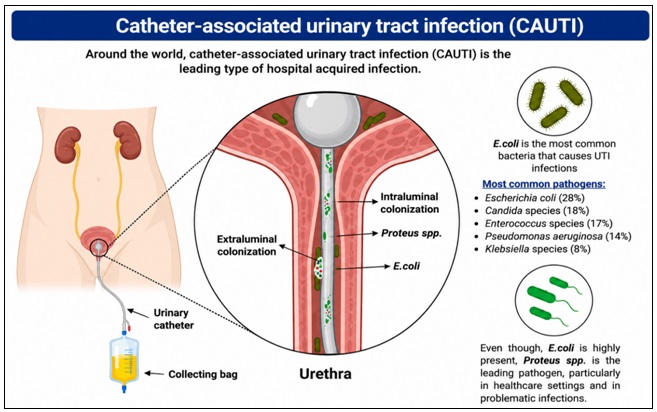
FIG. 1: CATHETER ASSOCIATED UTI
Pathogenesis and Microbiology: Urinary tract infections (UTIs) generally originate from the contamination of the urethra by rectal or periurethral flora, which then migrate to the bladder, adhere to host tissues, and establish colonization. Indwelling catheters create a direct pathway from the external environment to the bladder, circumventing the protective mechanical flushing effect of normal urination and causing trauma to the urothelium, thereby increasing the likelihood of bacterial adhesion and ascending infection. Bacteria adhere through pili and adhesins; catheterization also leads to fibrinogen deposition on the catheter surface, which fibrinogen-binding organisms like Enterococcus faecalis exploit to colonize, even if they cannot directly adhere to the catheter material directly 1.
Once bacteria adhere, they form biofilms – structured communities embedded in a matrix of extracellular DNA, exopolysaccharide, and surface adhesins such as pili and curli – which begin developing within minutes of catheter insertion and expand more rapidly after about three weeks. Biofilms protect bacteria from antibiotics and the host's immune system, serving as a persistent reservoir that seeds the urinary tract.
Different uropathogens employ distinct strategies: uropathogenic Escherichia coli (UPEC) uses type 1 pili, antigen 43, and curli; Pseudomonas aeruginosa relies on alginate production, quorum sensing, and surface hydrophobicity; and urease-producing organisms like Proteus mirabilis hydrolyze urea to increase urinary pH, forming crystalline biofilms of calcium and magnesium ammonium phosphate 1, 2.
Molecular profiling studies reveal that the microbiome associated with catheters is highly individualized. In a longitudinal study of three neurogenic-bladder patients using T-RFLP and 16S rRNA amplicon sequencing, Proteobacteria were predominant in the catheter microbiota (averaging 79% of sequences), with Enterobacteriaceae and Enterococcaceae consistently represented across patients, though community composition and diversity varied significantly between individuals and clustered strongly by patient identity 4. Notably, microbial community composition changed noticeably in the days before a clinically diagnosed urinary tract infection, with a significant increase in community diversity and the appearance of taxa such as Veillonella and Bacteroidales before symptoms appeared – suggesting that monitoring the microbiome could potentially provide early warning of an impending infection. The same study showed that oral probiotic administration (Lactobacillus rhamnosus/reuteri or LGG-BB12 combinations) caused a measurable but temporary shift in catheter-associated flora, which reverted to the pre-treatment community profile within weeks of stopping treatment, indicating that the native catheter microbiome could serve as an early warning system 4.
The most common organisms causing complicated UTI/CAUTI after UPEC (responsible for about 65% of complicated infections) include Enterococcus spp. (11%), Klebsiella pneumoniae (8%), Candida spp. (7%), Staphylococcus aureus (3%), Proteus mirabilis (2%), Pseudomonas aeruginosa (2%), and Group B Streptococcus (2%) (Werneburg, 2022). This distribution aligns broadly with findings from an Indian MICU cohort, where E. coli (6% of all catheterized patients; the most common isolate) was followed by Enterococcus species (4%), Pseudomonas species (3.3%), Enterobacter aerogenes (2%), and Klebsiella and Acinetobacter species 2.
Risk Factors:
- Duration of catheterization – the dominant and most consistently reported risk factor; bacteriuria risk increases 3–7% per catheter-day, and CAUTI incidence rises sharply after roughly one week of catheterization 1, 2.
- Female sex – attributed to a shorter urethra, its proximity to the anus, and urethral dilatation, which together facilitate ascending bacterial spread2.
- Extremes of age, particularly older adults, in whom atypical presentation further complicates diagnosis 2, 5.
- Diabetes mellitus – associated with increased perineal microbial colonization and higher CAUTI incidence (17.2% vs 14.0% in non-diabetic catheterized patients) 2.
- Catheter type – indwelling urethral catheters carry substantially higher UTI incidence than suprapubic catheters, intermittent catheterization, condom catheters, or normal voiding; in one prospective comparison, incidence per 100 patient-days was 2.72 for indwelling urethral catheters versus 0.34–0.41 for suprapubic tubes or intermittent catheterization 6.
- Breaks in closed drainage systems, improper insertion technique, and positioning of tubing or drainage bags above the level of the bladder 1.
- ICU admission and critical illness, associated with 3–5 times higher CAUTI incidence than general hospital wards 1.
TABLE 1: MAJOR RISK FACTORS ASSOCIATED WITH CAUTI
| Risk Factors | Evidence From Studies |
| Prolonged catheterization | Risk increases 3–7% per catheter day |
| Female sex | Higher incidence due to anatomical factors |
| Advanced age | Higher susceptibility |
| Diabetes mellitus | Increased microbial colonization |
| ICU admission | 3–5 times higher risk than wards |
| Improperinsertion technique | Promotes early colonization
|
Diagnosis:
Signs, Symptoms, and Overdiagnosis: Diagnosis of CAUTI conventionally requires both a compatible clinical picture and a positive urine culture. However, in catheterized patients, classic urinary symptoms (urgency, frequency, dysuria) are not applicable because voiding is no longer volitional, and the correlate symptom complex - new fever, rigors, altered mental status, malaise, flank pain, or costovertebral angle tenderness - is nonspecific and frequently overlaps with other causes of clinical deterioration 1.
In populations with neurogenic bladder or spinal cord injury (SCI), symptom recognition is further complicated: patients often cannot reliably self-predict whether they have a UTI (accuracy in prospective studies has ranged from 61–66%), and atypical markers such as increased spasticity or autonomic dysreflexia may be the only clues to infection 6. This diagnostic ambiguity, combined with the high baseline prevalence of asymptomatic bacteriuria in catheterized patients, drives substantial overdiagnosis and overtreatment.
Guidelines from the Infectious Diseases Society of America (IDSA) and the American Urological Association explicitly recommend against screening for or treating asymptomatic bacteriuria in catheterized patients (with rare exceptions such as pregnancy or planned urologic surgery with anticipated mucosal trauma), since bacteriuria in this population reflects colonization rather than infection in the overwhelming majority of cases and unnecessary antibiotic use accelerates resistance without clinical benefit 1, 6.
Limitations of Pyuria and Urinalysis: Unlike in uncomplicated UTI, pyuria has limited diagnostic value in CAUTI: it is common in both true infection and asymptomatic bacteriuria, and studies report positive predictive values as low as 32% for bacteriuria 1. The IDSA specifically states that pyuria should not be used to diagnose or differentiate CAUTI from asymptomatic bacteriuria in catheterized patients, and that cloudy or malodorous urine should likewise not trigger culture or treatment in isolation. A Delphi consensus among international experts similarly concluded that urinalysis (dipstick nitrite/leukocyte esterase) should not influence treatment decisions in frail older adults with urinary tract–related symptoms unless both nitrite and leukocyte esterase are negative – in which case a UTI can reasonably be ruled out 5.
Culture Thresholds and Specimen Collection: Diagnostic colony-forming-unit (CFU) thresholds vary between guideline bodies: the IDSA and European Association of Urology (EAU) use ≥10³ CFU/mL, while the CDC/NHSN surveillance definition uses ≥10⁵ CFU/mL. Specimens should be collected prior to initiating antibiotics, ideally via the catheter port using aseptic technique; for catheters that have been indwelling for a prolonged period, replacing the catheter and culturing from the freshly placed device is preferred, since culture results from long-indwelling, biofilm-laden catheters may not accurately reflect true bladder bacteriology 1.
Emerging Diagnostic Approaches: Because urine culture requires at least 48 hours to finalize antibiotic susceptibility, there is active interest in more rapid, culture-independent diagnostics. Candidate biomarkers include interleukin-6 and interleukin-8 (IL-8 rises specifically at the time of UTI onset, while IL-6 elevation precedes UTI by 2–4 days but is nonspecific), neutrophil gelatinase-associated lipocalin (NGAL, AUC 0.82 for distinguishing UTI from asymptomatic bacteriuria in a pediatric neurogenic bladder cohort), procalcitonin, lactoferrin, and urinary cell-free DNA. Machine learning approaches are also being applied to accelerate antibiotic susceptibility prediction (94–99% accuracy within four hours in one study), to guide empiric antibiotic selection from electronic medical record data, and to automate interpretation of urine culture plate images with reported accuracy matching laboratory technologist consensus. Validated symptom instruments such as the Urinary Symptom Questionnaires for People with Neurogenic Bladder (USQNB) have also been developed to more systematically elicit symptoms that may or may not reflect true infection in this population 1.
TABLE 2: COMMON CAUTI PATHOGENS REPORTED IN INCLUDED STUDIES
| Organism | Approximate Frequency (%) |
| Escherichia coli | 65 |
| Enterococcus spp. | 11 |
| Klebsiella pneumoniae | 8 |
| Candida spp. | 7 |
| Staphylococcus aureus | 3 |
| Proteus mirabilis | 2 |
| Pseudomonas aeruginosa | 2 |
| Group B Streptococcus | 2 |
Prevention:
General Principles and Care Bundles: The single most effective prevention strategy is to avoid unnecessary catheterization altogether and to remove catheters as soon as they are no longer clinically indicated; daily assessment of catheter necessity is considered the cornerstone intervention (Werneburg, 2022; Saint et al., 2009).
Multimodal 'bundle' interventions – combining nurse-driven removal protocols, physician reminder systems, catheter placement restrictions to defined indications, staff education, and surveillance feedback – have repeatedly demonstrated meaningful reductions in CAUTI rates, generally in the range of 25–75%, although complete elimination of risk is not achievable and randomized evidence for individual bundle components (such as automatic 'stop orders') has been mixed. A national US survey found that as of 2005, 56% of hospitals had no system for tracking which patients had a catheter in place, 74% did not monitor catheter duration, and only 9% used any form of removal reminder – underscoring a substantial implementation gap relative to available evidence. Implementation of structured EMR-based bundles (insertion criteria, maintenance checklists, and removal reminders) has been associated with CAUTI rate reductions of up to 37% in multinational studies and reduced catheter utilization from roughly 20% to 19% of patient-days in a US national program 1.
Insertion Technique, Drainage, and Catheter Exchange: Aseptic insertion technique, hand hygiene, use of the smallest appropriate catheter caliber, adequate lubrication, and maintenance of a closed drainage system are foundational IDSA-endorsed practices. The drainage bag and connective tubing should be kept below the level of the bladder; positioning above bladder level is associated with increased bacteriuria. Catheter securement devices may reduce urethral trauma and catheter-related infection, although trial evidence remains statistically underpowered (a 45% CAUTI reduction with the StatLock securement device did not reach significance because of small sample size). Current IDSA guidance does not recommend scheduled catheter changes at fixed intervals in the absence of infection, obstruction, or a break in the closed system, despite evidence that biofilm burden and CAUTI risk increase with indwelling time 1.
Catheter Materials and Antimicrobial Coatings: No consistent difference in CAUTI risk has been demonstrated between latex and silicone catheters, so material selection is generally guided by allergy status rather than infection prevention. Hydrogel and PTFE coatings reduce nonspecific bacterial adherence to varying degrees; silver-alloy coated catheters have produced conflicting clinical results, with some large trials showing higher bacteriuria in silver-coated groups and a Cochrane review reporting a modest protective effect, but current evidence suggests silver catheters are unlikely to be cost-effective. Nitrofurazone-impregnated catheters show promising in vitro antimicrobial activity but inconsistent clinical benefit and higher rates of discomfort, and the topical agent has since been implicated as a possible carcinogen. Newer approaches under active investigation include silver, gold, copper, and zinc-doped nanoparticle coatings, antimicrobial peptides (e.g., CWR11, RRWRIVVIRVRRC, Chain201D), and engineered catheter geometries (asymmetric balloons, additional drainage holes) designed to reduce residual bladder volume and biofilm burden – most of these remain in preclinical or early clinical development 1.
Antibiotic and Antiseptic Prophylaxis: Evidence for antibiotic prophylaxis in long-term indwelling catheterization is sparse and generally not recommended, given the risk of selecting for resistant organisms; short-term (perioperative) prophylaxis has weak-to-moderate supporting evidence, primarily for reducing bacteriuria rather than symptomatic infection, and a 2013 meta-analysis found a 5.8% absolute risk reduction in CAUTI with prophylaxis at the time of catheter removal (number needed to treat = 17). By contrast, methenamine – a urinary antiseptic rather than an antibiotic, and therefore not associated with resistance selection – has more consistent evidence for delaying bacteriuria onset and reducing CAUTI incidence in catheterized populations, although it is contraindicated in renal impairment and severe hepatic disease 6.
Cranberry, D-Mannose, and Probiotics: Cranberry products, which are thought to act by disrupting P-pilus- and type-1-pilus-mediated bacterial adherence to the uroepithelium, have produced inconsistent results specifically in CAUTI prevention: a 2012 Cochrane review found no benefit, while a 2015 randomized trial in gynecologic surgery patients found roughly a 50% CAUTI reduction with cranberry tablets (Werneburg, 2022). Trials specifically in neurogenic bladder populations have not shown benefit, plausibly because these patients are frequently colonized by organisms other than E. coli, against which cranberry's proanthocyanidin-mediated mechanism is less effective (Linsenmeyer, 2018). D-mannose, which competitively blocks the FimH adhesin of type-1 pili, has shown promise in small studies but remains under-evaluated in catheterized cohorts.
Probiotic prophylaxis with Lactobacillus species has a more favorable evidence base in the general recurrent-UTI population but has not shown benefit in the largest randomized trial in patients with neurogenic bladder and indwelling or intermittent catheterization (the ProSCIUTTU trial, n = 207)1. Mechanistic work using catheter biofilm sequencing corroborates this: probiotic administration measurably alters catheter-associated microbial community composition, but the effect is transient and the community reverts toward baseline within weeks of stopping treatment, which may explain why trials haven’t seen durable clinical benefit 4.
Catheter Irrigation and Asymptomatic Bacteriuria: Cochrane-reviewed evidence on catheter irrigation/washout for infection prevention remains limited by trial quality, though a subsequent randomized trial of daily saline bladder irrigation in comatose ICU patients showed benefit, and small studies of intravesical gentamicin or povidone-iodine irrigation have reported reductions in symptomatic UTI in neurogenic bladder populations performing clean intermittent catheterization. As emphasized throughout the literature, screening for or treating asymptomatic bacteriuria is not recommended outside pregnancy or planned urologic mucosal surgery, since this practice increases antibiotic exposure without demonstrated clinical benefit and may worsen resistance 3.
Choice of Catheterization Method: Indwelling vs Intermittent, Single-Use vs Reuse: Where clinically feasible, alternatives to indwelling catheterization - condom catheters in men, clean intermittent catheterization (CIC), and suprapubic catheterization - carry substantially lower UTI risk than indwelling urethral catheters. Within intermittent catheterization, the choice between single-use and reusable catheters, and between hydrophilic-coated (HC) and uncoated catheters, has been extensively studied but remains debated. A literature review covering studies published 2014 onward found that single use of catheters – whether hydrophilic-coated or uncoated – was associated with lower UTI risk in nearly all included studies (the sole exception involving pediatric patients whose dexterity with HC catheters had not been formally assessed), and that cost-effectiveness analyses from multiple health systems (Canada, Brazil, Italy, Japan, the UK) consistently favored single-use HC catheters despite their higher upfront cost, owing to reduced downstream costs from UTI-related complications 7.
A previously influential 2014 Cochrane review had concluded reuse was non-inferior to single use, but this review was subsequently withdrawn after independent appraisal identified substantial methodological flaws; reanalysis found a small but non-significant trend favoring single use overall, and a statistically significant reduction in UTI incidence specifically with hydrophilic-coated catheters (risk ratio 0.81, 95% CI 0.65–0.99) 7. Notwithstanding this evidence, no consensus exists on optimal cleaning methods for reusable catheters, and national guideline bodies remain divided: European and North American nursing/urology associations (SUNA, EAUN, EAU) generally endorse single-use sterile catheters as the preferred standard, whereas the Canadian Urological Association continues to permit catheter reuse for up to approximately one week with soap-and-water cleaning, a position increasingly at odds with regulatory labeling and the broader evidence base 7.
Treatment:
Catheter Management: When symptomatic CAUTI is diagnosed, the catheter should be removed if no longer indicated, or exchanged for a new catheter prior to initiating antibiotics, particularly if the existing catheter has been in place for more than two weeks. A randomized trial in long-term-care residents with CAUTI found that catheter replacement (versus no replacement) prior to fluoroquinolone therapy produced significantly lower rates of polymicrobial bacteriuria, faster resolution of fever, and a lower 28-day CAUTI recurrence rate, at the cost of a modest risk of mucosal trauma from reinsertion.
Antibiotic Selection and Duration: Empiric antibiotic choice should be guided by illness severity, local antibiogram data, allergy history, and (once available) culture sensitivities; EAU guidance advises against empiric amoxicillin, trimethoprim-sulfamethoxazole, or amoxicillin-clavulanate for complicated UTI given contemporary resistance patterns, and reserves fluoroquinolones for settings where local resistance is below 10% because of the associated risk of tendinopathy.
The IDSA recommends a seven-day antibiotic course for patients with prompt symptom resolution, 10–14 days for those with delayed response, and as short as three days in women ≤65 years whose catheter has been removed, reflecting the general principle of minimizing unnecessary treatment duration to limit selection pressure for resistant organisms.
Multiple organisms are frequently isolated from catheter-associated infections, particularly with indwelling catheters (found in up to 71% of indwelling-catheter CAUTI episodes in one series, versus 14% with intermittent catheterization), which complicates empiric antibiotic selection and often necessitates combination therapy pending final sensitivities come back 6. Antibiotic susceptibility surveillance from an Indian MICU cohort found that Gram-negative isolates retained high susceptibility to nitrofurantoin (100%), imipenem (92.9%), and colistin (92.9%), but showed marked resistance to ciprofloxacin (92.9% resistant) and variable susceptibility to third-generation cephalosporins, underscoring the importance of local antibiogram-guided therapy over generic empiric regimens 2.
Considerations Specific to Neurogenic Bladder and Spinal Cord Injury: Because bacterial colonization of the bladder is essentially universal and may confer a degree of protective competitive exclusion against more pathogenic organisms, prophylactic antibiotics are strongly discouraged in patients with indwelling catheters, and treatment should be reserved for genuinely symptomatic episodes rather than asymptomatic bacteriuria. Because antibiotic exposure measurably disrupts gut microbiota – with community diversity loss evident within 3-4 days of starting ciprofloxacin and often incomplete recovery even a week after treatment ends – judicious, narrowly targeted antibiotic use is emphasized as both an antimicrobial stewardship priority and a means of preserving protective host flora 6.
Cauti in Neurogenic Bladder and Spinal Cord Injury: Patients with neurogenic bladder secondary to spinal cord injury represent a particularly high-risk and diagnostically challenging population. UTI remains among the most common infectious complications in this group, at an estimated 2.5 episodes per patient per year, and indwelling urethral (but not suprapubic) catheters confer a materially higher UTI risk than other bladder management strategies. The dominant mechanism of infection in this population is bladder wall ischemia secondary to overdistension and elevated intravesical pressure, which permits bacterial invasion through mucosal microtears; management strategies therefore emphasize prevention of overdistension (anticholinergic medication, botulinum toxin injection, avoidance of kinked tubing or overfilled collection bags) alongside conventional infection-control measures.
A key conceptual distinction in this literature is between asymptomatic bacterial colonization – which is expected, common, and does not warrant treatment – and true symptomatic infection, which requires the combination of increased colony counts, pyuria, and new symptoms (which in this population may include increased spasticity or autonomic dysreflexia rather than classic urinary symptoms). Overtreatment of asymptomatic bacteriuria remains a persistent clinical problem in this group, driven by diagnostic uncertainty and, at times, patient or provider anxiety about culture positivity in the absence of true symptoms.
Emerging non-antibiotic strategies specific to this population include bacterial interference (deliberate bladder colonization with a benign, non-pathogenic E. coli strain such as 83972 or its papG-deleted derivative HU2117 to competitively exclude uropathogens), urinary acidification with methenamine, and probiotic or prebiotic supplementation, although evidence quality for most of these approaches remains preliminary 4, 6. Molecular monitoring of the catheter-associated microbiome – using T-RFLP fingerprinting or 16S rRNA sequencing – has been proposed as a potential tool for tracking probiotic treatment compliance and for early detection of the community shifts that precede symptomatic UTI in this population, though this remains a research application rather than established clinical practice 4.
A Structured Decision Tool for Suspected UTI in Frail Older Adults: Given the diagnostic ambiguity inherent to nonspecific signs and symptoms in older or catheterized patients, an international Delphi consensus process involving 16 experts across five countries developed and validated a structured decision tool for empiric antibiotic treatment of suspected UTI in frail older adults, both with and without indwelling urinary catheters5. Key findings that underpin the tool include the following.
- The large majority of nonspecific signs and symptoms – including agitation, confusion, decreased alertness, fatigue, decreased oral intake, falls, dizziness, and general malaise – should prompt evaluation for causes other than UTI rather than automatic antibiotic initiation, since expert consensus rated these as unlikely to be caused by UTI in isolation.
- Urine dipstick or urinalysis should not influence the treatment decision in a patient with urinary-tract-specific symptoms unless both nitrite and leukocyte esterase are negative, in which case UTI can reasonably be excluded.
- For non-catheterized patients, empiric antibiotics are reserved for recent-onset dysuria, urgency, frequency, incontinence, or visible urethral purulence combined with systemic signs, or for two or more such localizing signs, or for new costovertebral angle pain or suprapubic pain with no alternative explanation.
- For catheterized patients, empiric antibiotics are reserved for scenarios with no other identifiable infectious focus plus at least one of: fever lasting 24 hours or more, rigors/shaking chills, or clear-cut delirium after urinary retention has been excluded as an alternative cause.
This tool illustrates a broader theme across the literature reviewed here: because urinalysis and nonspecific symptoms are poor discriminators of true infection in vulnerable populations, structured algorithms that weight localizing urinary signs more heavily than systemic or cognitive symptoms are increasingly favored over reflexive dipstick-driven prescribing 5.
Emerging and Investigational Approaches:
Bacterial Interference: Deliberate colonization of the bladder or catheter with a non-pathogenic bacterial strain to competitively exclude uropathogens has been tested in several clinical trials, primarily using E. coli 83972 or its derivatives. In patients with SCI performing clean intermittent catheterization, pre-inoculated catheters produced sustained colonization in 8 of 13 patients at six weeks, with a corresponding reduction in UTI rate from 2.27 to 0.77 episodes per patient-year. Randomized trials in patients with chronic indwelling catheters and recurrent symptomatic CAUTI have shown lower average rates of symptomatic UTI in inoculated versus control groups, though colonization durability and occasional cases of urosepsis following inoculation highlight the need for further optimization of avirulent strain safety 1.
Vaccination: Vaccine candidates targeting common uropathogens (E. coli, Enterococcus spp.) have shown efficacy primarily in recurrent uncomplicated UTI. The oral E. coli membrane-protein vaccine OM-89 (Uro-Vaxom) and the sublingual multi-uropathogen lysate vaccine MV-140 (Uromune) have both demonstrated significant reductions in UTI recurrence in phase III trials in women, and are incorporated into EAU immune prophylaxis guidance, although their efficacy specifically in catheterized populations remains unestablished. Pilus-targeted vaccine candidates (FimCH, PapDG) and an antibody-based approach targeting the EbpA adhesin of Enterococcus are in earlier stages of clinical development but represent mechanistically promising avenues given the central role of pilus-mediated adhesion in CAUTI pathogenesis 1.
Bacteriophage Therapy: Renewed interest in bacteriophage therapy, driven by rising antibiotic resistance, has produced encouraging preclinical results – phage cocktails reduced Pseudomonas and Proteus biofilm counts by several orders of magnitude on hydrogel-coated catheters in vitro – and early clinical evidence of safety and noninferiority to standard antibiotic care in a trial of intravesical bacteriophage instillation in men undergoing transurethral prostate resection, roughly a third of whom had an indwelling catheter. Further trials specifically addressing CAUTI prevention and treatment are needed 1, 9.
Small-Molecule and Anti-Adhesion Therapeutics: Because pilus-mediated adhesion is a rate-limiting early step in catheter colonization, small molecules that disrupt pilus–receptor interactions (mannosides, which occupy the FimH binding site) or pilus assembly itself (pilicides, coilicides) are under active development as antibiotic-sparing alternatives; several mannoside compounds are now in early-phase human trials (Werneburg, 2022). Because these agents target virulence mechanisms rather than essential bacterial metabolism, they are theorized to exert less selective pressure for resistance and to spare commensal gut and vaginal flora relative to conventional antibiotics 1, 10.
Diagnostic and Antimicrobial Pipeline: Novel antibiotics recently approved for complicated UTI (including cefiderocol, meropenem-vaborbactam, plazomicin, and imipenem-relebactam) offer activity against multidrug-resistant Gram-negative organisms, though clinical uptake has been limited and most represent incremental modifications of existing drug classes rather than genuinely novel mechanisms. AI-driven antibiotic discovery platforms have identified structurally novel candidates such as halicin, and culture-independent discovery methods have identified new antibiotic classes (e.g., malacidins) from previously unculturable environmental bacteria, offering some longer-term hope for a pipeline that's otherwise increasingly constrained 1, 11.
Health Policy Considerations: Non-Payment for Hospital-Acquired CAUTI: Because CAUTI was judged to be reasonably preventable, high-cost, and high-volume, it was among the first conditions selected by the U.S. Centers for Medicare and Medicaid Services (CMS) for non-payment when acquired during hospitalization, effective October 2008, under the Deficit Reduction Act's Hospital-Acquired Conditions Initiative. This policy was intended to strengthen financial incentives for CAUTI prevention by removing the additional diagnosis-related-group payment hospitals previously received for treating a hospital-acquired infection.
Anticipated benefits included increased institutional focus on catheter-associated infection prevention, more consistent adherence to appropriate catheter insertion indications, and earlier catheter removal – all of which independently improve patient comfort and reduce non-infectious complications such as immobility-related venous thromboembolism. However, the policy also created potential for unintended consequences: increased 'defensive' urine testing at admission to document bacteriuria as present-on-admission (with attendant risk of unnecessary antibiotic treatment for asymptomatic bacteriuria), coding complexity and potential misclassification, possible reduced access to care for high-risk populations whose complications are harder to avoid, and opportunity costs associated with compliance infrastructure 3, 12. The authors of this policy analysis concluded that the rule change was likely, on balance, to do more good than harm, while cautioning that its real-world effects warranted close ongoing monitoring – a conclusion that subsequent adoption of structured prevention bundles across U.S. hospitals appears to have partially validated 1, 3.
CONCLUSION: CAUTI remains the most common healthcare-associated infection globally and a major contributor to antimicrobial resistance, morbidity, and healthcare cost, driven fundamentally by the combination of near-ubiquitous catheter use, rapid biofilm formation, and the diagnostic difficulty of distinguishing true infection from asymptomatic colonization – particularly in older, critically ill, or neurologically impaired populations. The most consistently effective interventions remain unglamorous but evidence-dense: avoiding unnecessary catheterization, using the least invasive drainage method clinically appropriate, adhering to aseptic insertion and maintenance technique, and removing catheters at the earliest safe opportunity through structured reminder and bundle systems. Antibiotic treatment should be reserved strictly for symptomatic infection, guided by local resistance patterns, and limited in duration. A substantial pipeline of non-antibiotic strategies – antimicrobial and anti-adhesive catheter coatings, bacterial interference, vaccination, bacteriophage therapy, and small-molecule pilus inhibitors – offers promise for reducing reliance on antibiotics, but most remain in preclinical or early clinical stages and require further trials, particularly in catheterized and neurogenic bladder populations, before they can be incorporated into routine practice.
Health-system-level incentives, such as non-payment for hospital-acquired CAUTI, appear to have meaningfully accelerated institutional prevention efforts, though their downstream effects on testing and coding practices merit continued surveillance.
ACKNOWLEDGEMENT: The authors express their sincere gratitude to the Management, Principal, and Department of Pharmacy Practice, KMCH College of Pharmacy, Coimbatore, Tamil Nadu, for providing the necessary facilities, library resources, and constant encouragement to carry out this review work.
CONFLICTS OF INTEREST: Nil
REFERENCES:
- Bossa L, Kline K, McDougald D, Lee BB and Rice SA: Urinary catheter-associated microbiota change in accordance with treatment and infection status. PLoS One 2017; 12(6): e0177633.
- Linsenmeyer TA: Catheter-associated urinary tract infections in persons with neurogenic bladders. J Spinal Cord Med 2018; 41(2): 132–141.
- Parihar S, Sharma R, Kinimi SV and Choudhary S: An observational study from northern India to evaluate catheter-associated urinary tract infection in medical intensive care unit at a tertiary care center. Indian J Crit Care Med 2023; 27(9): 642–646.
- Saadat SH, Shepherd S, Van Asseldonk B and Elterman DS: Clean intermittent catheterization: single use vs. reuse. Can Urol Assoc J 2019; 13(2) :64–69.
- Saint S, Meddings JA, Calfee D, Kowalski CP and Krein SL: Catheter-associated urinary tract infection and the Medicare rule changes. Ann Intern Med 2009; 150(12): 877–884.
- van Buul LW, Vreeken HL and Bradley SF: The development of a decision tool for the empiric treatment of suspected urinary tract infection in frail older adults: a Delphi consensus procedure. J Am Med Dir Assoc 2018; 19(9): 757–764.
- Werneburg GT: Catheter-associated urinary tract infections: current challenges and future prospects. Res Rep Urol 2022; 14: 109–133.
- Hooton TM, Bradley SF, Cardenas DD, Colgan R, Geerlings SE and Rice JC: Diagnosis, prevention, and treatment of catheter-associated urinary tract infection in adults: 2009 International Clinical Practice Guidelines from the Infectious Diseases Society of America. Clin Infect Dis 2010; 50(5): 625–663.
- Tambyah PA and Maki DG: Catheter-associated urinary tract infection is rarely symptomatic: a prospective study of 1497 catheterized patients. Arch Intern Med 2000; 160(5): 678–682.
- Nicolle LE: Catheter-related urinary tract infection. Drugs Aging 2005; 22(8): 627–639.
- Lo E, Nicolle LE, Coffin SE, Gould C, Maragakis LL and Meddings J: Strategies to prevent catheter-associated urinary tract infections in acute care hospitals. Infect Control Hosp Epidemiol 2014; 35(5): 464–479.
- Gould CV, Umscheid CA, Agarwal RK, Kuntz G and Pegues DA: Guideline for prevention of catheter-associated urinary tract infections 2009. Infect Control Hosp Epidemiol 2010; 31(4): 319–326.
- Meddings J, Rogers MA, Krein SL, Fakih MG, Olmsted RN and Saint S: Reducing unnecessary urinary catheter use and other strategies to prevent CAUTI. BMJ Qual Saf 2014; 23(4): 277–289.
- Saint S: Clinical and economic consequences of nosocomial catheter-related bacteriuria. Am J Infect Control 2000; 28(1): 68–75.
- Jacobsen SM, Stickler DJ, Mobley HL and Shirtliff ME: Complicated catheter-associated urinary tract infections due to Escherichia coli and Proteus mirabilis. Clin Microbiol Rev 2008; 21(1):26–59.
- Stickler DJ: Bacterial biofilms in patients with indwelling urinary catheters. Nat Clin Pract Urol 2008; 5(11): 598–608.
- Stickler DJ: Clinical complications of urinary catheters caused by crystalline biofilms. J Intern Med 2014; 276(2): 120–129.
- Tenke P, Kovacs B, Bjerklund Johansen TE, Matsumoto T, Tambyah PA and Naber KG: European and Asian guidelines on management and prevention of catheter-associated urinary tract infections. Int J Antimicrob Agents 2008; 31(1): 68–78.
- Tenke P, Koves B, Nagy K, Hultgren SJ, Mendling W and Wullt B: Update on biofilm infections in the urinary tract. World J Urol 2012; 30(1): 51–57.
- Johnson JR, Kuskowski MA and Wilt TJ: Systematic review: antimicrobial urinary catheters to prevent catheter-associated urinary tract infection. Ann Intern Med 2006; 144(2): 116–126.
- Niel-Weise BS and van den Broek PJ: Urinary catheter policies for long-term bladder drainage. Cochrane Database Syst Rev 2005; (1): 004201.
- Niel-Weise BS and van den Broek PJ: Urinary catheter washout policies in long-term catheterization. Cochrane Database Syst Rev 2002; (3): 004012.
- Meddings J and Saint S: Disrupting the life cycle of the urinary catheter. Clin Infect Dis 2011; 52(11): 1291–1293.
- Fakih MG, Watson SR, Greene MT, Kennedy EH, Olmsted RN and Krein SL: Reducing inappropriate urinary catheter use. Arch Intern Med 2012; 172(3): 255–260.
- Greene MT, Fakih MG, Watson SR, Ratz D, Saint S and Krein SL: Reductions in catheter-associated urinary tract infection. JAMA Intern Med 2013; 173(10): 874–879.
- Chenoweth CE and Saint S: Preventing catheter-associated urinary tract infections in the intensive care unit. Crit Care Clin 2013; 29(1): 19–32.
- Warren JW: Catheter-associated urinary tract infections. Int J Antimicrob Agents 2001; 17(4): 299–303.
- Warren JW, Tenney JH, Hoopes JM, Muncie HL and Anthony WC: A prospective microbiologic study of bacteriuria in patients with chronic indwelling catheters. J Infect Dis 1982; 146(6): 719–723.
- Trautner BW and Darouiche RO: Catheter-associated infections: pathogenesis affects prevention. Arch Intern Med 2004; 164(8): 842–850.
- Trautner BW: Management of catheter-associated urinary tract infection. Curr Opin Infect Dis 2010; 23(1): 76–82.
- Tambyah PA, Halvorson KT and Maki DG: A prospective study of pathogenesis of catheter-associated urinary tract infections. Mayo Clin Proc 1999; 74(2): 131–136.
- Saint S and Lipsky BA: Preventing catheter-related bacteriuria. Arch Intern Med 1999; 159(8): 800–808.
- Saint S, Kaufman SR, Rogers MA, Baker PD, Boyko EJ and Lipsky BA: Risk factors for nosocomial urinary tract-related bacteremia. AJIC 2006; 34(7): 401–407.
- Maki DG and Tambyah PA: Engineering out the risk of infection with urinary catheters. Emerg Infect Dis 2001; 7(2): 342–347.
- Rogers MA, Mody L, Kaufman SR, Fries BE, McMahon LF and Saint S: Use of urinary collection devices in nursing homes. J Am Geriatr Soc 2008; 56(5): 854–861.
- Nicolle LE: Catheter-associated urinary tract infections. Antimicrob Resist Infect Control 2014; 3: 23.
- Cardenas DD and Hoffman JM: Hydrophilic catheters versus non-coated catheters. Arch Phys Med Rehabil 2009; 90(10): 1668–1671.
- Prieto J, Murphy CL, Moore KN and Fader M: Intermittent catheterisation for long-term bladder management. Cochrane Database Syst Rev 2014; (9): 006008.
- Moore KN, Fader M and Getliffe K: Long-term bladder management by intermittent catheterisation. Cochrane Database Syst Rev 2007; (4): 006008.
- Marschall J, Carpenter CR, Fowler S and Trautner BW: Antibiotic prophylaxis for urinary tract infections after catheter removal. BMJ 2013; 346: 3147.
- Pickard R, Lam T, MacLennan G, Starr K, Kilonzo M and McPherson G: Types of urethral catheters for reducing symptomatic urinary tract infections. Lancet 2012; 380(9857): 1927–1935.
- Feneley RC, Hopley IB and Wells PN: Urinary catheters: history, current status, adverse events and research agenda. J Med Eng Technol 2015; 39(8): 459–470.
- Salgado CD, Karchmer TB and Farr BM: Prevention of catheter-associated urinary tract infections. Clin Microbiol Newsl 2003; 25(3): 17–22.
- Kunin CM: Urinary tract infections in females. Clin Infect Dis 1994; 18(1): 1–12.
- Horan TC, Andrus M and Dudeck MA: CDC/NHSN surveillance definition of healthcare-associated infection. Am J Infect Control 2008; 36(5): 309–332.
- Magill SS, Edwards JR, Bamberg W, Beldavs ZG, Dumyati G and Kainer MA: Multistate point-prevalence survey of healthcare-associated infections. N Engl J Med 2014; 370(13): 1198–1208.
- Klevens RM, Edwards JR, Richards CL Jr, Horan TC, Gaynes RP and Pollock DA: Estimating healthcare-associated infections in U.S. hospitals. Public Health Rep 2007; 122(2): 160–166.
- Flores-Mireles AL, Walker JN, Caparon M and Hultgren SJ: Urinary tract infections: epidemiology and pathogenesis. Nat Rev Microbiol 2015; 13(5): 269–284.
- Mody L, Greene MT, Saint S, Bradley SF and Krein SL: Comparing catheter-associated urinary tract infection prevention programs. CGM 2016; 32(3): 473–486.
- Trautner BW and Grigoryan L: Approach to a positive urine culture in a patient with urinary catheter. Infect Dis Clin North Am 2014; 28(1): 15–31.
How to cite this article:
Dhandapani C and Nandhini K: The evolving landscape of catheter-associated urinary tract infection: a systematic review of mechanisms, risk, diagnosis, and prevention across general and neurogenic bladder populations. Int J Pharm Sci & Res 2026; 17(11): 3396-07. doi: 10.13040/IJPSR.0975-8232.17(11).3396-07.
All © 2026 are reserved by International Journal of Pharmaceutical Sciences and Research. This Journal licensed under a Creative Commons Attribution-NonCommercial-ShareAlike 3.0 Unported License.
Article Information
10
3396-3407
824 KB
9
English
IJPSR
C. Dhandapani and K. Nandhini *
Department of Pharmacy Practice, KMCH College of Pharmacy, Coimbatore, Tamil Nadu, India.
nandhinikaran1310@gmail.com
14 July 2026
12 August 2026
22 October 2026
10.13040/IJPSR.0975-8232.17(11).3396-07
01 November 2026
 Download