




THERAPEUTIC POTENTIAL OF TRYUSHNADI MANDURA IN IRON-DEFICIENCY ANEMIA: A REVIEW
HTML Full TextTHERAPEUTIC POTENTIAL OF TRYUSHNADI MANDURA IN IRON-DEFICIENCY ANEMIA: A REVIEW
Apoorva Sharma *, Brahm Dutt Sharma and Nisha K. Ojha
Department of Kaumarbhritya, National Institute of Ayurveda (Deemed to be University), Jaipur, Rajasthan, India.
ABSTRACT: Background: Iron deficiency anemia (IDA) is a major global health problem, especially affecting children, women, and pregnant females. In Ayurveda, IDA can be correlated with Pandu Roga, which is associated with impaired digestion (Mandagni) and defective formation of Rakta Dhatu. Iron deficiency anemia (IDA) is the most frequent hematological disorder in children, with an incidence in industrialized countries of 20.1% between 0 and 4 years of age and 5.9% between 5 and 14 years (39 and 48.1% in developing countries). Objective: To critically review the available classical and contemporary evidence on the safety and therapeutic potential of Tryushanadi Mandura in the management of iron deficiency anemia. Material and Mathods: A narrative literature review was conducted using Ayurvedic classical texts such as Chakradutta and electronic databases including PubMed, Google Scholar, and Medline. Relevant articles on formulation components, pharmacological actions, and anemia management were screened. The index, non-index medical journals has also referred to collect information of relevant topic. Results: The formulation contains multiple herbal and mineral ingredients with reported Deepana, Pachana, Rasayana, and Raktavardhaka properties. Individual components demonstrate pharmacological activities such as antioxidant, anti-inflammatory, hepatoprotective, and bioavailability-enhancing effects. However, there is limited direct clinical evidence specifically evaluating Tryushanadi Mandura in IDA. Conclusion: Tryushanadi Mandura shows potential as a supportive formulation in IDA management based on classical rationale and pharmacological properties. However, current evidence is insufficient to conclusively establish its clinical safety and efficacy. Well-designed clinical trials are required.
Keywords: Hematinic, Iron deficiency anemia, Mandagni, Pandu Roga, Tryushanadi Mandura
INTRODUCTION: Iron deficiency Anemia (IDA) is a global public health crisis, so also in India.
As per the World Health Organization's (WHO's) report, there are about two billion Anemia cases globally, of which half of them are IDA 1.
Anemia is the late indicator of iron deficiency in the human body, hence the prevalence of iron deficiency is estimated 2.5 times higher than that of Anemia. Similarly, IDA during pregnancy is associated with maternal mortality, preterm labor, low birth weight, and infant mortality 2.
IDA among children affects their cognitive and motor development and increases the susceptibility of infections 3. According to the World Health Organization, the global prevalence of anemia was estimated at 29.9% in women of reproductive age, 29.6% in non-pregnant women of reproductive age, 36.5% in pregnant women, 39.8% in children aged 6–59 months, and 60.2% in children under 5 years old in 2019. It leads to symptoms such as lassitude, general debility, lethargy, and poor work performance, and in some cases, it can result in mental retardation, low intelligence, and an aberrant immune response 4.
The Ayurvedic anemia correcting agents are found to be practiced since centuries 5. With this background, an effort is made to review various types of Ayurvedic formulations that have prove efficient in the management of IDA. In Ayurveda, the disease Pandu Roga can be compared with that of IDA, especially owing to the clinical manifestation of Panduta or pallor in the whole body 6. Unlike modern medicine, which primarily addresses hematological parameters, Ayurveda emphasizes a systemic imbalance rooted in digestion, metabolism, and tissue nourishment 7.
The Concept of Iron Deficiency Anemia in Ayurveda: In Ayurveda, a condition with striking resemblance to anemia is described as Pandu Roga. Irregular and faulty PittaPrakopaka dietary habits and lifestyle like Amla, Lavana, Katu Rasa Atisevana, Kshara, Ushna, Tikshna, Ruksha Ahara Atisevana impairs the digestion, leading to Mandagni. Due to Nidana, Pittadosha gets vitiated and expelled by Vayu. It then reaches the Hridya and from there it mobilizes into entire body via Dashadhamani and get localized between Twaka and Mamsa causing Dhatushaithayata and Guruta. Vitiated kapha, Vata, Asruk, Twaka and Mamsa cause Twakavaivarnata such as Pandu, Haridra, Harita etc. There are systemic symptoms like Exertion dyspnoea, tiredness, breathlessness, leg cramps, etc. In ayurvedic classics, this diseased condition is known as Pandu Roga.
Exploring the Potential Superiority of Traditional Medicine in Managing IDA: The burden of iron-deficiency anemia (IDA) remains persistently high in India due to the poor tolerability of oral iron supplementation. Therefore, more focus is required to explore traditional medicine for safe and effective options for managing IDA. The primary treatment for IDA is oral iron replacement therapy, which is convenient, affordable, and effective in the management of stable IDA patients 8. It rapidly improves hemoglobin levels, but it is often poorly tolerated over time due to associated nausea, vomiting, constipation, and abdominal discomfort 9. The poor tolerability of oral iron supplementation may compromise its good compliance and, in turn, leads to the persistence of IDA 10. Hence, it is imperative to explore traditional medical systems for interventions with comparable efficacy to oral iron supplementation, minimal adverse event/adverse drug reaction, and better tolerability.
Drug Review: Tryushanadi Mandura (Chakradutta Pandu Roga Chikits Adhyaya8/35-40).
TABLE 1: INGREDIENTS OF TRYUSHANADI MANDURA
| S. no. | Drug | Botanical Name | Part used |
| 1 | Tvak | Cinnamomum zeylanicum Breyn. | Twak, Patra |
| 2 | Shunthi | Zingiber officinalis Rosc. | Rhizome |
| 3 | Maricha | Piper nigrum Linn. | Phal |
| 4 | Pippali | Piper longum Linn. | Phal |
| 5 | Pippalimool | Piper longum Linn. | Mool |
| 6 | Vidang | Embelia ribes Burm. F. | Phal |
| 7 | Devdaru | Cedrus deodara Lond. | Kandsar |
| 8 | Chitrak | Plumbago zeylanica Linn. | Mool Twak |
| 9 | Daruharidra | Berberis aristata DG. | Mool |
| 10 | Haritaki | Terminalia chebula Retz. | Phal |
| 11 | Bhibitaki | Terminalia bellerica Roxb. | Phal |
| 12 | Amalaki | Embelica officinalis Gaertn. | Phal |
| 13 | Chavya | Piper retrofractum Vahl. | Mool |
| 14 | Mustak | Cyperus rotundus Linn. | Rhizome |
| 15 | Swarnmakshik | Chalcopyrite | Bhasma |
| 16 | Mandura | Ferric oxide | Bhasma |
| 17 | Gomutra | Cow urine |
TABLE 2: THE RASA-PANCHAKA OF CONTENTS OF TRYUSHANADI MANDURA
| S. no. | Drug | Rasa | Guna | Virya | Vipaka | Doshaghnata |
| 1 | Tvak 11 | Katu, Madhura, Tikta | Laghu, Rooksha, Tikshna | Ushna | Katu | Kaphavatahara, |
| 2 | Shunthi 12 | Katu | Laghu, Snigdha | Ushna | Madhura | Vata Kaphahara |
| 3 | Maricha 13 | Katu | Laghu, Teekshna | Ushna | Katu | Vata Kaphahara |
| 4 | Pippali 14 | Katu | Laghu, Teekshna, Snigdha | Anushna sheeta | Madhura | Kaphavatahara |
| 5 | Pippalimool 15 | Katu | Laghu, Rooksha | Ushna | Katu | Kaphavatahara, Pittakara |
| 6 | Vidang 16 | Katu, Tikta | Ruksha, Laghu, teekshna | Ushna | Katu | Kaphavatashamaka |
| 7 | Devdaru 17 | Tikta | Laghu, Snigdha | Ushna | Katu | Kaphavatashamaka |
| 8 | Chitrak 18 | Katu | Laghu, Rooksha, Teekshna | Ushna | Katu | Kaphavatashamaka, Pittavardhaka |
| 9 | Daruharidra 19 | Tikta, Kashaya | Laghu, Rooksha | Ushna | Katu | Kaphapittashamaka |
| 10 | Haritaki 20 | Kashaya pradhanalavanavarjitasadrasa | Laghu, Rooksha | Ushna | Madhura | Tridoshasamaka |
| 11 | Bhibitaki 21 | Kashaya | Laghu, Rooksha | Ushna | Madhura | Tridoshahara |
| 12 | Amalaki 22 | Amla pradhana lavana varjita rasa | Laghu, Rooksha | Sheeta | Madhura | Tridoshasamaka |
| 13 | Chavya 23 | Katu | Laghu, Rooksha | Ushna | Katu | Kaphavatashamaka, Pittavardhaka |
| 14 | Mustak 24 | Katu, Tikta, Kashya | Laghu, Rooksha | Sheeta | Katu | Kapha Pittashamaka |
| 15 | Swarnmakshik 25 | Madhura, Tikta | Snigdha, Guru | Katu | Tridoshanghan | |
| 16 | Mandura 26 | Madhura, Kashaya Tikta | Guru Rooksha | Sheeta | Madhura | Pittasamaka |
| 17 | Gomutra 27 | Katu, Tikta, Kashya Anurasa‑Lavana | Laghu, Rooksha Tikshna | Ushna | Katu | KaphavatashamakaPittavardhaka |
TABLE 3: AYURVEDA PROPERTIES AND PHARMACOLOGY ACTION FOUND IN THE INGREDIENTS OF TRYUSHANADI MANDURA
| S. no. | Drug | Ayurveda properties | Pharmacology Action |
| 1 | Tvak | Pachan, Ruchya 28 | antioxidant, Anti-inflammatory Activity 29 |
| 2 | Shunthi | Hrdya, Deepana, Ruchya, and Pachana 30 | anti‑inflammatory, bioavailability enhancer, anti‑oxidant and gastroprotective 31 |
| 3 | Maricha | Deepana, Pachana, Vatanulomana, Krimighna,32 | Increases the permeability of intestinal cells 33 |
| 4 | Pippali | Deepana, Hrdya, Ruchya, Rasayana, and Balya 34 | Anti‑inflammatory 35, anthelminthic, immunomodulator 36, bioavailability enhancer 37 |
| 5 | Pippalimool | Agnideepana, Pachana38 | Tonic, anthelmintic, digestive, anti‑inflammatory 39 |
| 6 | Vidang | Balya, Deepana, Pachana, Anulomana and Rasayana 40 | Anthelminthic 41 |
| 7 | Devdaru | Vatanulomana, Amahara and Deepana 42 | Anti‑inflammatory, anti‑ulcer 43 |
| 8 | Chitrak | Deepana, Pachana, Rasayana 44 | Anthelminthic, and appetizer, digestive 45 |
| 9 | Daruharidra | Dipana, Pachana, Rasayana 46 | Anti‑inflammatory, anti‑diarrheal 47 |
| 10 | Haritaki | Rasayana, Cakshushya, Ayuvardhaka, Brhmana, Anulomana, Balya, Medhya, Deepana Pachana 48 | Anti‑oxidantlaxative, stomachic, cardio tonic, hypotensive, myocardial depressan 49 |
| 11 | Bhibitaki | Deepana, Pachana, Anulomana, Dhatuvardhaka 50 | Hepatoprotective, anti‑inflammatory, and anti‑oxidant 51 |
| 12 | Amalaki | Rasayani, Deepana, Stambhana, Medhya, Anulomana, and Hrdya 52 | Anti‑inflammatory, anti‑oxidant 53, hepatoprotective, growth promoting, improves homeostasis, and cytoprotective 54 |
| 13 | Chavya | Deepana, Pachana, and Vatanulomana 55 | Muscle relaxant, anti‑catarrhal 56 |
| 14 | Mustak | Medhya, Deepana, Pachana, Balya 57 | Anti‑inflammatory, anti‑oxidant, and gastroprotective activity 58 |
| 15 | Swarnmakshik | Rasayan, Hrudya, Chakshushya 60 | Anti‑oxidant, Neurological action 59 |
| 16 | Mandura | Ruchikaraka, Deepana, Raktavriddhirikara, and Dardyakara 61 | Hematinic, cytoprotective, hepatoprotective, and provides sufficient amount of iron essential for normal erythropoiesis 62 |
| 17 | Gomutra | Krimighna, Medhya, and Agnideepana Lekhana 63 | Immunity enhancer, anti‑oxidants, bio‑enhancer, and contains erythropoietin stimulating factor 64 |
TABLE 4: CHEMICAL CONSTITUENTS FOUND IN THE INGREDIENTS OF TRYUSHANADI MANDURA
| S. no. | Drug | Chemical constituents |
| 1 | Tvak | Essential oil, tannin and mucilage 65 |
| 2 | Shunthi | Essential oil, pungent constituents (gingerol and shogaol), resinous matter and starch 66 |
| 3 | Maricha | Alkaloids (Piperine, Chavicine, Piperidine, Piperetine) and Essential Oil 67 |
| 4 | Pippali | Essential Oil and Alkaloids 68 |
| 5 | Pippalimool | Alkaloids (Piperine, Piperlongumine, Piperlonguminine etc), Essential Oils 69 |
| 6 | Vidang | Benzoquinones, alkaloid (Christembine), tannin and essential oil 70 |
| 7 | Devdaru | Terpenoids, Flavonoids and Glycosides 71 |
| 8 | Chitrak | Plumbagin 72 |
| 9 | Daruharidra | Alkaloids 73 |
| 10 | Haritaki | Tannins, anthraquinones and polyphenolic compounds 74 |
| 11 | Bhibitaki | Gallic acid, tannic acid and glycosides 75 |
| 12 | Amalaki | Ascorbic acid and gallotannins 76 |
| 13 | Chavya | Alkaloids, Glycosides and Steroids 77 |
| 14 | Mustak | Volatile Oil 78 |
| 15 | Swarnmakshik | Iron, Sulphur |
| 16 | Mandura | Iron, Silica, fayalite |
| 17 | Gomutra | Salt, minerals, urea and enzymes |
DISCUSSION: Due to the predominance of Katu-Tikta Rasa Tryushanadi Mandura will improve the Agni, exhibit germicidal action, and will aid in clearing the Srotas 79. Due to predominance of Laghu Rooksha Guna, it will act as Pathya, Ropana, and Sthambana. Since most of the drugs possess mainly Katu Vipaka, it will help in subsiding the symptoms due to vitiated Kapha. The formulation will enhance Pachana due to its Ushna Veerya which is very essential in conditions associated with Mandagni and Ama 80. The ingredients such as Chitraka, Chavya, and Pippali will act as appetizer, digestive, hepatoprotective, cholagogue, and gastro protective which will alleviate Aruchi. Further, Tryushanadi Mandura contains Amalaki, one of the richest sources of ascorbic acid which helps in the absorption of iron Further, Lauha Bhasma possesses hematinic and hemoglobin regeneration properties 81. Pippali, Amalaki, Musta is Balya and will act as immunomodulator which is helpful for controlling Shrama. Mandura Bhasma, Daruharidra, and Gomutra are digestive and hematinic which will help in balancing erythropoiesis and thus alleviates Panduta, the cardinal symptom of the disease. The drugs such as Maricha, Pippalimula, Chavya, Shunti, and Pippali will act as analgesic and thus help in managing Pindikodweshtana. Pippali, Musta, Chitraka, Triphala, Maricha, Shunti, Vidanga, and Daruharidra possess Dipana, Pachana, and Amahara properties along with antipyretic activity and are effective against symptoms such as Jwara, Alasya, and Gaurava. The Rasayana and Raktavardhaka action of Triphala, Vidanga, Daruharidra, and Mandura bhasma will act against Dhatu kshaya. Few drugs such as Pippali, Shunti, Bibhitaki, and Daruharidra act on Pranavaha Srotas and help in alleviating Shwasa, that is, shortness of breath. Drug such as Triphala, and Gomutra exhibits properties such as Dipana, Pachana, Rechana, and Bhedana. Gomutra, and Shunti ingredients will act as Mutrala and Shothaghna and thus alleviate Shotha. In cases of anemia of inflammation due to associated inflammatory diseases in which features such as low serum iron despite adequate systemic iron stores is present, drugs possessing anti-inflammatory action such as Pippali, and Amalaki will come in aid 82. Rakta Dhatu gets vitiated due to the intake of Nishpava, Masha, Pinyaka, Tila, Kshara, Mrit, and food substances which are Ushna, Vidahi, Teekshna, Asatmya, and Viruddha Ahara. The vitiated Rakta Dhatu will further affect the Moolasthana of Raktavaha Srotas, that is, Yakrut and Pleeha 83. The drugs possessing hepatoprotective action will help in preventing the condition from further progression. Anti-ulcerative drugs such as Amalaki, Devadaru and Musta will help in sustaining the gastric function which is very essential for absorption of Iron 84. Helminths that are transmitted through soil may get ingested and further infect the gastrointestinal tract leading to hampered food intake, malabsorption, and nutrient loss due to the intake of Mrit (pica) which is enlisted as one of the causative factors for Pandu Roga 85. Drugs such as Vidanga, Musta, Chitraka, Pippali, and Pippalimoola possesses anti-helminthic property and can act against the progression of the disease in such conditions. Mandura bhasma is considered as incinerated red oxide of iron, which is the main component of Tryushanadi Mandura. It pacifies aggravated Pitta and improves digestion and metabolism. The required amount of iron for normal erythropoiesis can be supplied by the ferric and ferrous forms of Mandura. Gomutra, the Dravya which is used for the Shodana of Mandura, is an antioxidant and it contains erythropoietin hormone which helps in the production of red blood cells and hemoglobin. The functional grouping of the formulation ingredients according to their principal Ayurvedic actions (Deepana-Pachana, Rasayana, Balya, and Anulomana) is summarized in Fig. 1.
CONCLUSION: Pandu is a Tridoshaja Vyadhi with Pitta as a predominant Dosha. It is more prevalent among poor and middle class and especially women are more prone to this disease. It is found more in Mandagni people. It can be concluded that Tryushanadi Mandura, a poly herbomineral formulation. Iron is an essential element as it is essential for various metabolic processes such as oxygen transport, DNA synthesis, and electron transport 86. The body requires iron for the synthesis of its oxygen transport proteins, that is, hemoglobin and myoglobin and for the formation of heme enzymes and other iron-containing enzymes involved in electron transfer and oxidation reductions 87. Anemia, if left untreated, can affect cognitive development, immunity mechanisms, work capacity, and learning ability. In case of unresolved IDA during pregnancy, it can lead to increased risk of sepsis, maternal mortality, perinatal mortality, and low birth weight 88. So, we can use Tryushanadi Mandura as easily obtainable, palatable, cost-effective alternative drug of choice in iron deficiency anemia (IDA) in children.
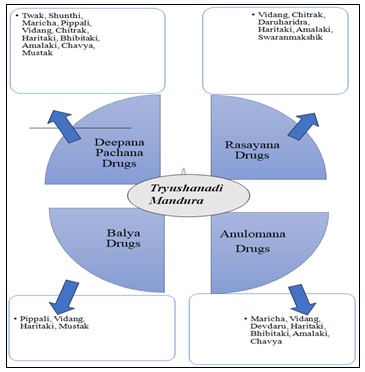
FIG. 1: FUNCTIONAL GROUPING OF THE INGREDIENTS OF TRYUSHANADI MANDURA ACCORDING TO THEIR PRINCIPAL AYURVEDIC ACTIONS
ACKNOWLEDGEMENT: Nil
CONFLICTS OF INTEREST: Nil
REFERENCES:
- WHO, UNICEF, UNU. Iron Deficiency Anaemia: Assessment, Prevention and Control: A Guide for Programme Managers. 2001 Geneva, Switzerland WHO, UNICEF, UNU
- Zimmermann MB and Hurrell RF: Nutritional iron deficiency. Lancet 2007; 370: 511–20.
- Baker RD and Greer FR: Committee on Nutrition American Academy of Pediatrics. Diagnosis and prevention of iron deficiency and iron-deficiency anemia in infants and young children (0-3 years of age) Pediatrics 2010; 126: 1040–50
- Gardner GW, Edgerton VR, Senewiratne B, Barnard RJ and Ohira Y: Physical work capacity and metabolic stress in subjects with iron deficiency anemia. Am J Clin Nutr 1977; 30: 910–7.
- Nadkarni KM: The Indian Materia Medica. Ed 23rd Bombay Popular Prakashan 1976; 54–67.
- Aacharya YT” Charaka Samhita of Agnivesha, Chikitsa sthana, Ch. 16, Ver. 7-9. Reprint edition. 5 Varanasi ChaukhambhaSurbharati Prakashana 2005; 527.
- Pandey R: Clinical efficacy of Punarnava Mandura in anemia: A randomized trial. AYU 2014; 35(1): 50–6.
- Centers for Disease Control and Prevention (CDC). . Iron deficiency-United States, 1999-2000 MMWR Morb Mortal Wkly Rep 2002; 51(40): 897–9.
- Peyrin-Biroulet L, Williet N and Cacoub P: Guidelines on the diagnosis and treatment of iron deficiency across indications: a systematic review Am J Clin Nutr 2015; 102(6): 1585–94
- Peyrin-Biroulet L, Williet N and Cacoub P: Guidelines on the diagnosis and treatment of iron deficiency across indications: a systematic review Am J Clin Nutr 2015; 102(6): 1585–94 doi: 10.3945/ajcn. 114.103366
- Anonymous, The Ayurvedic Pharmacopeia of India, Government of India, Ministry of Health and Family Welfare, Dept of ISM & H New Delhi, The controller of publications Civil lines, 2001, Part I, Vol-1, P.-113
- Anonymous, The Ayurvedic Pharmacopeia of India, Government of India, Ministry of Health and Family Welfare, Dept of ISM & H New Delhi, The controller of publications Civil lines, 2001, Part I, Vol-1, P.-103
- Anonymous, The Ayurvedic Pharmacopeia of India, Government of India, Ministry of Health and Family Welfare, Dept of ISM & H New Delhi, The controller of publications Civil lines, 2001, Part I, Vol-3, P.-115
- Anonymous, The Ayurvedic Pharmacopeia of India, Government of India, Ministry of Health and Family Welfare, Dept of ISM & H New Delhi, The controller of publications Civil lines, 2001, Part I, Vol-4, P.-91
- Anonymous, The Ayurvedic Pharmacopeia of India, Government of India, Ministry of Health and Family Welfare, Dept of ISM & H New Delhi, The controller of publications Civil lines, 2001, Part I, Vol-2, P.-133
- Anonymous, The Ayurvedic Pharmacopeia of India, Government of India, Ministry of Health and Family Welfare, Dept of ISM & H New Delhi, The controller of publications Civil lines, 2001, Part I, Vol-1, P.-123
- Anonymous, The Ayurvedic Pharmacopeia of India, Government of India, Ministry of Health and Family Welfare, Dept of ISM & H New Delhi, The controller of publications Civil lines, 2001, Part I, Vol-4, P.-23
- Anonymous, The Ayurvedic Pharmacopeia of India, Government of India, Ministry of Health and Family Welfare, Dept of ISM & H New Delhi, The controller of publications Civil lines, 2001, Part I, Vol-1, P.-29
- Anonymous, The Ayurvedic Pharmacopeia of India, Government of India, Ministry of Health and Family Welfare, Dept of ISM & H New Delhi, The controller of publications Civil lines, 2001, Part I, Vol-2, P.-23
- Anonymous, The Ayurvedic Pharmacopeia of India, Government of India, Ministry of Health and Family Welfare, Dept of ISM & H New Delhi, The controller of publications Civil lines, 2001, Part I, Vol-1, P.-47
- Anonymous, The Ayurvedic Pharmacopeia of India, Government of India, Ministry of Health and Family Welfare, Dept of ISM & H New Delhi, The controller of publications Civil lines, 2001, Part I, Vol-1, P.-26
- Anonymous, The Ayurvedic Pharmacopeia of India, Government of India, Ministry of Health and Family Welfare, Dept of ISM & H New Delhi, The controller of publications Civil lines, 2001, Part I, Vol-1, P.-5
- Anonymous, The Ayurvedic Pharmacopeia of India, Government of India, Ministry of Health and Family Welfare, Dept of ISM & H New Delhi, The controller of publications Civil lines, 2001, Part I, Vol-2, P.-29
- Anonymous, The Ayurvedic Pharmacopeia of India, Government of India, Ministry of Health and Family Welfare, Dept of ISM & H New Delhi, The controller of publications Civil lines, 2001, Part I, Vol-3, P.-129
- Vagbhata; Rasa Ratna Samuchaya, Edited by Siddhi Nandan Misra: Chapter-2 verse: 79 Chaukamba Orientalia Publications. Varanasi 2011; 42.
- Anonymous, The Ayurvedic Pharmacopeia of India, Government of India, Ministry of Health and Family Welfare, Dept of ISM & H New Delhi, The controller of publications Civil lines 2001; 7: 26.
- Valiathan MS: Hyderabad, India, Orient Longman Private Ltd, the Legacy of Susruta 2007; 158.
- Sharma PV and Dravyaguna Vigyan: Varanasi: Chaukhamba Bharati Academy 2013; 251.
- Gruenwald J, Freder J and Armbruester N: Cinnamon and health. Critical Reviews in Food Science and Nutrition 2010; 50(9): 822-34.
- Sharma PV: Dravyaguna Vigyan. Varanasi: Chaukhamba Bharati Academy 2013; 2: 333.
- Haniadka R, Saldanha E, Sunita V, Palatty PL, Fayad R and Baliga MS: A review of the gastro protective effects of ginger (Zingiber officinale Roscoe). Food Funct 2013; 4: 845-55.
- Sharma PV: Dravyaguna Vigyan. Varanasi: Chaukhamba Bharati Academy 2013; 2: 364.
- Reddy SV, Srinivas PV, Praveen B, Kishore KH, Raju BC and Murthy US: Antibacterial constituents from the berries of Piper nigrum. Phytomedicine 2004; 11: 697-700.
- Sharma PV and Dravyaguna Vigyan: Varanasi: Chaukhamba Bharati Academy 2013; 2: 277.
- Baghel MS, Prajapati PK, Ravishankar B, Patgiri BJ and Shukla VJ: Galib, Monograph on Punarnava Mandura (SMP and Safety Profile). Jamnagar, India: Institute for Post Graduate Teaching and Research in Ayurveda, Gujarat Ayurved University 2009; 7.
- Khajuria A, Zutshi U and Bedi KL: Permeability characteristics of piperine on oral absorption-An active alkaloid from peppers and a bioavailability enhancer. Indian J Exp Biol 1998; 36: 46-50.
- Kesarwani K, Gupta R and Mukerjee A: Bioavailability enhancers of herbal origin: An overview. Asian Pac J Trop Biomed 2013; 3: 253-66.
- Sharma PV and Dravyaguna Vigyan: Varanasi: Chaukhamba Bharati Academy 2013; 2: 278.
- Sharma PC, Yelne MB and Dennis TJ: Database on Medicinal Plants Used in Ayurveda. New Delhi: Central Council for Res in Ayurveda and Siddha 2001; 3: 473.
- Sharma PV and Dravyaguna Vigyan: Varanasi: Chaukhamba Bharati Academy 2013; 2: 505.
- Venkatasubramanian P, Godbole A, Vidyashankar R and Kuruvilla GR: Evaluation of traditional anthelmintic herbs as substitutes for the endangered embeliaribes, using caenorhabditis elegans model. Curr Sci 2013; 105: 1593-8.
- Sharma PV and Dravyaguna Vigyan: Varanasi: Chaukhamba Bharati Academy 2013; 2: 77.
- Kumar A, Singh V and Chaudhary AK: Gastric antisecretory and antiulcer activities of Cedrus deodara (Roxb.) Loud. in Wistar rats. J Ethnopharmacol 2011; 134: 294-7.
- Sharma PV and Dravyaguna Vigyan: Varanasi: Chaukhamba Bharati Academy 2013; 2: 360.
- Akhilraj AR, Bhat S, Priyalatha B and Vimala KS: Comparative hepatoprotective activity of detoxified roots of Plumbago zeylanica L. and Plumbago rosea L. in Wistar rats. J AyurvedaIntegr Med 2021; 12: 452-7.
- Sharma PV and Dravyaguna Vigyan: Varanasi: Chaukhamba Bharati Academy 2013; 2: 538.
- Sharma PC, Yelne MB and Dennis TJ: Database on Medicinal Plants Used in Ayurveda. Vol. 1. New Delhi: Central Council for Research in Ayurveda and Siddha 2000; 120-3.
- Sharma PV and Dravyaguna Vigyan: Varanasi: Chaukhamba Bharati Academy 2013; 2: 754.
- Saha S and Verma RJ: Antioxidant activity of polyphenolic extract of Terminalia chebula Retzius fruits. J Taibah Univ Sci 2016; 10: 805-12.
- Sharma PV and Dravyaguna Vigyan: Varanasi: Chaukhamba Bharati Academy; 2013; 2: 237.
- Gupta A and Pandey AK: Aceclofenac-induced hepatotoxicity: Anameliorative effect of Terminalia bellirica fruit and ellagic acid. World J Hepatol 2020; 12: 949-64.
- Sharma PV and Dravyaguna Vigyan: Varanasi: Chaukhamba Bharati Academy; 2013; 2: 759.
- Sharma PV Dravyagunavijnana, (Chaukhamba Sansthan, Varanasi) 1867, varanasi, reprint edition 2008, Aushadhivarga pg-46.
- Ali, Salima Barkat, Naima Aslam Khan and Amena Zehra: "Effect of Volunteerism on Mental Health and Happiness." International Journal of Humanities and Social Sciences IJHSS 2016; 5(2): 123-130.
- Sharma PV and Dravyaguna Vigyan: Varanasi: Chaukhamba Bharati Academy 2013; 2: 336.
- More SD and Dwivedi RR: A clinical study of panchakola siddha yavagu in the management of agnimandya. Ayu 2011; 32: 70-5.
- Sharma PV and Dravyaguna Vigyan: Varanasi: Chaukhamba Bharati Academy 2013; 2: 371.
- Thomas D, Govindhan S, Baiju EC, Padmavathi G, Kunnumakkara AB and Padikkala J: Cyperus rotundus L. Prevents non-steroidal anti-inflammatory drug-induced gastric mucosal damage by inhibiting oxidative stress. J Basic Clin PhysiolPharmacol 2015; 26: 485-90.
- Vagbhata and Rasa Ratna Samuchaya: Edited by Siddhi Nandan Misra. Chapter-2 verse: 80 Chaukamba Orientalia Publications. Varanasi 2011; 42
- Li Z, Li B, Song X and Zhang D: Dietary zinc andiron intake and risk of depression: A meta analysis. Psychiatry Res 2017 [cited 2017May] 251:41-47. Available from: https://www.ncbi.nlm.nih.gov/pubmed/28189077
- Anonymous, The Ayurvedic Pharmacopeia of India, Government of India, Ministry of Health and Family Welfare, Dept of ISM & H New Delhi, The controller of publications Civil lines, 2001, Part I, Vol-7, P.-27
- Sarkar PK, Prajapati PK, Choudhary AK, Shukla VJ and Ravishankar B: Haematinic evaluation of Lauha-bhasma and Mandur-bhasma on HgCl₂-induced anaemia in rats. Indian J Pharm Sci 2007; 69(6): 791-5.
- Valiathan MS: Hyderabad, India, Orient Longman Private Ltd, The Legacy of Susruta 2007; 159.
- Abbaspour N, Hurrell R and Kelishadi R: Review on iron and its importance for human health. J Res Med Sci 2014; 19: 164-74.
- Anonymous, The Ayurvedic Pharmacopeia of India, Government of India, Ministry of Health and Family Welfare, Dept of ISM & H New Delhi, The controller of publications Civil lines, 2001, Part I, Vol-1, P.-152
- Anonymous, The Ayurvedic Pharmacopeia of India, Government of India, Ministry of Health and Family Welfare, Dept of ISM & H New Delhi, The controller of publications Civil lines, 2001, Part I, Vol-1, P.-139
- Anonymous, The Ayurvedic Pharmacopeia of India, Government of India, Ministry of Health and Family Welfare, Dept of ISM & H New Delhi, The controller of publications Civil lines, 2001, Part I, Vol-3, P.-117
- Anonymous, The Ayurvedic Pharmacopeia of India, Government of India, Ministry of Health and Family Welfare, Dept of ISM & H New Delhi, The controller of publications Civil lines, 2001, Part I, Vol-4, P.-106
- Anonymous, The Ayurvedic Pharmacopeia of India, Government of India, Ministry of Health and Family Welfare, Dept of ISM & H New Delhi, The controller of publications Civil lines, 2001, Part I, Vol-2, P.-142
- Anonymous, The Ayurvedic Pharmacopeia of India, Government of India, Ministry of Health and Family Welfare, Dept of ISM & H New Delhi, The controller of publications Civil lines, 2001, Part I, Vol-1, P.-165
- Anonymous, The Ayurvedic Pharmacopeia of India, Government of India, Ministry of Health and Family Welfare, Dept of ISM & H New Delhi, The controller of publications Civil lines, 2001, Part I, Vol-4, P.-28
- Anonymous, The Ayurvedic Pharmacopeia of India, Government of India, Ministry of Health and Family Welfare, Dept of ISM & H New Delhi, The controller of publications Civil lines, 2001, Part I, Vol-1, P.-40
- Anonymous, The Ayurvedic Pharmacopeia of India, Government of India, Ministry of Health and Family Welfare, Dept of ISM & H New Delhi, The controller of publications Civil lines, 2001, Part I, Vol-2, P.-35
- Anonymous, The Ayurvedic Pharmacopeia of India, Government of India, Ministry of Health and Family Welfare, Dept of ISM & H New Delhi, The controller of publications Civil lines, 2001, Part I, Vol-1, P.-63
- Anonymous, The Ayurvedic Pharmacopeia of India, Government of India, Ministry of Health and Family Welfare, Dept of ISM & H New Delhi, The controller of publications Civil lines, 2001, Part I, Vol-1, P.-34
- Anonymous, The Ayurvedic Pharmacopeia of India, Government of India, Ministry of Health and Family Welfare, Dept of ISM & H New Delhi, The controller of publications Civil lines, 2001, Part I, Vol-1, P.-8
- Anonymous, The Ayurvedic Pharmacopeia of India, Government of India, Ministry of Health and Family Welfare, Dept of ISM & H New Delhi, The controller of publications Civil lines, 2001, Part I, Vol-2, P.-31.
- Anonymous, The Ayurvedic Pharmacopeia of India, Government of India, Ministry of Health and Family Welfare, Dept of ISM & H New Delhi, The controller of publications Civil lines, 2001, Part I, Vol-3, P.-131.
- Sushrutha A: Nibandha Sangraha commentary of Dalhanaachrya. In: Acharya VJ, editor. Sushrutha Samhita. 1st ed. Varanasi: Chaukambha Surabharti Prakashana 2002; 252-824.
- Madhikarmi NL and Murthy KR: Antioxidant enzymes and oxidative stress in the erythrocytes of iron deficiency anaemic patients supplemented with vitamins. Iran Biomed J 2014; 18: 82-7.
- Sarkar PK, Prajapati PK, Choudhary AK, Shukla VJ and Ravishankar B: Haematinic evaluation of Lauha-bhasma and Mandur-bhasma on HgCl2-induced anaemia in rats Indian J Pharm Sci 2007; 69: 791–5.
- Annibale B, Capurso G, Martino G, Grossi C and Fave GD: Iron deficiency anaemia and Helicobacter pylori infection. Int J Antimicrob Agents 2000; 16: 515-9.
- Karnath BM: Anaemia in the adult patient. Hosp Physician 2004; 32-6. Available from: www.semanticscholar.org [Last accessed on 2022 Dec 10].
- Harshitha GS, Joshi S, Sulochana A, Bali MR, Nagari ND and Rajput M: A clinical study of draksha gritha in the management of anaemia in pregnancy (Garbhini Pandu). Ayush 2020; 7: 2591-8.
- Kumari M, Ashok BK, Ravishankar B, Pandya TN and Acharya R: Antiinflammatory activity of two varieties of Pippali (Piper longum Linn.) Ayu 2012; 33: 307-10.
- Hurrell RF: Bioavailability of iron. Eur J Clin Nutr 1997; 51(1): 4-8.
- Centers for Disease Control and Prevention. Breastfeeding Report Card, United states: Outcome Indicators. Publication, from Centres for Disease Control and Prevention, National Immunization Survey. United States: Centers for Disease Control and Prevention 2010.
- Agnivesha A: Charaka and dridhabala with Ayurveda Deepika commentary of chakrapanidatta. In: Acharya VY, editor. Charaka Samhita. 1st ed. Varanasi: Chaukanbha Surabharati Prakashan 2016; 143(4): 738.
How to cite this article:
Sharma A, Sharma BD and Ojha NK: Therapeutic potential of Tryushnadi Mandura in iron-deficiency Anemia: a review. Int J Pharm Sci & Res 2026; 17(9): 2622-29. doi: 10.13040/IJPSR.0975-8232.17(9).2622-29.
All © 2026 are reserved by International Journal of Pharmaceutical Sciences and Research. This Journal licensed under a Creative Commons Attribution-NonCommercial-ShareAlike 3.0 Unported License.
Article Information
6
2622-2629
661 KB
4
English
IJPSR
Apoorva Sharma *, Brahm Dutt Sharma and Nisha K. Ojha
Department of Kaumarbhritya, National Institute of Ayurveda (Deemed to be University), Jaipur, Rajasthan, India.
apoorva.sharma2206@gmail.com
03 April 2026
23 August 2026
26 August 2026
10.13040/IJPSR.0975-8232.17(9).2622-29
01 September 2026
 Download